
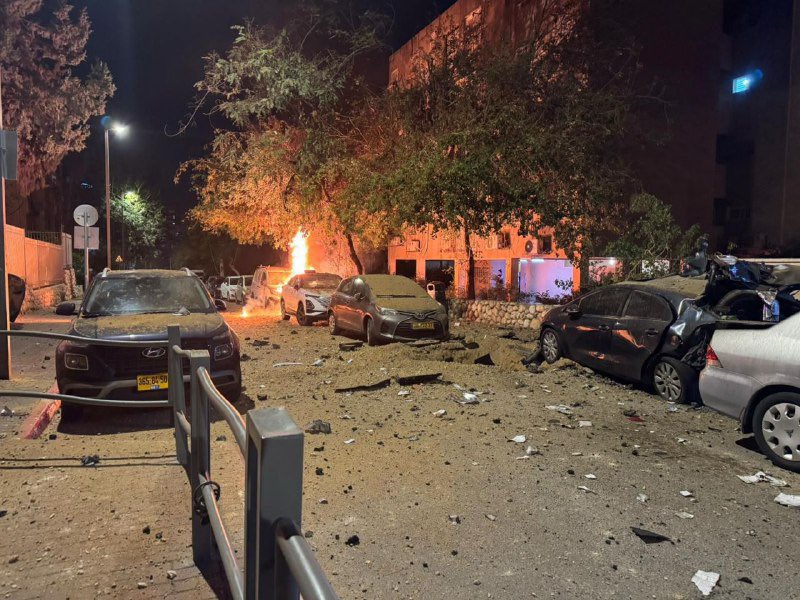
Image: from Shah Faisal AfRidi X @Sfaisalafridi
UN CONFIRMS USE OF FRAGMENTATION WEAPONRY IN CIVILIAN AREAS; HUMAN RIGHTS GROUPS CONDEMN “INDISCRIMINATE” RETALIATION
By OPEN CHRONICLE STAFF with Agencies
JERUSALEM — The escalating conflict between Iran and Israel has taken a grim humanitarian turn following reports that Tehran utilized cluster munitions during its massive overnight missile and drone barrage. UN observers and battlefield analysts in Israel confirmed Wednesday that remnants of fragmentation submunitions, widely banned under international law, were discovered in several impact zones, including residential areas in the Galilee and near the southern city of Arad.
The use of these weapons marks a significant escalation in the “Martyr Larijani” retaliatory operation, signaling Tehran’s willingness to employ indiscriminate force to overwhelm Israeli civil defense.
⚠️One of the cluster munitions from the ballistic missile that was fired by the Iranian regime terrorists shortly before, had impacted a train station in central #Israel.
A train carriage was damaged as well as the station.
No injuries.#Iran— paralel_universe (@ignis_fatum) March 17, 2026
The Mechanism of Terror
Cluster munitions are designed to open in mid-air, releasing dozens or even hundreds of smaller “bomblets” over an area the size of several football fields. Because many of these submunitions fail to explode on impact, they effectively turn the strike zone into a minefield, posing a lethal threat to civilians, especially children, long after the initial attack has ended.
“We have identified several M-26 style submunitions of Iranian manufacture,” said a ballistics expert with the IDF. “These were not aimed at hardened military bunkers; they were designed to saturate open areas and cause maximum personnel casualties. It is a weapon of terror, plain and simple.”
International Condemnation
The news has triggered a wave of condemnation from the international community. Human Rights Watch (HRW) issued an emergency bulletin calling on Iran to immediately cease the use of the weaponry. “The deployment of cluster munitions in populated areas is a clear violation of the laws of war,” the statement read. “Iran is not only targeting its enemy; it is leaving a deadly legacy for innocent civilians that will last for years.”
While neither Iran nor Israel is a signatory to the 2008 Convention on Cluster Munitions, the UN’s High Commissioner for Human Rights stated that their use in urban environments likely constitutes a war crime due to the inability to distinguish between combatants and non-combatants.
Impact on Israel’s “Iron Dome”
Military analysts suggest that the use of cluster-capable missiles may be a tactical attempt to “bleed” Israel’s defensive arrays. Intercepting a single missile is a standard procedure for the Iron Dome, but if the missile releases its submunitions before interception, it creates a cloud of targets that can saturate the system’s tracking capabilities.
“It’s a saturation game,” noted Dr. Julianne West. “By using fragmentation warheads, Iran is forcing Israel to expend multiple interceptors on a single incoming threat or risk a ‘rain of fire’ on the ground.”
Tehran’s Defiance
In a statement released via the Fars News Agency, the IRGC defended its choice of weaponry, claiming that all targets were “legitimate military sites” and that Israel had forfeited its right to international protection when it assassinated Ali Larijani. “Those who sow the wind in Tehran will reap the whirlwind in their own cities,” the statement warned.
The Cleanup Challenge
As the sun rose on Wednesday, Israeli emergency services (Magen David Adom) cautioned residents not to approach any unexploded metallic objects found in streets or fields. “If you see a small, ribboned object or a metal canister, do not touch it,” a public service announcement urged. “The danger is not over when the sirens stop.”
Specialist sapper units have been deployed to the north of the country to begin the painstaking process of clearing duds, a task made increasingly difficult as the threat of a secondary Iranian wave remains high.