
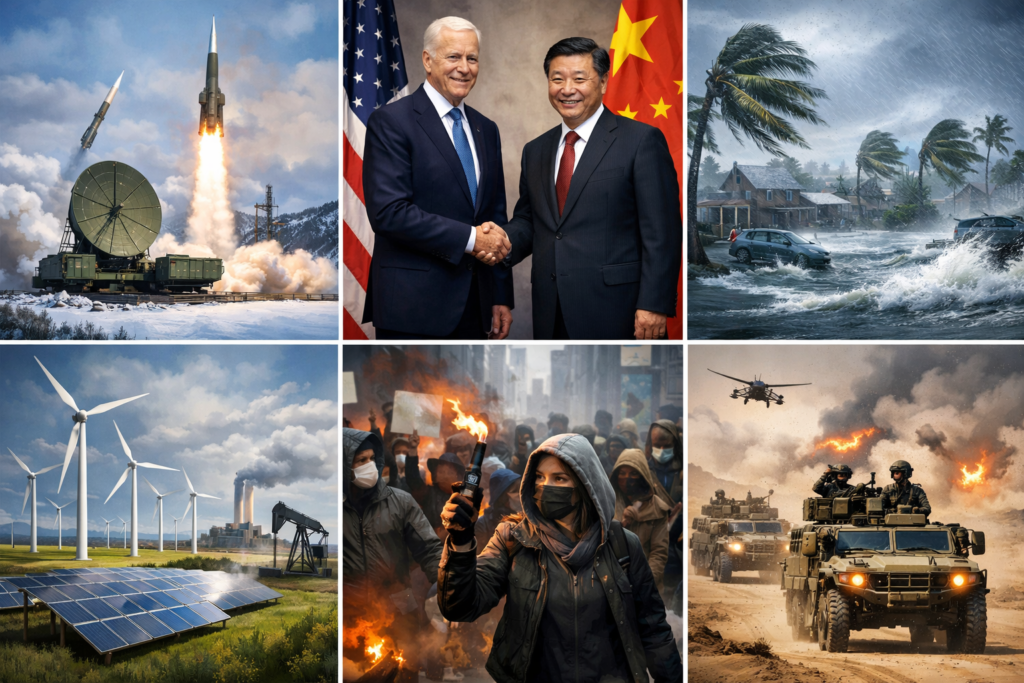
Image Credentials: Image Title: Global News Brief: Key Events and Developments for March 19, 2026 Source: (sora.openai) Date: March 2026. Attribution: This image was created using AI-generated imagery
By Open Chronicle with Agencies
The Middle East conflict continues to expand into critical energy infrastructure and diplomatic fault lines this Thursday, as strikes on gas facilities, retaliatory missile attacks, and coordinated regional pressure on Iran signal a dangerous new phase of escalation.
Top Stories
Israeli strike hits South Pars as Iran retaliates against Qatar
An Israeli airstrike targeted gas storage facilities at Iran’s South Pars field near Asaluyeh, one of the world’s largest natural gas complexes. The attack forced a halt in production at two major refineries, underscoring the vulnerability of global energy infrastructure amid the conflict.
In retaliation, Iran launched ballistic missile strikes on Ras Laffan Industrial City, Qatar’s primary liquefied natural gas hub. Qatari authorities confirmed that the હુમલો caused material damage, raising alarm over the security of one of the world’s most critical LNG export centers.
The exchange marks a significant escalation, bringing direct attacks to the heart of global energy supply chains.
Arab and Islamic ministers urge Iran to halt attacks
A coalition of Arab and Islamic nations has called on Iran to immediately cease its military actions following a high-level meeting in Riyadh.
The gathering, hosted by Saudi Arabia, included foreign ministers from across the region, who issued a joint statement condemning Iranian missile and drone strikes targeting civilian infrastructure. The statement highlighted attacks on oil facilities, airports, desalination plants, and diplomatic sites.
Among the key voices, Faisal bin Farhan warned that Tehran risks miscalculating the resolve of Gulf states, signaling a growing willingness among regional actors to respond collectively.
Qatar expels Iranian military attaches
Qatar has declared Iranian military and security attaches stationed at its embassy in Doha “persona non grata,” ordering them to leave within 24 hours.
The decision, announced by Qatar’s Foreign Ministry, comes in response to repeated Iranian strikes on its territory. Officials described the attacks as violations of sovereignty and warned of further measures if Tehran continues its current course.
This diplomatic rupture reflects the rapid deterioration of relations between Iran and Gulf states as the conflict widens.
News in Brief
Donald Trump stated that Israel would refrain from further strikes on Iran’s South Pars field unless Tehran launches additional attacks, while warning that any targeting of Qatar’s LNG infrastructure could trigger a decisive US response.
NATO confirmed the deployment of an additional Patriot missile defense system to southern Türkiye, reinforcing regional defenses amid rising tensions.
Russia’s Kremlin condemned what it described as the “liquidation” of Iranian leadership figures, while China agreed to postpone a planned meeting between Donald Trump and Xi Jinping.
In Europe, Pedro Sanchez pledged €1 billion in military aid to Ukraine following talks with Volodymyr Zelenskyy in Madrid.
Elsewhere, Iran experienced a brief restoration of internet connectivity after a prolonged blackout exceeding 400 hours, before access was again disrupted, according to monitoring groups.
Business & Economy
Federal Reserve holds rates steady
The Federal Reserve kept its benchmark interest rate unchanged in the 3.5% to 3.75% range, aligning with market expectations.
Officials emphasized that uncertainty remains elevated, as geopolitical instability and inflation risks continue to shape the economic outlook.
Iraq resumes oil exports via Türkiye
Iraq has restarted oil exports through Türkiye’s Ceyhan port, resuming shipments from the Kirkuk fields after a nearly three-year توقف.
Initial export capacity is set at 250,000 barrels per day, offering a modest boost to global supply at a time of heightened market volatility.
As attacks increasingly target energy infrastructure and diplomatic relations fracture across the region, the conflict is no longer confined to military خطوط. Instead, it is reshaping global energy flows, alliances, and economic stability, with consequences likely to extend far beyond the Middle East.