
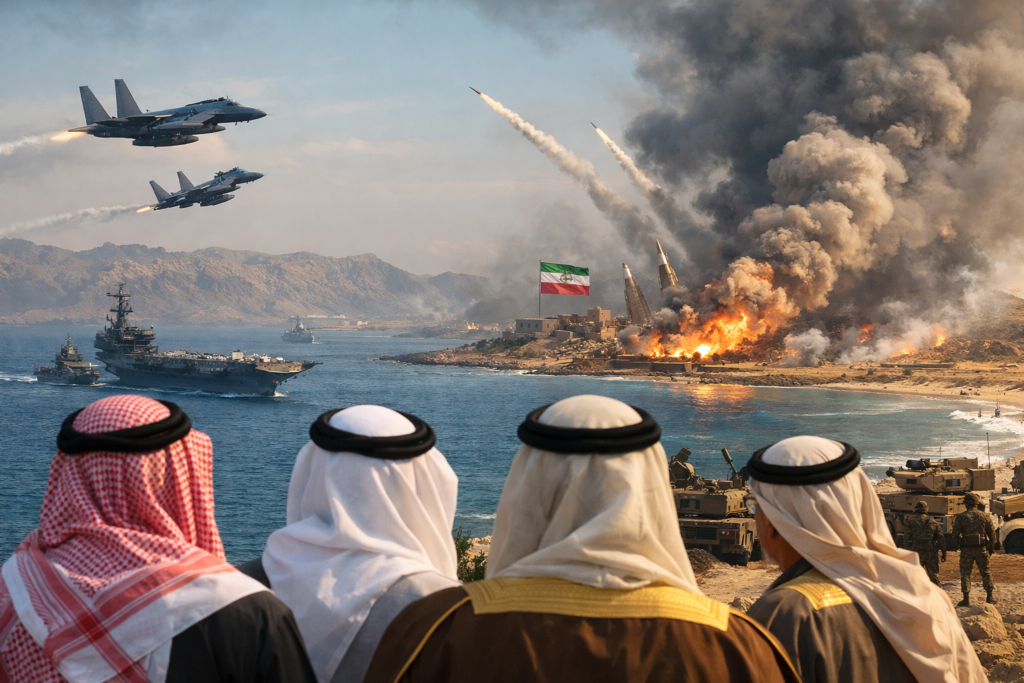
Image Credentials: Image Title: Gulf States Urge Washington to ‘Finish the Job’ as Conflict with Iran Escalates Source: (sora.openai) Date: March 2026. Attribution: This image was created using AI-generated imagery
By The Open Chronicle Editorial Staff with Agencies
DUBAI / WASHINGTON — In a dramatic shift in regional policy, Gulf Arab states are reportedly pressing the United States to decisively neutralize Iran’s military capabilities, moving beyond mere containment as the Islamic Republic continues to strike critical energy infrastructure and maritime corridors.
According to high-level diplomatic and regional sources, the prevailing mood among the six Gulf Cooperation Council (GCC) nations has hardened. While these states are not explicitly calling for a ground war, they are urging President Donald Trump not to halt the current military campaign until Iran is stripped of its ability to threaten the “oil lifeline” that underpins the global economy.
A Shift from Defense to Deterrence
“There is a wide feeling across the Gulf that Iran has crossed every red line,” said Abdulaziz Sager, chairman of the Gulf Research Center. Sager noted that while regional powers previously opposed escalation, recent direct strikes on airports, ports, and oil facilities have reclassified Tehran as an active enemy.
The strategic dilemma for the Gulf is stark:
-
The Energy Threat: Iran has demonstrated its ability to disrupt the Strait of Hormuz, the transit point for one-fifth of the world’s oil.
-
Economic Stability: Beyond physical damage, the strikes threaten the hard-won reputation of the Gulf as a stable hub for tourism and trade.
-
The Power Vacuum: Leaders fear that if the U.S. “pulls out before the task is complete,” they will be left vulnerable to a wounded but still capable Iranian regime.
Washington Seeks a United Front
While the Gulf states want Iran’s wings clipped, President Trump is reportedly applying counter-pressure, urging these nations to formally join the U.S.-Israeli military coalition. Sources indicate that the White House believes regional participation is essential to bolster the international and domestic legitimacy of the campaign.
U.S. Secretary of Defense Pete Hegseth recently suggested that Gulf partners are “stepping up,” hinting at a transition toward offensive operations and integrated air defenses. However, public commitment remains cautious. The United Arab Emirates (UAE) has affirmed its right to safeguard its sovereignty while maintaining that it does not seek to be “drawn into conflicts.”
The Shadow of Escalation
The risk of a “total war” remains the primary deterrent to a unified Arab military response. Regional leaders are wary of unilateral action, preferring a collective intervention to avoid being singled out for Iranian retaliation.
“If the Americans pull out before the task is complete, we’ll be left to confront Iran on our own,” Sager warned, reflecting a growing consensus that “inaction is now the greater risk.”
As U.S. and Israeli airstrikes intensify into their third week, the world’s eyes are on the Strait of Hormuz. With President Trump calling for a global coalition to reopen the waterway, the pressure is mounting not just on the West, but on Asian economies like China and Japan, which rely most heavily on the region’s embattled oil exports.