
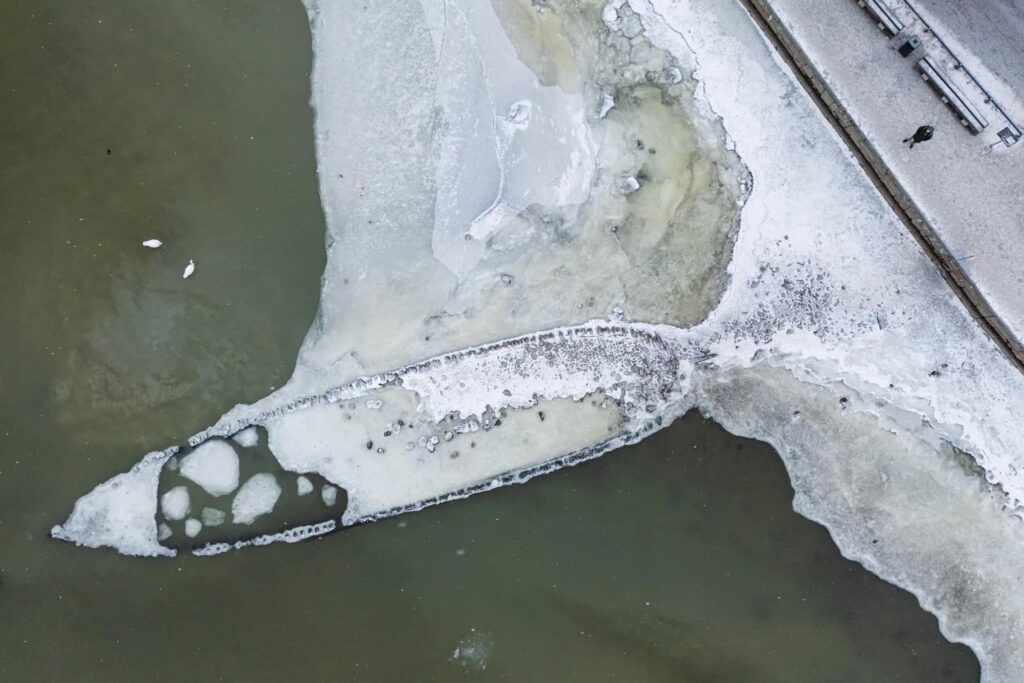
Image: from Breaking911 X @Breaking911
By Open Chronicle History Desk | March 24, 2026
STOCKHOLM — For nearly four centuries, the dark, brackish waters of the Baltic Sea held a secret just meters from the bustling center of Sweden’s capital. In February 2026, a rare meteorological event, a prolonged high-pressure system that pushed Baltic waters out toward the Atlantic, resulted in the lowest sea levels recorded in a century. As the waterline receded, the skeletal remains of a 17th-century naval warship began to break the surface off the island of Kastellholmen, offering a haunting and tangible link to Sweden’s “Age of Greatness.”
The Scuttled Foundation
Unlike the ill-fated Vasa, which famously capsized on its maiden voyage in 1628 due to structural instability, this newly visible wreck did not meet a tragic end in battle or storm. According to Jim Hansson, a marine archaeologist at Stockholm’s Vrak – Museum of Wrecks, the ship was “sunk on purpose.”
Around 1640, the Swedish Navy reached a pragmatic conclusion for its aging fleet. Rather than letting decommissioned hulls rot at the docks, engineers utilized the sturdy oak skeletons as the literal foundation for a new bridge to Kastellholmen. This particular vessel is one of five similar ships believed to be lined up in the area, acting as underwater caissons to support the infrastructure of a growing naval empire.
A Preservation Miracle
The Baltic Sea is a unique sanctuary for maritime history. Unlike the saltier oceans of the world, the Baltic lacks Teredo navalis, the notorious shipworm that consumes wooden hulls. “We don’t have shipworm here… so it lasts for 400 years,” Hansson noted, standing beside the exposed oak planks that remain remarkably intact despite four centuries of submersion.
While the exact identity of this specific hull remains under investigation by the “Lost Navy” research program, its construction mirrors the transition in Swedish naval architecture following the Vasa disaster. Archaeologists are using dendrochronology (tree-ring dating) to determine the exact year the timber was felled, hoping to match the wreck to archival records of the mid-17th century.
Context in the “Lost Navy”
This discovery is the latest in a series of breakthroughs for Swedish marine archaeology. In recent years, researchers have identified several high-profile wrecks in the Stockholm archipelago:
-
The Äpplet (The Apple): Found in 2021 near Vaxholm, the Äpplet was the Vasa’s sister ship. Built slightly wider to correct the Vasa’s instability, it served for 30 years before being scuttled as an underwater “spike strip” to block enemy fleets.
-
The Apollo and Maria: Medium-sized warships from 1648, discovered during the search for the Äpplet.
-
The Hercules: Identified in 2025 near Karlskrona, it remains the oldest warship found in that region, dating back to 1651.
The Great Northern Legacy
The emergence of the Kastellholmen wreck serves as a reminder of the “fiscal-military state” Sweden became under King Gustav II Adolf and his successors. During the 1600s, Sweden transformed from a small northern kingdom into a dominant European power, a feat achieved through a massive investment in naval technology and a fleet that effectively turned the Baltic into a “Swedish Lake.”
As water levels eventually return to normal, the ghost of Kastellholmen will once again vanish beneath the waves. However, the data gathered during this brief window of visibility provides a vital “piece of the puzzle” in understanding how 17th-century shipbuilders moved past the failures of the Vasa to create the seaworthy behemoths that defined an era.
References
- Agence France-Presse. “17th-century wreck reappears in Stockholm after sea levels drop.” The Straits Times, February 17, 2026. https://www.straitstimes.com/world/europe/17th-century-wreck-reappears-from-stockholm-deep-after-drop-in-sea-levels.
- CBS News. “Naval shipwreck emerges in Sweden after being buried underwater for 400 years.” CBS News, February 18, 2026. https://www.cbsnews.com/news/navy-shipwreck-emerges-baltic-sea-sweden/.
- Hansson, Jim, and Patrik Höglund. “Vasa’s Sister Ship Äpplet Found – A Unique Historical Discovery.” Vrak – Museum of Wrecks. Accessed March 24, 2026. https://www.vrak.se/en/about-vrak/aktuellt/nyheter-2022/vasas-sister-ship-found.
- Hydro International. “17th-century Swedish warship found by marine archaeologists.” Hydro International, February 7, 2023. https://www.hydro-international.com/content/news/17th-century-swedish-warship-found-by-marine-archaeologists.
- Smithsonian Magazine. “Archaeologists Discover Lost 17th-Century Warship ‘Äpplet’ in Sweden.” Smithsonian Magazine, October 28, 2022. https://www.smithsonianmag.com/smart-news/archaeologists-discover-lost-17th-century-warship-applet-in-sweden-180981006/.