
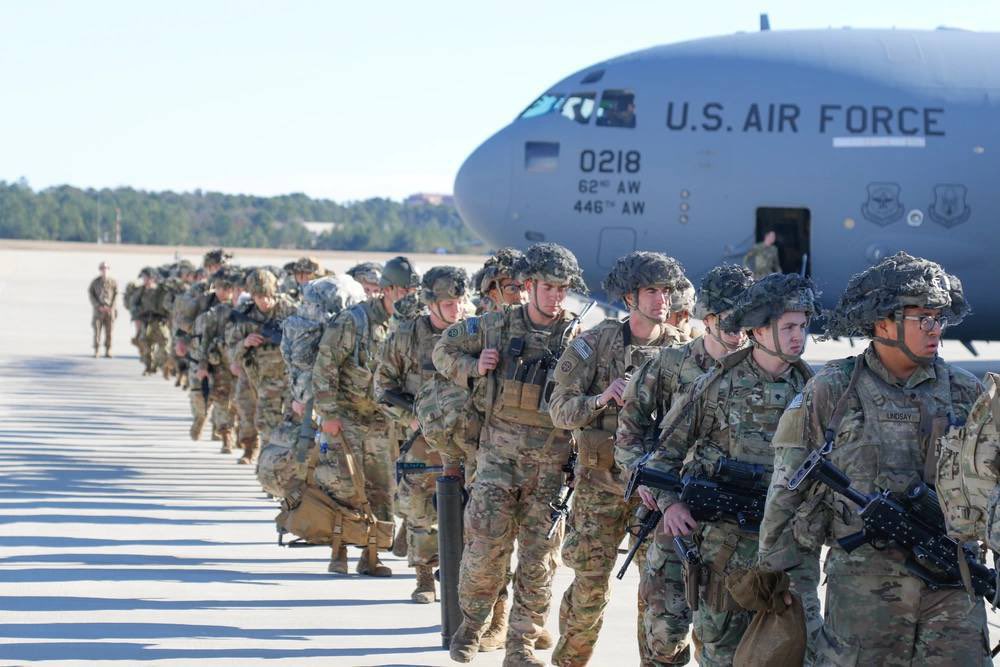
Image: from Prime X @nucleusprime
By Harrison Vane | Open Chronicle Defense & Security Correspondent
FORT LIBERTY, N.C. — The “Guardians of the Night” are heading back to the desert. The Pentagon confirmed Wednesday that approximately 1,000 paratroopers from the elite 82nd Airborne Division have been ordered to deploy to the Middle East in the coming days. The rapid-response movement follows a week of intensifying hostilities between the U.S.-led coalition and Iranian forces, marked by ballistic missile exchanges and strikes on regional transit hubs.
The deployment marks the division’s most significant mobilization since the opening phases of “Operation Epic Fury” in February, signaling that the White House is bracing for a protracted ground-tier confrontation despite ongoing diplomatic efforts in Pakistan.
JUST IN: 🇺🇸 The U.S. plans to deploy 1,000+ troops from the elite 82nd Airborne Division to the Middle East, trained for parachute insertions and securing hostile areas.pic.twitter.com/mWY99swzuG
— Donald J Trump Posts TruthSocial (@TruthTrumpPost) March 25, 2026
1. The “Immediate Response” Factor
The 1st Brigade Combat Team of the 82nd Airborne serves as the core of the nation’s Immediate Response Force (IRF), a unit kept on a permanent standby to deploy anywhere in the world within 18 hours. While the Pentagon has not specified exactly where the paratroopers will land, sources suggest they will be positioned at “enduring locations” in Kuwait and Jordan to serve as a security buffer for U.S. assets.
“This is about being ready for the ‘what if,'” a senior defense official told. “As the air campaign degrades the IRGC’s infrastructure, we must ensure our regional partners and our own logistical hubs are insulated from asymmetric retaliation.”
2. A Theater in Flux
The arrival of the 82nd coincides with a dangerous expansion of the conflict’s geography. Earlier this week, drone strikes targeted fuel infrastructure at Kuwait International Airport, an escalation that sent shockwaves through the global aviation industry. By placing “boots on the ground” in neighboring territories, the Trump administration is sending a clear signal of reassurance to Gulf allies who fear they are being drawn into the crossfire.
3. The Shadow of 2020
Military historians and veterans have noted the parallels to the January 2020 deployment, when the 82nd was rushed to the region following the strike on Qasem Soleimani. However, analysts point out that the 2026 landscape is vastly different. The U.S. is now utilizing “Physical AI” and long-range precision munitions like the PrSM to clear the path, meaning the role of the 82nd may focus less on traditional frontline combat and more on “site exploitation” and high-value asset protection.
4. Domestic Readiness
At Fort Liberty (formerly Fort Bragg), the atmosphere is one of practiced calm. Families of the deployed paratroopers are being supported by “Ready and Resilient” programs, though the sudden nature of the orders—arriving just as the White House signaled potential talks in Islamabad, has left many wondering if the diplomatic “off-ramp” is as viable as the administration claims.
As the C-17s begin their long trek across the Atlantic, the presence of the 82nd Airborne in the Middle East remains the ultimate “big stick” of American diplomacy. Their arrival ensures that, regardless of what happens at the negotiating table in Pakistan, the U.S. maintains the physical capacity to respond to any Iranian move in real-time.