
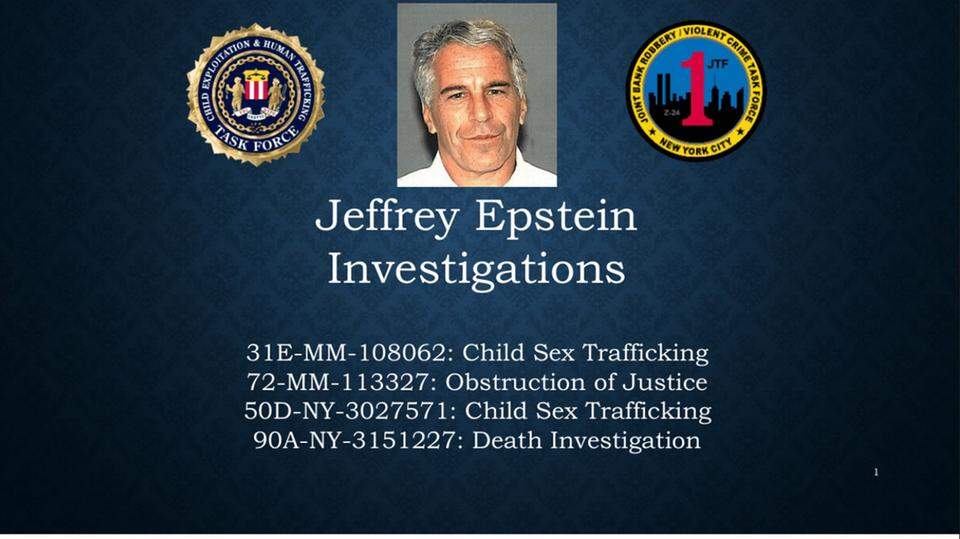
A PowerPoint was published among the Department of Justice files on Jeffrey Epstein. A Miami Herald analysis of thousands of pages in the Epstein files found there were bags of shredded documents at the Metropolitan Correctional Center in the days after Epstein’s death there. Department of Justice TNS
By Julian Thorne | Open Chronicle Investigative Correspondent
NEW YORK — More than six years after the death of disgraced financier Jeffrey Epstein, the official ruling of “suicide by hanging” is facing a renewed and rigorous challenge. A fresh analysis of forensic evidence, highlighted in recent investigative reports, suggests that the physical injuries sustained by Epstein in his Manhattan jail cell are more consistent with homicidal strangulation than self-inflicted death.
The resurgence of the case comes as legal teams and independent forensic experts point to specific “mechanical anomalies” in the autopsy report that were allegedly downplayed during the initial 2019 federal inquiry.
The FBI literally lost the murder weapon. The feds admit they could not even establish which noose killed Jeffrey Epstein because guards ripped it off and tainted the entire crime scene. Absolute intentional destruction of evidence. pic.twitter.com/Mmxh1oy99g
— Furkan Gözükara (@FurkanGozukara) March 21, 2026
The Hyoid Bone Fracture
At the center of the controversy is the fracture of Epstein’s hyoid bone, a small, U-shaped bone in the neck. While the official report cited this as a result of the hanging, many forensic pathologists, including the renowned Dr. Michael Baden, have noted that such fractures are significantly more common in victims of manual strangulation.
“In a typical suicidal hanging, the hyoid bone rarely breaks,” noted one forensic consultant. “When you see multiple fractures in the neck, including the thyroid cartilage and the hyoid, it raises a massive red flag for external pressure applied by another person.”
The “Blind Spot” in Security
The physical evidence is compounded by the systemic failures at the Metropolitan Correctional Center (MCC) on the night of August 10, 2019. It has been reconfirmed that:
-
Camera Malfunctions: Two cameras directly outside Epstein’s cell failed to record during the critical hours of his death.
-
Sleeping Guards: The two guards assigned to monitor Epstein, who was supposedly on “suicide watch” just days prior, admitted to falling asleep and browsing the internet instead of performing their required 30-minute checks.
-
The Cellmate Transfer: Epstein’s cellmate was transferred out of the unit just one day before his death, leaving him uncharacteristically alone.
The “Suicide Note” Discrepancy
New scrutiny has also been applied to the “suicide note” found in the cell. Analysts have pointed out that the note lacked the typical emotional markers associated with final messages, instead reading more like a list of grievances or legal complaints. Furthermore, the lack of DNA or fingerprint evidence on the “noose,” which was reportedly fashioned from a bedsheet, has led skeptics to question if the scene was staged post-mortem.
A Legacy of Silence
The persistence of the “murder” theory is fueled by the high-profile nature of Epstein’s “Little Black Book.” With ties to powerful figures in politics, royalty, and business, the motive for silencing Epstein before he could testify or provide discovery was immense.
While the Department of Justice officially closed its investigation into the guards’ negligence, the “suspicion of foul play” remains a fixture of public discourse. For many, the Epstein case isn’t just a criminal mystery; it is a symbol of perceived institutional protection for the global elite.
As long as the forensic contradictions remain unresolved, the cell at the MCC will continue to be viewed not as a site of a desperate end, but as the scene of one of the most successful “disappearances” of truth in modern history.