
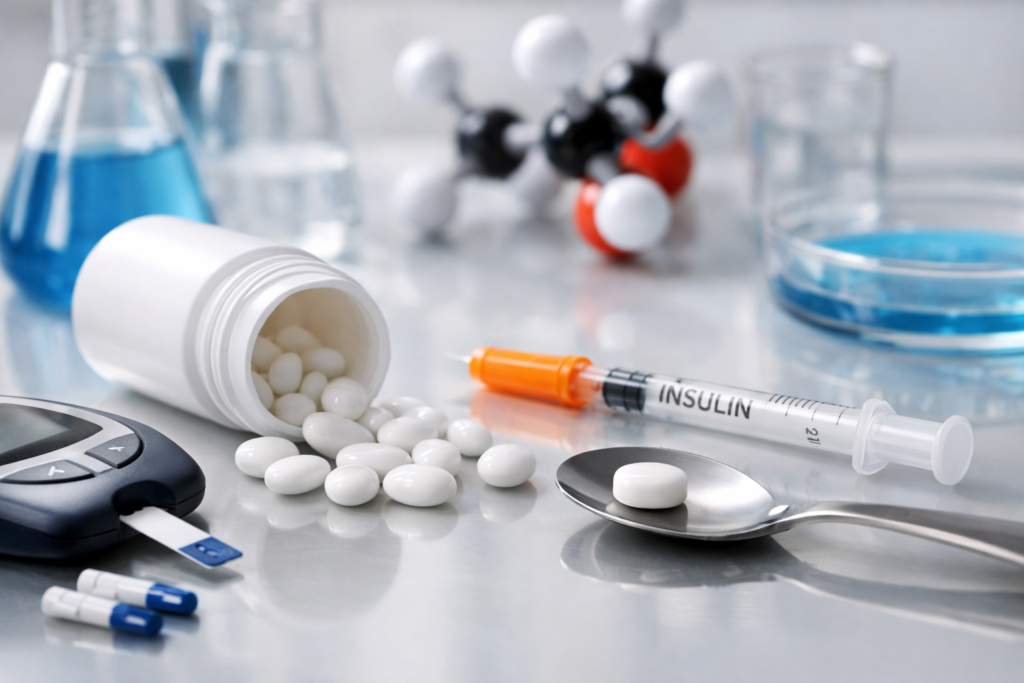
Image Credentials: Image Title: Scientists Advance Development of Insulin Pill to Replace Daily Injections Source: (sora.openai) Date: March 2026. Attribution: This image was created using AI-generated imagery (sora.openai) and does not depict a real-world scene.
By Open Chronicle Science
For over a century, the scientific community has pursued the “holy grail” of diabetes treatment: an effective insulin pill. Currently, millions of patients worldwide rely on daily subcutaneous injections to manage their blood sugar levels, a regimen that, while life-saving, remains a significant physical and psychological burden. Now, a breakthrough from Japan may finally bring the era of needle-free insulin therapy within reach.
Overcoming the Digestive Barrier
The primary obstacle to oral insulin has always been the human body’s own defenses. The digestive system is designed to break down proteins, meaning enzymes typically degrade insulin before it can ever reach the bloodstream. Furthermore, the intestinal wall lacks a natural mechanism to absorb large insulin molecules efficiently.
However, a research team at Kumamoto University, led by Associate Professor Shingo Ito, has developed a promising solution recently highlighted in Science Daily. Their innovation centers on a cyclic peptide known as the DNP peptide, which possesses the unique ability to traverse the small intestine.
Two Paths to Oral Delivery
Published in the journal Molecular Pharmaceutics, the study details two distinct methods developed by the team to transport insulin across the intestinal barrier:
-
The Interaction-Based Mixing Method: The researchers combined a modified “D-DNP-V peptide” with zinc-stabilized insulin hexamers. When administered orally to diabetic mice (including both chemically induced STZ models and genetically predisposed Kuma models), this mixture rapidly reduced blood sugar to normal levels. Remarkably, stable glucose control was maintained with a single daily dose over three consecutive days.
-
The Covalent Bonding Conjugation Method: In this approach, the DNP peptide was linked directly to the insulin molecule, creating a “DNP-insulin conjugate.” This version proved just as effective as the mixing method, confirming that the peptide actively facilitates the transport of insulin through the gut.
Unprecedented Efficiency
One of the greatest hurdles for previous oral insulin candidates has been the requirement for massive dosages, often ten times higher than an injection, to achieve the same effect. The Kumamoto University platform significantly narrows this gap.
The study reported a pharmacological availability of approximately 33-41% compared to subcutaneous injections. This high level of efficiency suggests that oral insulin is not just scientifically possible, but commercially and practically viable for real-world use.
The Future of Biologics
“Insulin injections remain a daily burden for many patients,” stated Associate Professor Shingo Ito. “Our peptide-based platform offers a new route for oral insulin delivery and could apply to long-acting insulin formulations and other injectable biologics.”
The implications of this research extend beyond diabetes. If this platform can successfully transport insulin, it may eventually be used to deliver other life-saving protein-based drugs that currently require injections. The team is now moving forward with further studies, including trials on larger animals and systems that replicate the human intestine, as they pave the way toward clinical applications.