
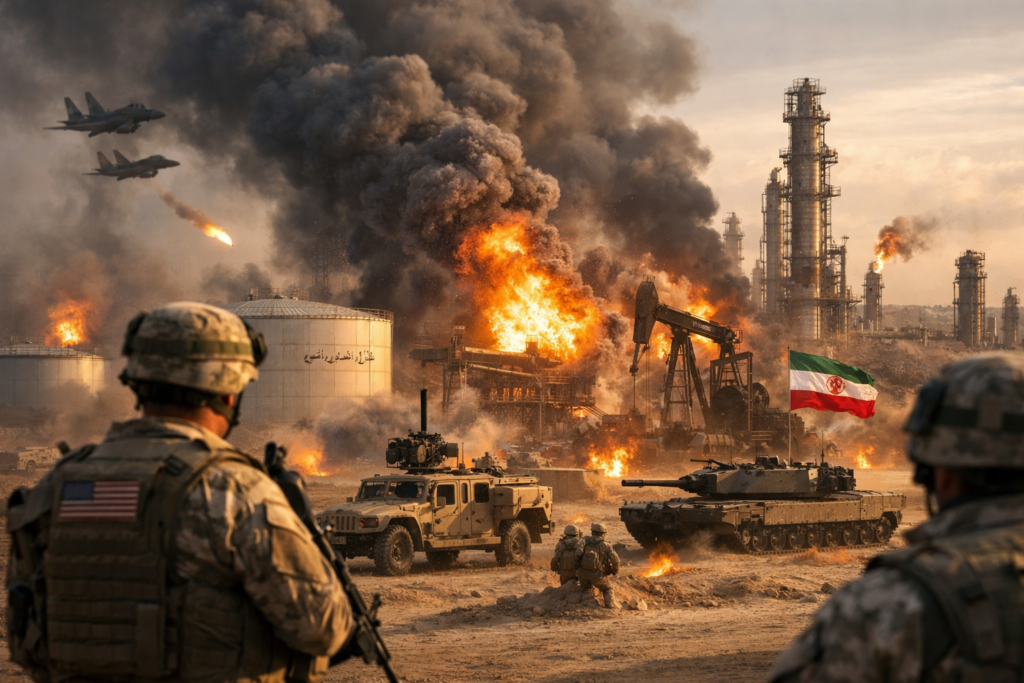
Image Credentials: Image Title: Taking Control of Iran’s Oil ‘An Option,’ Says Trump as Conflict Enters Fifth Week Source: (sora.openai) Date: March 2026. Attribution: This image was created using AI-generated imagery (sora.openai) and does not depict a real-world scene.
By Open Chronicle Staff with Agencies
WASHINGTON/ERBIL — President Donald Trump signaled a potential shift in U.S. strategy toward Tehran on Thursday, stating that taking control of Iran’s vast oil reserves is a “viable option” as the military campaign enters its second month.
Speaking to reporters at the White House, the President directly compared the situation to recent U.S. actions in South America. “It’s an option. I mean, I wouldn’t talk about it, but it’s an option,” Trump said. “Well, in Venezuela, we’ve done very well… we’ve taken in billions and billions of dollars.”
The remarks come as the U.S. and Israel continue a high-intensity air campaign against the Islamic Republic, a conflict that has already claimed the lives of Supreme Leader Ayatollah Ali Khamenei and security chief Ali Larijani.
Reporter: Would you take control of Iran’s oil?
Trump: It’s an option… We have done very well in Venezuela. pic.twitter.com/CiIgAsQ1Gc
— Clash Report (@clashreport) March 26, 2026
The “Eight Big Boats” of Oil
In a surprising revelation, President Trump claimed that Tehran had sent a “sign of goodwill” to initiate renewed negotiations. According to the President, Iran dispatched 10 tanker ships of oil to the United States.
“They said to show you the fact that we’re real and solid and we’re there. We’re gonna let you have eight boats of oil, eight big boats,” Trump told reporters. He added that two additional tankers were sent as an “apology” for unspecified remarks made by Iranian officials.
Despite these claims, the Iranian government has officially denied entering into direct talks. A source cited by semi-official Iranian media on Thursday maintained that while a response to a U.S. 15-point proposal was delivered, it was conditioned on heavy demands, including war reparations and a guarantee of Iranian sovereignty over the strategic Strait of Hormuz.
Diplomatic Fog
The identity of Washington’s negotiating partners remains a point of confusion. While the President alluded to being in contact with a “top Iranian leader,” he explicitly denied recognizing the authority of the newly appointed Supreme Leader, Mojtaba Khamenei.
Meanwhile, Pakistani Foreign Minister Ishaq Dar confirmed on Thursday that Islamabad is currently mediating indirect talks between the two warring nations, even as the “Department of War”, a term the Trump administration has increasingly adopted, continues daily strikes.
Global Energy Crisis
The conflict has pushed global oil prices to extreme volatility. Iran’s blockade of the Strait of Hormuz, which handles roughly 20 percent of the world’s oil supply, led to a massive spike in prices earlier this month. However, news of a potential five-day “suspension” of strikes on energy infrastructure, coupled with Trump’s talk of a deal, caused prices to plunge 14 percent to approximately $96 a barrel.
As the war enters its fifth week, the White House appears to be weighing the merits of a “take the oil” policy, similar to the administration’s handling of the Venezuelan crisis earlier this year, against the possibility of a total collapse of the Iranian state.