
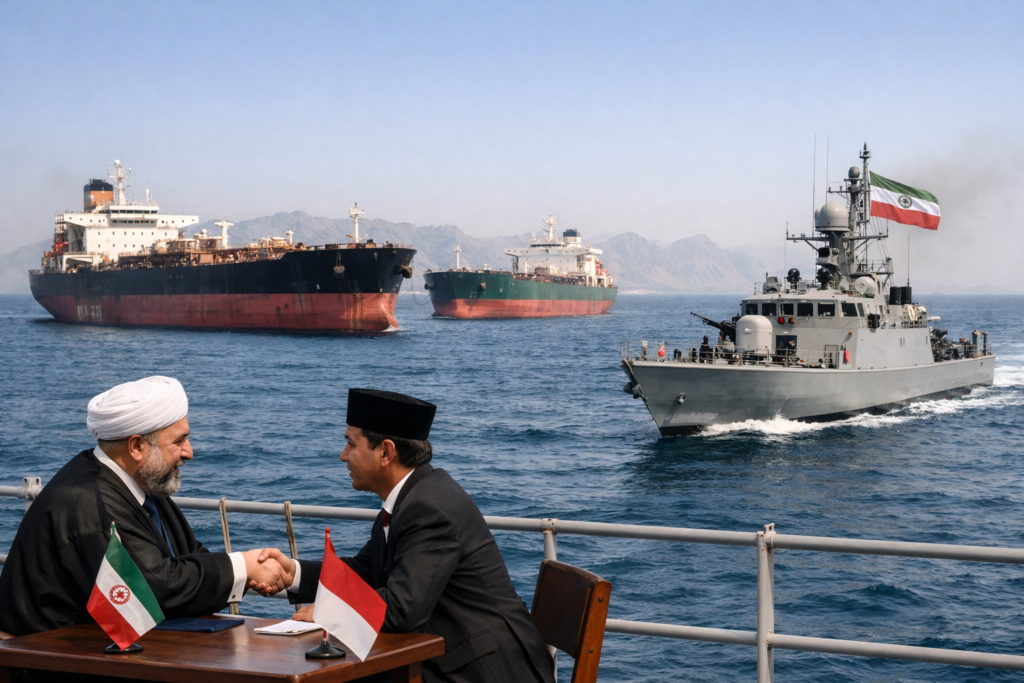
Image Credentials: Image Title: Iran Signals ‘Positive Response’ to Indonesia on Stranded Tankers in Strait of Hormuz Source: (sora.openai) Date: March 2026. Attribution: This image was created using AI-generated imagery (sora.openai) and does not depict a real-world scene.
By OPEN CHRONICLE STAFF with Agencies
JAKARTA — Indonesia’s weeks-long diplomatic stalemate with Tehran appears to be nearing a breakthrough. On Friday, the Indonesian Foreign Ministry announced it had received a “positive response” from Iranian authorities regarding the passage of two state-owned tankers currently trapped behind the blockade of the Strait of Hormuz.
The vessels, belonging to the state oil giant Pertamina, have been unable to exit the Persian Gulf for weeks due to severe traffic disruptions following the escalation of military hostilities between Israel and Iran. The Strait, a narrow chokepoint through which a quarter of the world’s seaborne oil flows, remains under a functional stranglehold by the Iranian Revolutionary Guard.
Foreign Ministry spokesman Vahd Nabyl A. Mulachela confirmed that “intense” high-level discussions with Tehran have finally borne fruit. “The development of the discussions has yielded a positive response from Iran,” Nabyl told the Jakarta Globe via text. “The relevant parties are currently following up on the technical and operational aspects.”
The two stranded vessels include the VLCC Pertamina Pride, which was tasked with transporting light crude oil to Indonesia, and the Gamsunoro, which was operating on a third-party cargo contract. Their inability to navigate the Strait had raised concerns regarding Indonesia’s energy security and the safety of its maritime assets.
Despite the tension, Energy Minister Bahlil Lahadalia sought to downplay fears of a domestic fuel crisis. While admitting that negotiating the tankers’ release was “not easy,” he emphasized that Indonesia has already moved to insulate its economy from Middle Eastern volatility.
“The Middle East only makes up 20% of our crude imports,” Bahlil said Friday. “We have found other crude sources outside the region. Please don’t ask where they come from. If God is willing, we have the supplies.”
Government officials have previously indicated that Jakarta is tapping U.S. crude to plug the supply gaps left by the Hormuz paralysis. This pivot comes as the current administration under President Prabowo Subianto seeks to balance traditional non-aligned diplomacy with the harsh realities of a disrupted global energy market.
Indonesia’s progress follows a similar breakthrough by neighboring Malaysia, which successfully clinched a passage agreement with Tehran earlier this month. The maritime crisis is expected to dominate the agenda when President Prabowo hosts Malaysian Prime Minister Anwar Ibrahim in Jakarta shortly.
Foreign Ministry spokeswoman Yvonne Mewengkang noted that the two leaders will discuss “ASEAN’s joint efforts to mitigate the economic impact of the conflict on the region’s stability and prosperity.”
The Strait of Hormuz remains the world’s most sensitive oil artery. Iran’s territorial waters extend into the strait, allowing it to disrupt traffic as a retaliatory measure against the U.S.-Israeli airstrikes launched in late February. While the “positive response” to Jakarta suggests a softening of Tehran’s stance toward neutral Islamic-majority nations, the broader maritime route remains fraught with risk for global shipping.
As technical teams work to coordinate the exit of the Pertamina Pride and the Gamsunoro, the maritime world is watching closely to see if this represents a localized diplomatic success or a broader de-escalation in the world’s most vital waterway.