
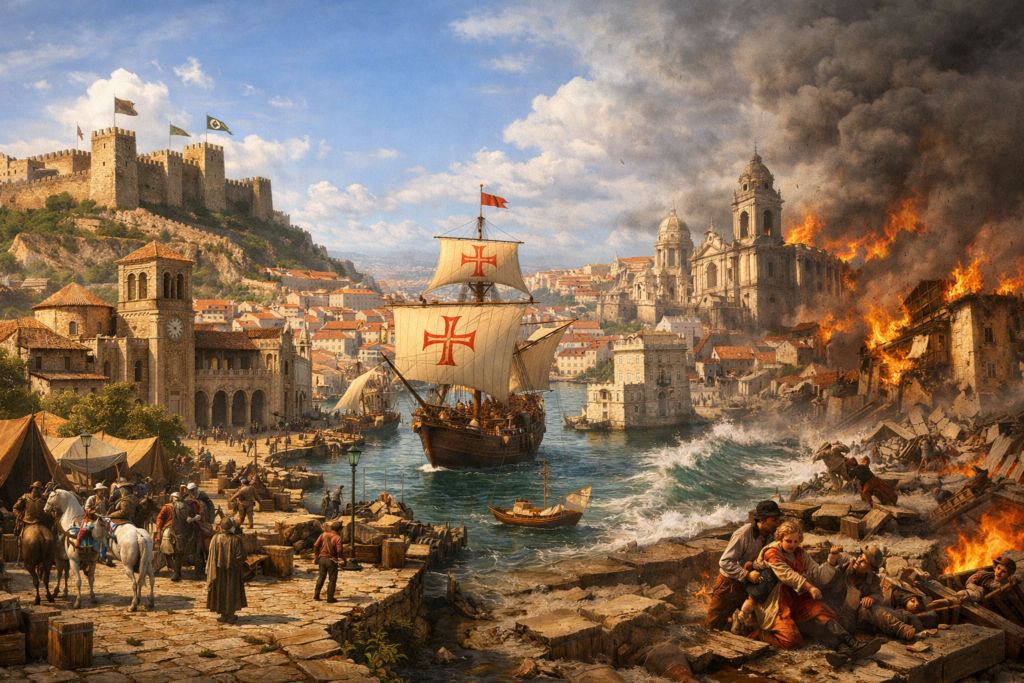
Image Credentials: Image Title: Lisbon 1147–1755 A Journey Through the Rise and Fall of a Global Capital Source: (sora.openai) Date: March 2025. Attribution: This image was created using AI-generated imagery (sora.openai) and does not depict a real-world scene.
By José Carlos Palma *
LISBON, Portugal — The history of Lisbon is a dramatic saga of conquest, immense wealth, and sudden catastrophe. In a detailed historical reconstruction, author Matt Reconstructs History traces the city’s evolution from a medieval stronghold to the epicenter of the Age of Discovery, culminating in the disaster that forced the world to rethink its understanding of nature.
The Crusader Conquest (1147)
The Christian era of Lisbon began not with a local uprising, but with a twist of fate involving the Second Crusade. A fleet of English, Flemish, and German crusaders, diverted by storms to the Portuguese coast, joined forces with King Afonso Henriques. Together, they laid siege to the Moorish city of Al-Ushbuna. After four months of brutal fighting, the city fell, was renamed Lisbon, and became the seat of the nascent Portuguese kingdom.
The Golden Age of the Spice Trade
By the 15th century, Lisbon had transformed into the “center of the world.” Under the House of Aviz, the city became the primary gateway for exotic goods from the East.
-
Vasco da Gama: In 1497, his successful voyage to India bypassed traditional Mediterranean routes, funneling unimaginable wealth directly into the Tagus River.
-
The Manueline Style: This era’s prosperity was etched into the city’s stone. Structures like the Jerónimos Monastery and the Belém Tower were built in the Manueline style, featuring intricate carvings of ropes, anchors, and sea creatures, an architectural “thank you” to the Atlantic Ocean.
-
The Ribeira Palace: Seeking to be closer to the source of his wealth, the King moved his residence from the hilltop São Jorge Castle down to the riverfront, where he could watch the spice-laden caravelas dock at the Casa da Índia.
The Disaster of 1755
The city’s opulence vanished in a single morning. On November 1, 1755, All Saints’ Day, a massive earthquake, estimated at magnitude 8.5 to 9.0, struck while the populace was gathered in churches.
-
The Quake: Thick stone walls collapsed on thousands of worshippers.
-
The Tsunami: Forty minutes later, a massive wave surged up the Tagus, drowning survivors who had fled to the docks for safety.
-
The Fire: Candles lit for the holiday ignited a firestorm that raged for five days, destroying 85% of the city’s infrastructure.
Legacy of the “Pombaline” Rebirth
The reconstruction, led by the Marquis of Pombal, introduced the world’s first earthquake-resistant urban planning. The new “Baixa” (downtown) was built on a modern grid system. Engineers implemented the “Pombaline Cage,” a flexible wooden internal structure designed to sway rather than break during future tremors.
While the disaster leveled much of the medieval city, iconic landmarks like the Lisbon Cathedral (Sé) and the São Jorge Castle survived as symbols of a capital that refused to be erased from the map.