
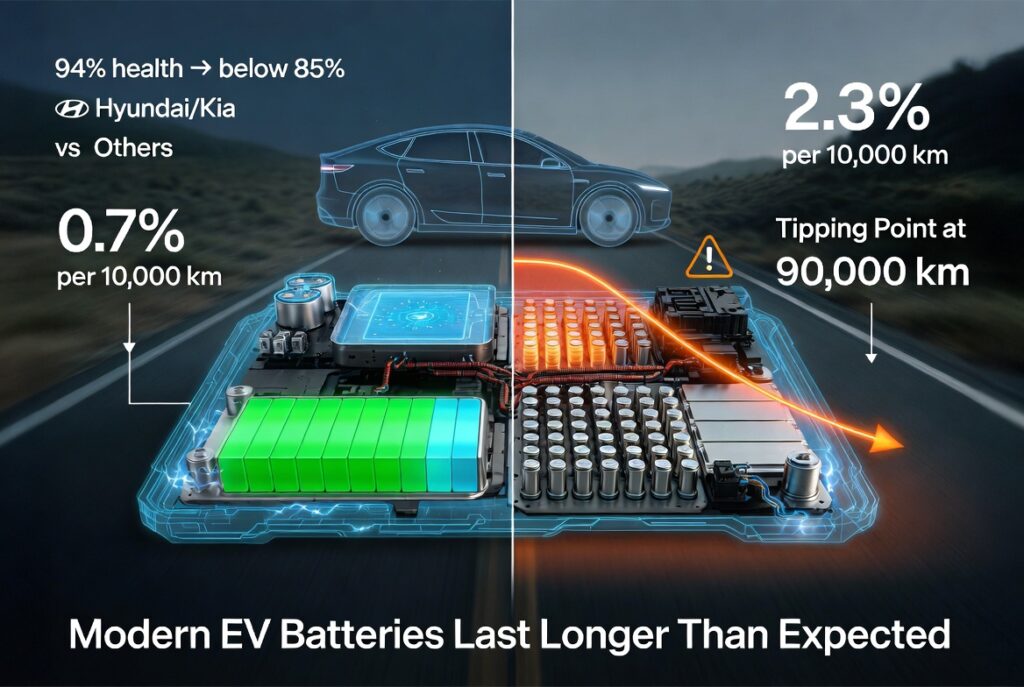
Image Credentials: Image Title: EV Battery Study Reveals “Tipping Point” for Degradation at 90,000 Kilometers: (Grok) Date: March 2025. Attribution: This image was created using AI-generated imagery (Grok) and does not depict a real-world scene.
By Open Chronicle Staff with Agencies
BERLIN — A large-scale independent study has provided a definitive answer to the most pressing question for used electric vehicle (EV) buyers: when exactly do batteries start to lose their punch? While modern EV batteries are proving more resilient than previously feared, researchers have identified a clear “inflection point” where degradation shifts from negligible to noticeable.
The study, conducted by technical service provider TÜV NORD in partnership with the technology firm Carly, analyzed the “State of Health” (SoH) of nearly 50,000 electric and plug-in hybrid vehicles. The findings debunk several common misconceptions about battery longevity, offering both reassurance and a tactical warning for the second-hand market.
The 90,000 Kilometer Threshold
The data reveals that battery wear is not a linear process. During the initial years of operation, degradation is almost imperceptible. On average, a vehicle loses only 0.7 percentage points of its capacity for every 10,000 kilometers driven. During this phase, the internal chemical composition remains remarkably stable, preserving the car’s original range.
However, the situation changes once the vehicle hits the 90,000-kilometer (approx. 56,000 miles) mark. At this “tipping point,” capacity loss accelerates sharply, jumping to an average degradation of 2.3 percentage points per 10,000 kilometers.
“A battery might show a very reassuring 94% health as it approaches 90,000 kilometers,” the report notes. “But that same battery can drop to below 85% after just a few more years of regular use.”
Performance by Brand
The study also highlighted significant discrepancies in how different manufacturers’ battery chemistries age. While newer models across the board show near-perfect scores, older generations reveal which brands mastered the chemistry early on.
-
Top Performers: Older models from Hyundai, Kia, and Mercedes-Benz were found to maintain capacities between 90% and 95% even with significant mileage.
-
Lower Retentions: Early electric models from Renault, Volkswagen, and Citroën exhibited more modest health values, often ranging between 70% and 80%.
Beating Manufacturer Promises
Despite the identified tipping point, the overall conclusion of the research is overwhelmingly positive for the EV sector. Most modern batteries are lasting significantly longer than experts predicted a decade ago.
The current industry standard typically guarantees a minimum capacity of 70% after eight years or 160,000 kilometers. In practice, the study found that nearly all vehicles on the road today are vastly outperforming these basic requirements, suggesting that the “million-mile battery” or at least a “lifetime battery” for the average consumer is becoming a reality.
For used car buyers, the takeaway is clear: while a high-mileage EV is no longer the risk it once was, the 90,000-kilometer mark remains the most critical metric for predicting future range retention.