
Image: from Mario Nawfal X @MarioNawfal
By Open Chronicle Staff with Agencies
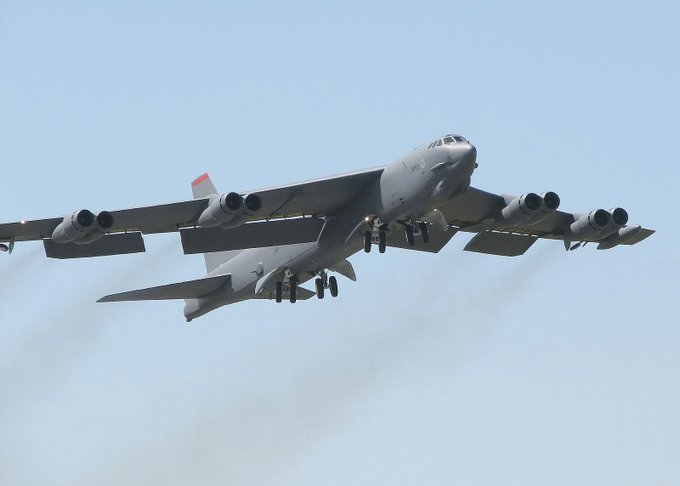
WASHINGTON — In a significant escalation of “Operation Epic Fury,” U.S. forces have begun conducting overland B-52 bomber missions across Iranian territory. The announcement was made on Tuesday by General Dan Caine, Chairman of the Joint Chiefs of Staff, signaling a new phase of air dominance in the month-long conflict.
Speaking at a joint news conference alongside Defense Secretary Pete Hegseth, Gen. Caine stated that the shift to overland sorties was made possible by the systematic degradation of Iran’s air defense capabilities.
“Given the increase in air superiority, we’ve successfully started to conduct the first overland B-52 missions, which allow us, as we’ve before, to continue to get on top of the enemy,” Gen. Caine told reporters.
General Dan Caine, Chairman of the Joint Chiefs of Staff:
“In the past 30 days, we’ve hit over 11,000 targets. With growing air superiority, we’ve also launched the first B-52 overland missions.” pic.twitter.com/tf6qYcppaM
— Open Source Intel (@Osint613) March 31, 2026
A Month of Devastating Strikes
The Chairman provided a grim statistical overview of the campaign’s first 30 days, revealing that U.S. and allied forces have struck more than 11,000 targets. The primary objective remains the total neutralization of Iran’s ability to project military power beyond its borders.
Gen. Caine confirmed that the joint force has already destroyed more than 150 ships belonging to the Iranian Navy, effectively paralyzing Tehran’s maritime reach in the Persian Gulf.
“Our joint force continues to focus on our military objectives as we systematically continue to degrade and destroy Iran’s ability to project power and threaten civility,” Caine added.
Diminishing Retaliation
Defense Secretary Pete Hegseth struck a confident tone during the briefing, noting that while Iran remains capable of launching occasional strikes, their offensive capacity is waning. According to Hegseth, the last 24 hours saw the lowest number of enemy missiles and drones fired since the start of the war.
“Iran will still shoot some missiles, but we will shoot them down,” Hegseth said, emphasizing the effectiveness of U.S. and Israeli missile defense systems.
A Region in Turmoil
The conflict, which began on February 28 with a massive joint offensive by Israel and the United States, has reshaped the Middle Eastern geopolitical landscape. The initial strikes resulted in the death of then-Supreme Leader Ayatollah Ali Khamenei and more than 1,340 others, according to regional reports.
In the weeks since, Iran has retaliated with waves of drone and missile strikes targeting Israel, Jordan, Iraq, and several Gulf nations hosting U.S. military assets. While these counter-strikes have caused casualties and significant infrastructure damage, the Pentagon maintains that the tide of the war has turned decisively in favor of the coalition.
The introduction of the B-52 Stratofortress—a heavy long-range bomber capable of carrying up to 70,000 pounds of weapons—into Iranian airspace marks a psychological and tactical milestone. The move suggests that the U.S. no longer views Iranian surface-to-air missile batteries as a credible threat to its heavy high-altitude assets.