
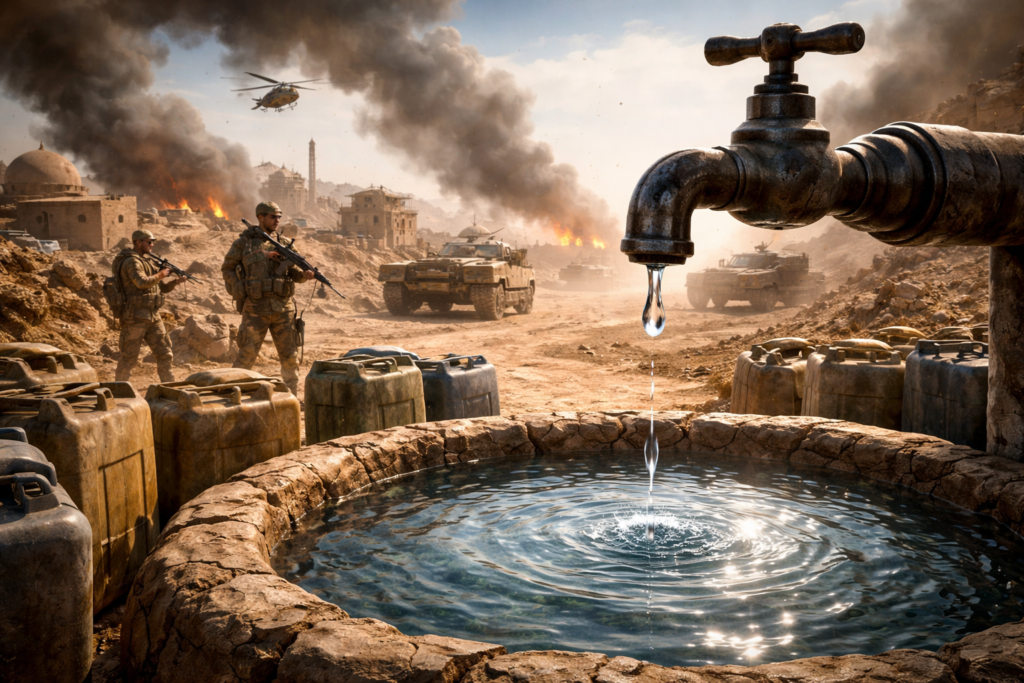
Image Credentials: Image Title: Why Water, Not Oil, is the Ultimate Brinkmanship in the 2026 Iran War Source: (sora.openai) Date: March 2025. Attribution: This image was created using AI-generated imagery (sora.openai) and does not depict a real-world scene.
By Open Chronicle Global Strategy Desk
THE PERSIAN GULF — For a century, the geopolitical gravity of the Middle East was anchored in a single commodity: crude oil. But as Operation Epic Fury enters its second month, a more primal liquid has redefined the “escalation ladder.” While the world watches the $4-a-gallon ticker at American gas pumps, the real existential war is being fought over the humming, salt-encrusted pipes of the Arabian Peninsula’s desalination plants.
The current conflict has exposed a terrifying strategic asymmetry. As President Donald Trump calls on allies to “take the Strait” and “get their own oil,” he is addressing a 20th-century energy crisis. Meanwhile, Tehran is executing a 21st-century Strategy of Ecological Terror.
The Asymmetry of Survival
The “Saltwater Kingdoms”, Saudi Arabia, the UAE, Kuwait, and Qatar, have built some of the most advanced civilizations on Earth atop a foundation of sand. Their survival is tethered to a handful of “soft targets”: massive conjoined power and desalination complexes.
The strategic math is brutal. Iran, blessed with natural geography and mountain-fed aquifers, relies on desalination for a mere 3% of its water. In contrast, the Gulf Cooperation Council (GCC) states are almost entirely dependent on the sea:
-
Qatar: 99% dependency
-
Kuwait: 90%+ dependency (with only a 7-day strategic reserve)
-
Saudi Arabia: 70% dependency
If an Iranian drone hits the Doha West plant in Kuwait, the nation doesn’t just lose power; it loses the ability to keep its population alive within a week. This isn’t just war; it’s a systematic threat to the biological viability of entire nations.
The “New” Strait of Hormuz
While the Strait of Hormuz remains the physical choke point for 20% of the world’s oil, the “Digital Strait” is the infrastructure connecting these water plants. President Trump’s recent rhetoric, urging the UK and others to “build up some delayed courage” and take control, ignores the fact that a secured waterway does not protect a coastal plant from a swarm of low-cost, “deniable” drones.
As General Dan Caine and Defense Secretary Pete Hegseth tout the success of overland B-52 missions, the tactical victory of “air superiority” is being challenged by the reality of “infrastructure vulnerability.” You can bomb a missile silo in Isfahan, but you cannot easily protect 14,000 kilometers of water pipelines from a motivated insurgency.
Soft Power vs. Kinetic Might
The arrival of King Charles III in Washington this April is more than a 250th-anniversary celebration; it is a desperate exercise in “soft power” diplomacy. While the UK’s Keir Starmer remains “reticent” to join the full-scale offensive, the British monarchy provides the only remaining bridge to a U.S. administration that has signaled it “won’t be there to help you anymore.”
The King’s visit represents the old world’s attempt to maintain the “Special Relationship” at a time when the U.S. is increasingly viewing the Middle East not as a protectorate, but as a market for U.S. energy (“Number 1, buy from the U.S., we have plenty”).
The Verdict: A Region on the Brink
The kidnapping of journalist Shelly Kittleson and the strike on the Al-Salmi tanker are symptoms of a theater where traditional “rules of engagement” are dissolving. When water becomes a weapon, the goal is no longer territory or regime change—it is the total degradation of a society’s ability to function.
As we look toward the potential of “Q-Day” and the obsolescence of current encryption, the physical world is already hitting its own “tipping point.” Much like the 90,000-kilometer mark for an EV battery, the Middle East has hit a point of no return where the cost of conflict is no longer measured in barrels, but in lives per gallon of fresh water.
Strategic Outlook:
-
Immediate Risk: Kuwaiti water shortages following incidental or direct strikes on coastal infrastructure.
-
Diplomatic Pivot: The UK’s role as a mediator between Trump’s “America First” withdrawal and the GCC’s desperate need for a security umbrella.
-
The “Silent” Victor: If the GCC is forced to build its own security, we may see a historic surge in Israeli-Gulf military integration, bypassing traditional Western alliances.
The Grand Strategy Institute
Continue Exploring Strategic Analysis
Return to The Grand Strategy Institute for strategic assessments, long-form analysis and research examining geopolitics, military affairs, international security, emerging technologies and the changing international order.
← Back to The Grand Strategy Institute