
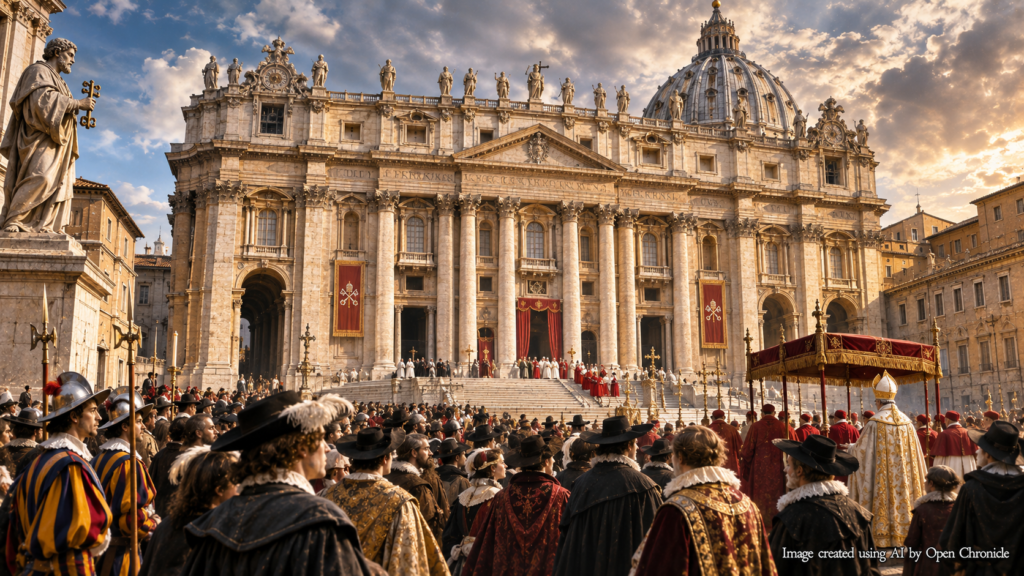
How Pope Urban VIII consecrated the new St. Peter’s Basilica, completing a century-long architectural transformation that united Renaissance ambition, Baroque magnificence, papal power and the enduring legacy of the Apostle Peter.
By Open Chronicle History Desk
On November 18, 1626, Rome witnessed a ceremony that marked the culmination of one of the most ambitious architectural undertakings in European history.
Pope Urban VIII consecrated the new St. Peter’s Basilica in Vatican City.
The immense church rose above a site associated for centuries with the burial of the Apostle Peter.
Its construction had involved some of the most celebrated artists and architects of the Renaissance and early Baroque periods.
Donato Bramante.
Michelangelo Buonarroti.
Carlo Maderno.
Gian Lorenzo Bernini.
Each contributed to the transformation of a sacred site into a monumental expression of religious authority, artistic achievement and architectural innovation.
The basilica that emerged was not simply a replacement for an aging church.
It represented a new vision of Rome.
Its enormous dome dominated the city’s skyline.
Its vast interior provided a setting for papal ceremonies.
Its architecture combined classical forms with Christian symbolism.
And its construction reflected the enormous political, financial and spiritual ambitions of the papacy.
Yet the story of St. Peter’s Basilica began long before the seventeenth century.
According to early Christian tradition, the Apostle Peter had been martyred in Rome during the reign of Emperor Nero.
His burial place became a focus of Christian devotion.
In the fourth century, Emperor Constantine sponsored the construction of a monumental church over the traditional site of Peter’s tomb.
For more than a thousand years, that earlier basilica served as one of Western Christianity’s most important pilgrimage destinations.
But by the Renaissance, the building had deteriorated.
Pope Julius II initiated a new construction project in 1506.
What followed was more than a century of architectural debate, political controversy and artistic experimentation.
The rebuilding of St. Peter’s became entangled with the financing of the Renaissance papacy and the religious conflicts of the Reformation.
It witnessed the emergence of new architectural techniques and the evolution of monumental church design.
When Urban VIII consecrated the new basilica in 1626, the principal structure was complete.
But the wider Vatican complex would continue to develop.
Bernini’s famous colonnades in St. Peter’s Square would not be constructed until decades later.
The ceremony therefore marked both an ending and a beginning.
A medieval and early Christian architectural tradition had been transformed.
A new monumental center of Catholic Christianity had emerged.
And Rome had acquired a building that would become one of the most recognizable landmarks in the world.
1. Rome and the Origins of Christianity
The history of St. Peter’s Basilica begins in the Roman Empire.
During the first century, Christianity emerged within the eastern Mediterranean.
Its earliest communities developed within the Jewish world before expanding across the empire.
Rome became an important center of the new religious movement.
Christian tradition associates the apostles Peter and Paul with the city’s earliest Christian history.
Their memory became central to Rome’s religious identity.
2. The Apostle Peter
Peter was one of the principal disciples of Jesus.
The New Testament presents him as an important figure among the earliest followers of Christianity.
Catholic tradition regards Peter as the first bishop of Rome and the foundational figure in the succession of popes.
The historical development of the Roman episcopate was gradual, however, and the precise institutional role Peter exercised in Rome remains a matter of scholarly discussion.
His importance in Christian memory is beyond dispute.
3. Peter’s Martyrdom
Early Christian tradition places Peter’s martyrdom in Rome during the reign of Emperor Nero.
The precise date is uncertain.
It is commonly associated with the persecution following the Great Fire of Rome in AD 64.
Later traditions describe Peter as having been crucified.
The familiar account that he requested an inverted crucifixion comes from later Christian literature.
The details cannot all be independently verified.
Nevertheless, the tradition of Peter’s martyrdom became deeply embedded in Roman Christianity.
4. The Vatican Hill
The Vatican area lay outside the ancient city center.
During the Roman imperial period, it included gardens, burial grounds and entertainment facilities.
The Circus of Nero was located in the wider area.
Christian tradition associated Peter’s martyrdom with this landscape.
The nearby necropolis became important to later claims about his burial.
Over time, the site acquired exceptional religious significance.
5. The Tomb of Peter
A burial site beneath the present basilica has long been venerated as Peter’s tomb.
Archaeological investigations have revealed a Roman necropolis and early structures associated with Christian devotion.
The evidence demonstrates the antiquity of the site’s religious importance.
Whether particular human remains can be conclusively identified as those of Peter remains debated.
The distinction between archaeological findings and religious tradition is essential.
6. Christianity Under Constantine
Emperor Constantine played a major role in the transformation of Christianity’s position within the Roman Empire.
Following his rise to power, Christianity gained increasing imperial support.
The Edict of Milan, issued in 313 by Constantine and Licinius, established a policy of religious toleration.
Christian communities were able to construct larger places of worship.
Imperial patronage helped transform the religious landscape of Rome.
7. The First St. Peter’s Basilica
Constantine sponsored the construction of a major church at the traditional burial site of Peter.
The project began during the fourth century.
The exact chronology remains debated.
The original basilica became one of the most important churches in the Christian world.
It established the site’s enduring architectural and devotional importance.
8. The Constantinian Basilica
The original St. Peter’s was a large longitudinal church.
Its design reflected the Roman basilica tradition.
The building contained a nave, aisles and an apse.
Its architectural form allowed large congregations to gather.
It also created a monumental setting for pilgrimage and worship.
The building would survive for more than a millennium.
9. Pilgrimage to Rome
St. Peter’s became a major destination for Christian pilgrims.
Visitors traveled to Rome to venerate the apostles and other saints.
Pilgrimage strengthened the city’s religious importance.
The basilica also became associated with papal ceremonies and major ecclesiastical events.
Its significance extended far beyond the local Christian community.
10. The Medieval Papacy
During the Middle Ages, the papacy developed into a major religious and political institution.
The popes exercised spiritual authority within Western Christianity.
They also governed territories in central Italy.
St. Peter’s served as a powerful symbol of papal legitimacy.
The building connected the papacy with the apostolic past.
Its architecture and ceremonies reinforced Rome’s religious prestige.
11. A Church in Decline
By the late Middle Ages, the ancient basilica had suffered structural deterioration.
Centuries of repairs and alterations had changed its appearance.
The building remained sacred and historically significant.
But Renaissance popes increasingly considered major reconstruction.
The question was whether to preserve the old structure or replace it.
The eventual decision would transform the site completely.
12. The Renaissance in Rome
The Renaissance encouraged renewed interest in classical architecture, proportion and monumental design.
Rome became a center of artistic patronage.
Popes commissioned churches, palaces, sculptures and urban improvements.
Architecture became a means of expressing religious authority and political prestige.
St. Peter’s offered an extraordinary opportunity for monumental construction.
13. Pope Julius II
Pope Julius II became one of the most ambitious patrons of the Renaissance.
He sought to strengthen the political and cultural authority of the papacy.
His projects included major artistic commissions.
He supported Michelangelo’s work on the Sistine Chapel ceiling.
He also initiated the reconstruction of St. Peter’s Basilica.
The project would become one of his most enduring legacies.
14. The Decision to Rebuild
In 1506, Julius II initiated the construction of the new basilica.
The decision involved the progressive demolition of the ancient Constantinian church.
The project was controversial.
The old building possessed enormous religious and historical significance.
But the new design promised a monumental church worthy of Renaissance Rome.
15. Donato Bramante
Donato Bramante became the first principal architect of the new St. Peter’s.
He proposed a grand centralized design.
His architectural vision drew inspiration from classical antiquity.
The project emphasized symmetry, geometry and monumental scale.
Bramante’s design influenced the development of the basilica even after his death.
16. The Foundation Stone of 1506
On April 18, 1506, Pope Julius II laid the foundation stone for the new basilica.
The ceremony marked the formal beginning of construction.
The project was expected to create one of Christianity’s greatest churches.
But the work would continue through multiple papacies.
Changes in leadership, finances and architectural priorities repeatedly altered its direction.
17. The Problem of Financing
Building St. Peter’s required enormous financial resources.
The papacy relied on several sources of revenue.
Fundraising campaigns included the promotion of indulgences.
The relationship between indulgence preaching and the financing of the basilica became especially controversial.
These practices contributed to wider criticism of the Renaissance Church.
18. Martin Luther and the Indulgence Controversy
In 1517, Martin Luther challenged the preaching and sale-related practices surrounding indulgences.
His Ninety-Five Theses became a defining event in the Protestant Reformation.
The financing of St. Peter’s was one element of the wider controversy.
The Reformation cannot be explained by a single fundraising campaign.
Nevertheless, the construction of the basilica became connected to one of the most consequential religious divisions in European history.
19. Bramante’s Death
Bramante died in 1514.
His death left the project without its original architect.
Other designers took responsibility.
The plans underwent significant revisions.
The question of whether the church should have a centralized or longitudinal form remained contested.
These debates shaped the eventual structure.
20. Raphael’s Contribution
Raphael became involved in the design after Bramante.
He proposed modifications to the architectural plan.
His work reflected changing ideas about the building’s organization.
Although much of his design was not executed, his participation demonstrated the project’s importance to Renaissance artistic culture.
21. Antonio da Sangallo the Younger
Antonio da Sangallo the Younger also played a major role in the basilica’s development.
He produced an elaborate design and architectural model.
His proposals emphasized structural complexity and monumental scale.
But the project continued to face delays.
The changing designs increased costs and complicated construction.
22. Michelangelo Takes Control
In 1546, Michelangelo became chief architect of St. Peter’s.
He was already one of the most celebrated artists of the Renaissance.
Michelangelo simplified aspects of the earlier designs.
He returned to a more unified centralized conception.
His work helped establish the architectural character of the building.
23. Michelangelo’s Architectural Vision
Michelangelo emphasized powerful structural forms.
His design used massive piers, monumental walls and a dominant dome.
He sought architectural clarity.
The resulting composition reflected both classical inspiration and Renaissance experimentation.
Although Michelangelo did not live to see the dome completed, his vision shaped its final form.
24. The Dome of St. Peter’s
The dome became the basilica’s most recognizable architectural feature.
Its design drew inspiration from earlier monumental structures, including the dome of Florence Cathedral.
Michelangelo developed the principal architectural conception.
The dome would become a defining feature of Rome’s skyline.
It also presented major engineering challenges.
25. Michelangelo’s Death
Michelangelo died in 1564.
Construction continued under subsequent architects.
His plans remained influential.
But practical engineering decisions required further development.
The completion of the dome would take several more decades.
26. Giacomo della Porta
Giacomo della Porta played a central role in completing the dome.
Working with Domenico Fontana, he oversaw major construction during the late sixteenth century.
The dome’s outer profile differed somewhat from Michelangelo’s earlier design.
The work demonstrated the technical sophistication of Renaissance engineering.
27. The Dome Is Completed
The principal dome structure was completed in 1590.
It rose above the Vatican as a monumental architectural achievement.
Its height and scale transformed the visual character of Rome.
The dome became a symbol of Catholic Christianity.
It remains one of the most recognizable domes in the world.
28. The Counter-Reformation
The rebuilding of St. Peter’s unfolded during the Catholic response to the Protestant Reformation.
The Council of Trent met intermittently between 1545 and 1563.
The Catholic Church pursued reforms in doctrine, discipline and religious practice.
Architecture and religious art became important expressions of Catholic identity.
St. Peter’s developed within this changing religious environment.
29. The Debate Over the Church’s Shape
Architects continued debating the basilica’s layout.
A centralized church offered geometric unity.
A longitudinal design provided more space for processions and large congregations.
The final building combined elements of both approaches.
The result reflected more than a century of architectural development.
30. Carlo Maderno
Carlo Maderno became one of the most important architects in the final construction phase.
Under Pope Paul V, he extended the nave.
The modification transformed the building into a Latin-cross plan.
Maderno also designed the monumental facade.
His work established much of the basilica’s present exterior appearance.
31. The Facade of St. Peter’s
Maderno’s facade was completed in the early seventeenth century.
It featured colossal columns and a broad classical composition.
The facade became the principal entrance to the basilica.
Its proportions reflected the monumental ambitions of the papacy.
It also influenced the way visitors experienced the building from the square.
32. The Completion of the Main Structure
By the 1620s, the basilica’s principal architectural structure was complete.
The project had lasted more than a century.
Several popes had supported it.
Multiple generations of architects and craftsmen had contributed.
The building represented an extraordinary accumulation of artistic and technical expertise.
33. Pope Urban VIII
Urban VIII became pope in 1623.
He belonged to the Barberini family.
His pontificate was associated with major artistic patronage.
He supported Gian Lorenzo Bernini and other artists.
Urban VIII presided over the consecration of the new St. Peter’s Basilica.
The ceremony became one of the defining events of his pontificate.
34. November 18, 1626
On November 18, 1626, Urban VIII consecrated the new basilica.
The date marked the formal dedication of the completed principal church structure.
The ceremony affirmed the basilica’s sacred function.
It also symbolized the culmination of the Renaissance rebuilding project.
The new St. Peter’s had become the monumental center of papal ceremony.
35. Why November 18?
November 18 was already associated in the Roman liturgical tradition with the dedication of the basilicas of Saints Peter and Paul.
The date linked the new building with the earlier Christian history of Rome.
Its selection emphasized continuity between the ancient apostolic tradition and the monumental church of the seventeenth century.
The ceremony therefore carried both religious and historical symbolism.
36. The Consecration Ceremony
The dedication of a major church involved solemn religious rites.
These ceremonies affirmed the building’s status as a sacred place.
Urban VIII’s consecration of St. Peter’s marked the official completion of its principal ecclesiastical purpose.
The basilica was ready to serve as a setting for major papal liturgies.
37. Gian Lorenzo Bernini
Bernini became one of the defining artists of Baroque Rome.
His work combined sculpture, architecture and theatrical presentation.
He received major commissions at St. Peter’s.
His artistic contributions helped transform the basilica’s interior and surrounding spaces.
The church became one of the greatest expressions of Baroque art.
38. The Baldachin
Bernini designed the enormous bronze baldachin above the papal altar.
The structure stands beneath the great dome.
Its twisted columns create a dramatic visual connection between architecture and sculpture.
The baldachin was completed in 1633, after the consecration.
It became one of the basilica’s most recognizable interior features.
39. The Papal Altar
The principal altar stands above the traditional site of Peter’s burial.
Its position connects the basilica’s architecture with its religious foundation.
The arrangement emphasizes the relationship between the papacy and the apostolic tradition.
The altar remains central to major papal ceremonies.
40. Bernini’s Later Contributions
Bernini continued working on projects associated with St. Peter’s.
His contributions included monumental sculpture and interior decoration.
He also designed the great colonnades surrounding St. Peter’s Square.
These later works expanded the architectural experience beyond the basilica itself.
41. St. Peter’s Square
The famous elliptical colonnades were constructed during the seventeenth century.
Bernini’s design created a monumental public space.
The colonnades were intended to organize large gatherings and frame the approach to the basilica.
They became one of the most celebrated examples of Baroque urban design.
The square’s present appearance therefore developed after the consecration of 1626.
42. The Basilica’s Dimensions
St. Peter’s is among the largest churches in the world.
Its immense interior reflects the scale of the Renaissance project.
The building extends approximately 187 meters in overall length, depending on the measurement used.
The dome rises to approximately 136 meters above the basilica floor at its highest exterior point.
The dimensions contribute to the building’s extraordinary visual impact.
43. Michelangelo’s Pietà
One of the basilica’s most famous artworks is Michelangelo’s Pietà.
The sculpture was completed in 1499.
It depicts Mary holding the body of Jesus after the Crucifixion.
Originally created for the earlier basilica complex, it eventually became part of the new church.
The sculpture remains a masterpiece of Renaissance art.
44. The Tombs of the Popes
St. Peter’s contains numerous papal tombs and monuments.
These works reflect centuries of religious and political history.
Some are elaborate sculptural compositions.
Others are more restrained.
Together, they illustrate the basilica’s role as a place of memory for the Roman Catholic Church.
45. St. Peter’s and Papal Authority
The basilica became a powerful symbol of papal authority.
Its architecture emphasized continuity with the apostolic past.
Its scale expressed the institutional importance of the Roman Church.
Its ceremonies reinforced the papacy’s international visibility.
But the building also reflected the political ambitions and financial resources of Renaissance and Baroque popes.
46. Architecture as Religious Communication
St. Peter’s demonstrates how architecture can communicate religious ideas.
Its dome draws attention upward.
Its vast nave creates a sense of procession and scale.
Its sculptures and altars connect artistic representation with theological meaning.
The building was designed to inspire awe.
Its architecture became part of the religious experience.
47. The Basilica and the Modern Vatican
The Vatican became the center of the Roman Catholic Church’s global administration.
St. Peter’s Basilica is one of its most important religious buildings.
It is located within Vatican City, the independent state established by the Lateran Treaty of 1929.
The basilica predates that modern political arrangement by centuries.
Its history reflects the long relationship between religion, territory and political sovereignty.
48. A Monument of World Heritage
St. Peter’s Basilica forms part of the historic and artistic landscape of Vatican City.
The Vatican was inscribed on the UNESCO World Heritage List in 1984.
Its cultural significance extends beyond religious devotion.
The basilica represents an extraordinary achievement in architecture, engineering, sculpture and urban planning.
It remains a major destination for visitors from around the world.
49. The Legacy of 1626
The consecration of St. Peter’s marked the culmination of more than a century of construction.
The project brought together several generations of leading artists.
It transformed a site of early Christian pilgrimage into a monumental architectural complex.
It influenced the development of Baroque church architecture.
Its legacy remains visible in religious buildings across the world.
50. Why November 18 Matters
November 18, 1626 marked the consecration of the new St. Peter’s Basilica.
The ceremony formally dedicated one of the most ambitious architectural projects of the Renaissance and Baroque periods.
It represented continuity with the ancient Christian tradition associated with the Apostle Peter.
It also symbolized the artistic and institutional ambitions of the papacy.
The building became one of the defining monuments of Rome.
November 18, 1626: A Monument Across the Centuries
Imagine Rome on the morning of November 18, 1626.
The city is preparing for a solemn ceremony.
Above the Vatican rises an immense dome.
The new basilica dominates the surrounding landscape.
Its construction has lasted more than a century.
Generations of architects have worked on its foundations, walls and vaults.
Artists have shaped its interior.
Craftsmen have carved stone and assembled monumental structures.
Popes have debated its design and financed its construction.
Religious controversies have transformed Europe during the decades of building.
The Protestant Reformation has divided Western Christianity.
The Catholic Church has responded through reform and renewed artistic patronage.
Now Pope Urban VIII enters the completed church.
The consecration begins.
The building is formally dedicated.
The new St. Peter’s has become a monumental expression of Rome’s religious and artistic identity.
But the story is not finished.
Bernini will continue transforming the interior.
The great square will take shape.
New sculptures and monuments will be added.
The basilica will witness centuries of religious ceremonies, political transformations and historical events.
Its dome will remain one of the defining features of the Roman skyline.
And the site associated with Peter’s burial will continue attracting pilgrims from around the world.
On November 18, 1626, Pope Urban VIII consecrated the new St. Peter’s Basilica. The ceremony marked the culmination of a century-long architectural transformation and established one of the most enduring monuments of Christian and European history.
Historical Sources and Further Reading
Institutional and scholarly references examining the history of St. Peter’s Basilica, its Renaissance reconstruction, its consecration in 1626 and its architectural and religious significance.
St. Peter’s Basilica: History, Architecture and Heritage
Official institutional information about the basilica, its historical development, architectural heritage, artistic treasures and continuing conservation.
Explore the Official Basilica Website →
Vatican City
UNESCO’s World Heritage documentation examining the exceptional cultural significance of Vatican City, including St. Peter’s Basilica, its architecture and the artistic achievements of successive centuries.
Read the World Heritage Documentation →
St. Peter’s Basilica
An overview of the basilica’s origins, architectural reconstruction, major artists and significance within the history of Christianity and European architecture.
Read the Historical Overview →
St. Peter’s in the Vatican
James S. Ackerman’s architectural study of St. Peter’s, examining the development of the building, the contributions of its major designers and the relationship between Renaissance architectural theory and construction.
The present St. Peter’s Basilica was consecrated by Pope Urban VIII on November 18, 1626, following a reconstruction project initiated under Pope Julius II in 1506. The ceremony should be distinguished from the dedication traditions associated with the earlier Constantinian basilica, whose precise fourth-century chronology remains less certain. The consecration of 1626 did not mark the completion of every decorative or architectural element of the Vatican complex. Major works, including Bernini’s baldachin and the colonnades of St. Peter’s Square, were completed later. This article distinguishes archaeological evidence concerning the ancient Vatican burial site from religious traditions identifying it with the Apostle Peter. The basilica’s architectural history is presented within the wider context of Renaissance patronage, the Protestant Reformation and the Catholic response to religious division.