
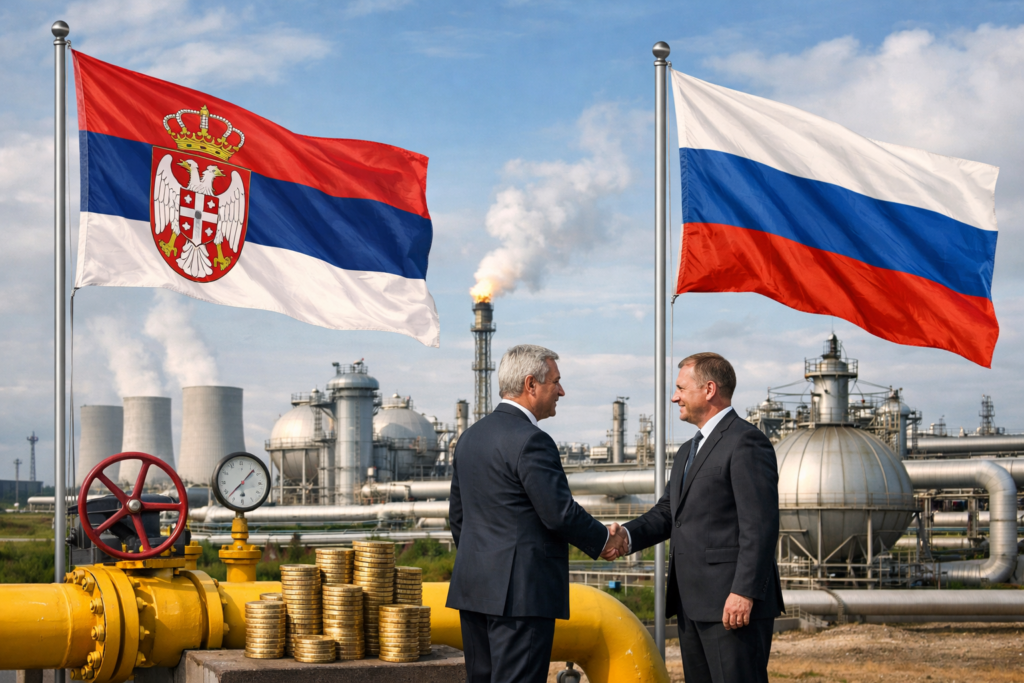
Image Credentials: Image Title: Why Water, Not Oil, is the Ultimate Brinkmanship in the 2026 Iran War Source: (sora.openai) Date: April 2026. Attribution: This image was created using AI-generated imagery (sora.openai) and does not depict a real-world scene.
By Open Chronicle Staff with Agencies
BELGRADE – Serbia has reached an agreement with the Russian Federation to extend its current natural gas arrangement, ensuring energy security for the Balkan nation through the coming months. Dušan Bajatović, the General Director of the state-owned enterprise Srbijagas, confirmed the deal, emphasizing that the move signals Russia’s commitment to maintaining a steady supply to Serbia despite broader regional volatility.
Speaking to the national broadcaster RTS, Bajatović hailed the extension as “excellent news,” noting that the agreement was solidified following high-level discussions between Serbian President Aleksandar Vučić and Russian President Vladimir Putin. He stated that the move reaffirms the “good bilateral relations” between Belgrade and Moscow.
Price Stability Amid Market Turmoil
While natural gas prices across Europe have experienced significant spikes, with some market indices showing increases of up to 100 percent due to geopolitical tensions in the Middle East, Serbia’s price will remain insulated. Bajatović revealed that the price for the next quarter will be set at $320 per 1,000 cubic meters. In contrast, the current stock market price in Europe sits at approximately $690.
“The price of gas for households will not change, and it will even become cheaper for the industry,” Bajatović said, highlighting that Serbia has successfully retained its “oil formula” for price calculation, which averages costs over nine months to smooth out market shocks.
Sanctions and Logistics
The extension covers three months, a duration Bajatović attributed to the complexities of navigating European Union sanctions and payment logistics. He noted that while “the old” long-term contract has been extended, the shorter timeframe allows both parties to manage the technicalities of payment agents and transit through third countries.
“Serbia is safe until at least January 1, 2028, in terms of transit through European countries to third countries that are not members of the EU,” the Srbijagas chief explained.
Seeking Alternatives
Despite the renewed deal with Gazprom, Serbia is continuing to explore diversification. Bajatović announced that talks with Azerbaijan are slated to resume in early April. Currently, Serbia receives up to 2 million cubic meters of gas from Azerbaijan, though higher volumes are restricted by existing technical and production capacities.
While gas can be sourced from German ports, Bajatović remarked that such options remain “economically less favorable” compared to the Russian supply.
No Impact on NIS
The director also addressed the ongoing negotiations regarding the Petroleum Industry of Serbia (NIS), which is majority-owned by Russia’s Gazprom Neft. He clarified that the gas arrangement is a separate matter from the discussions surrounding US sanctions against NIS and potential changes in its ownership structure. “I wouldn’t connect those two things. We have proved that we will change the majority ownership in NIS to meet the basic requirements of the sanctions,” he concluded.