
Imag: from Ryan Caton X @dpoddolphinpro
By Open Chronicle Staff with Agencies
HOUSTON — As the Artemis II mission propels humanity back toward the Moon for the first time in over half a century, NASA has released a trio of stunning photographs that bridge the gap between cutting-edge space exploration and everyday consumer technology.
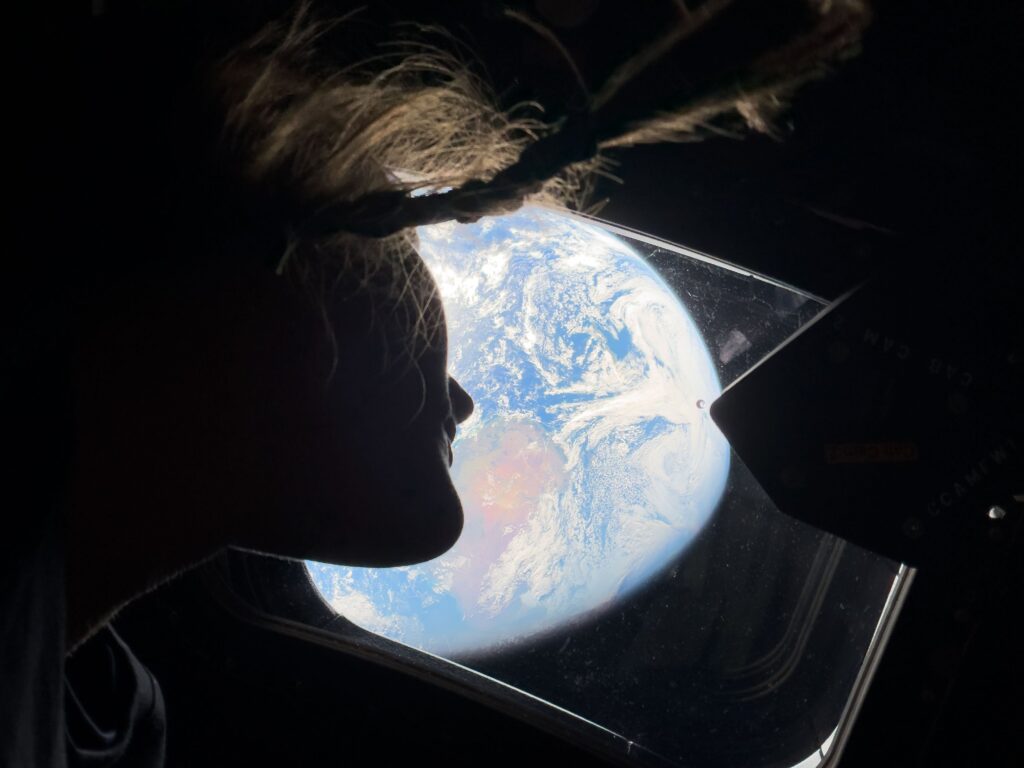
The images, captured aboard the Orion spacecraft, were shot using the iPhone 17 Pro Max, a device NASA recently fully qualified for extended orbital use. While the crew is equipped with professional-grade Nikon D5 and Z 9 systems, as well as GoPro HERO4 units, these personal snapshots offer a uniquely intimate perspective of the four-person crew’s journey.
A Selfie for the History Books
Something of note – These are the FIRST PHOTOS Shot on iPhone to be released from the Artemis II mission.
Both were captured on the iPhone 17 Pro Max.
A cousin of the phone you have in your pocket right now has seen the whole Earth in one. single. frame.
📷 @NASA https://t.co/z41y6xbiyX pic.twitter.com/Zwp69kdmX6
— Ryan Caton (@dpoddolphinpro) April 4, 2026
The newly released photos, verified by Flickr metadata, were taken on April 2, the mission’s second day. They feature Commander Reid Wiseman and Mission Specialist Christina Koch peering through Orion’s main cabin windows, with the curved sapphire marble of Earth suspended in the black void behind them.
Notably, the images were captured using the iPhone’s front-facing camera. Space enthusiasts have pointed out that the accessibility of the smartphone allows astronauts to document “the human side” of the mission with the same tools used by billions on Earth.
Breaking Apollo 13’s Record
The release of these photos comes as the mission reaches its most significant milestone. Today, Monday, April 6, the Orion spacecraft is expected to reach the far side of the Moon. In doing so, the crew will break the record for the farthest distance humans have ever traveled from Earth—a record held since April 1970 by the crew of Apollo 13.
At its peak, Orion will reach a distance of approximately 252,760 miles (406,777 km) from home, venturing about 4,100 miles further into the deep-space vacuum than any previous crewed flight.
The Final Stretch
Despite the proximity to the lunar surface, Artemis II is a “flyby” mission designed to test life-support systems and heat shield integrity for future landings. The Orion is not equipped to touch down; instead, it will use the Moon’s gravity to “slingshot” back toward Earth.
The mission is currently on track for a high-velocity reentry and splashdown:
-
April 6: Lunar far-side flyby and distance record achievement.
-
April 10: Scheduled splashdown in the Pacific Ocean at approximately 8:06 PM EDT.
NASA officials state that while the professional cameras provide the scientific data, these “shot on iPhone” moments serve a different purpose: making the vastness of space feel familiar and reachable for a new generation.