
Image: from Devana X @DevanaUkraine
By Open Chronicle Staff with Agencies
BELGRADE — A high-stakes diplomatic rift has opened between Belgrade and Budapest following explosive allegations of energy sabotage. Serbia’s top military intelligence official has publicly contradicted Hungarian Prime Minister Viktor Orbán, stating there is “no truth” to claims that Ukraine organized a plot to blow up a critical gas pipeline.
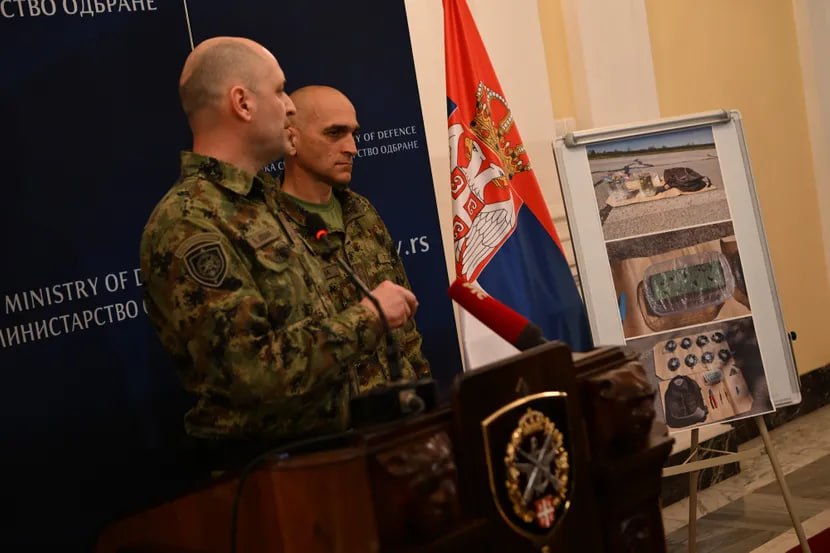
The incident involves a “devastating” explosive device discovered near a pipeline in Vojvodina, Serbia, which transports Russian gas to Hungary. The discovery comes at a politically volatile moment, just one week before Hungary’s general election on April 12, where Orbán faces the most significant challenge to his power in over a decade.
Wow. The head of Serbia’s military intel pushes back on the narrative being spread by Orban accusing Ukraine of planting the explosives found by a gas pipeline that goes to Hungary. Calls it disinformation. https://t.co/RNBmS4Qnx3
— Simon Ostrovsky (@SimonOstrovsky) April 6, 2026
Intelligence vs. Political Rhetoric
On Sunday, following an emergency meeting of Hungary’s National Defense Council, Prime Minister Orbán linked the discovery to Kyiv, asserting that Ukraine has been “working for years to cut Europe off from Russian energy.” While he stopped short of a formal legal accusation, he labeled the incident a direct threat to Hungarian sovereignty.
However, Đuro Jovanić, director of Serbia’s Military Security Agency (VBA), delivered a blunt rebuke to that narrative. Speaking late Sunday evening, Jovanić clarified that the investigation does not point to Kyiv.
“It is not true that the Ukrainians tried to organize this,” Jovanić stated. He further noted that while the explosives were “specially packaged and hermetically sealed,” their origin told a different story. “The markings show that it was manufactured in the U.S., but the manufacturer does not mean he is the one who ordered or executed it.”
Allegations of a “False Flag”
The timing of the discovery has drawn heavy fire from Orbán’s domestic political rival, Péter Magyar. Leading the opposition Tisza party, Magyar suggested the entire episode might be a “false flag” operation orchestrated by Orbán with Serbian and Russian assistance to boost his flailing campaign.
“If Viktor Orbán and his propaganda use this provocation for campaign purposes, it will be an open admission that this is a pre-planned operation,” Magyar said, noting that Orbán’s Fidesz party is currently trailing in the polls.
Ukraine’s Foreign Ministry has “categorically” denied responsibility, mirroring Magyar’s suspicions by suggesting the plot was likely a Russian provocation intended to influence the Hungarian vote.
Energy as a Battleground
The pipeline in question remains a lifeline for Hungary, which continues to rely heavily on Russian energy despite broader EU efforts to decouple from Moscow. For Orbán, energy security has been the cornerstone of his reelection bid, often framing himself as the sole protector of Hungarian households against “external saboteurs.”
As the April 12 election approaches, the discrepancy between Serbian intelligence findings and Hungarian political rhetoric has left voters and international observers questioning the true nature of the threat in Vojvodina.