
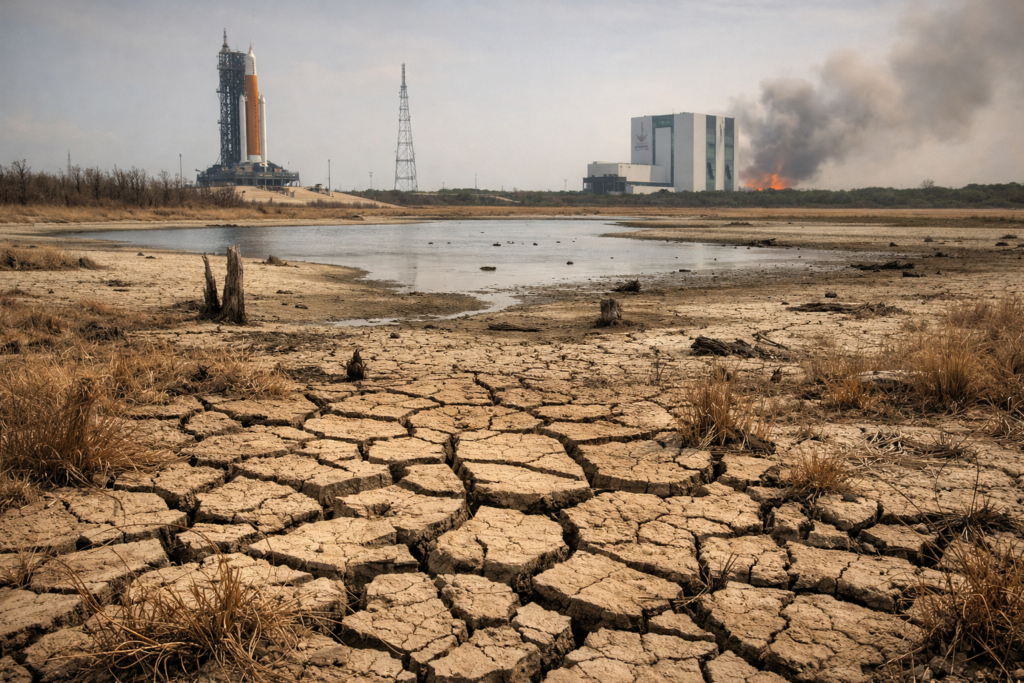
Image Credentials: Image Title: NASA Data Reveals Florida’s Worst Drought Since 2012 Source: (sora.openai) Date: April 2026. Attribution: This image was created using AI-generated imagery (sora.openai) and does not depict a real-world scene.
By Open Chronicle Staff with Agencies Wednesday, April 8, 2026
CAPE CANAVERAL — While the world’s attention has been fixed on the historic Artemis II mission to the far side of the Moon, a silent environmental crisis has gripped the state below the launchpads. New data released by NASA and the U.S. Drought Monitor confirms that Florida is facing a severe drought, with nearly 80 percent of the state now under “extreme” conditions.
The crisis follows an unusually dry 2025, with conditions deteriorating rapidly since January 2026. The current dry spell is now categorized as the most widespread and severe to affect the “Sunshine State” in over 14 years.
🚨 FLORIDA DROUGHT UPDATE (March 31, 2026) 🚨
This is getting worse… 👇
🌵 100% of Florida is still in drought
🔥 Nearly 80% of the state is in SEVERE to EXTREME drought
⚠️ Exceptional (D4) drought continues to expand, especially across North Florida
And here’s the alarming… pic.twitter.com/LRLlFA2Zov— PC Weather Boy (@PC_WeatherBoy) April 2, 2026
Groundwater Depletion
According to a report utilizing data from the twin GRACE-FO (Gravity Recovery and Climate Experiment Follow-On) satellites, a joint mission between NASA and the German Research Centre for Geosciences, the drought has severely impacted Florida’s underground aquifers.
Satellite measurements from March 30, 2026, indicate that groundwater levels in the northern and central regions are particularly depleted. These aquifers are the primary source for the state’s drinking water and its multibillion-dollar agricultural industry.
Impact on Agriculture and Ecology
The lack of rainfall has created a “perfect storm” for Florida’s farmers and ecosystems:
-
Crop Threats: Many crops are struggling to recover after suffering damage from hard freezes in February.
-
Wildfire Risks: Large wildland fires have already begun to flare up in several counties due to the tinder-dry vegetation.
-
Everglades in Peril: Even the state’s iconic wetlands are facing unusually dry conditions, threatening the delicate balance of the Everglades ecosystem.
In urban centers, the shortage is becoming visible to residents. Several water districts have moved to impose mandatory restrictions on non-essential water use, including lawn irrigation and car washing.
Record-Breaking Dryness
National Weather Service records highlight the severity of the rainfall deficit. Since September 1, 2025, many regions have received less than half of their typical precipitation.
-
St. Petersburg: Recorded only 7.7 inches of rain since September, compared to a historical norm of 19 inches, marking the driest such period on record for the city.
A Glimmer of Hope
While the current conditions are dire, experts note they have not yet reached the record-breaking intensity of the 2000–2001 drought.
Relief may be on the immediate horizon, however. Meteorologists are tracking a slow-moving rainstorm projected to cross the peninsula later this week. While a single storm system is unlikely to replenish the depleted aquifers, it could provide the critical moisture needed to dampen wildfire risks and offer temporary relief to parched surface crops.