
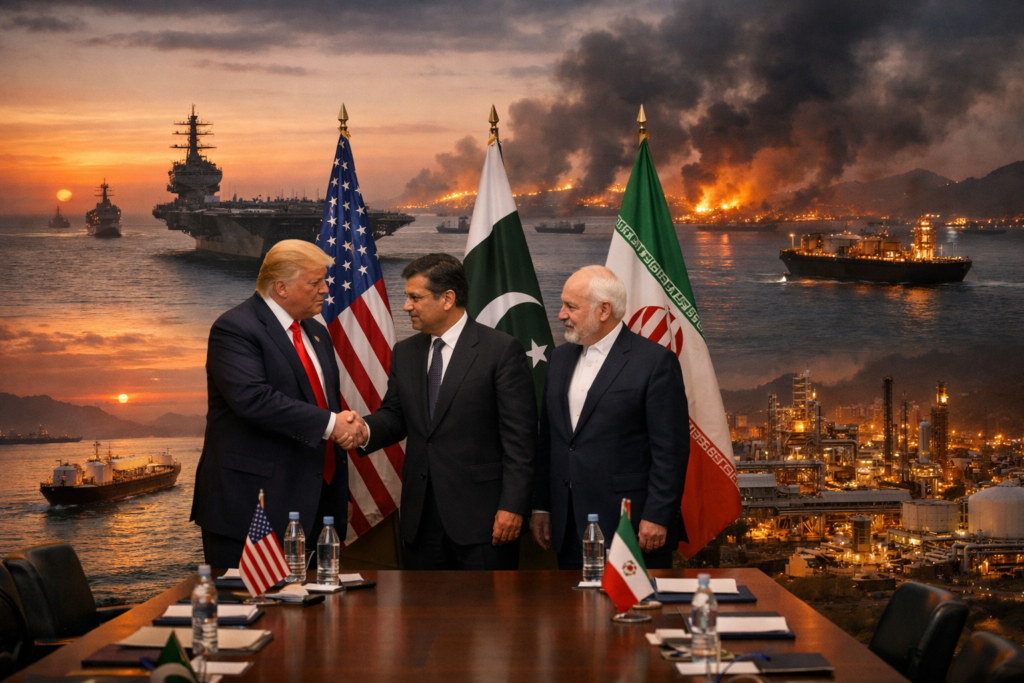
Image Credentials: Image Title: U.S.-Iran Truce Diplomacy Wins a Two-Week Reprieve in the Gulf Source: (sora.openai) Date: April 2026. Attribution: This image was created using AI-generated imagery (sora.openai) and does not depict a real-world scene.
By Open Chronicle Staff with Agencies
Wednesday, April 8, 2026
ISLAMABAD — A fragile two-week ceasefire between the United States and Iran took effect early Wednesday, providing a desperate breathing room for a region on the brink of total war. The truce, brokered in the final hour by Pakistan, has successfully paused President Donald Trump’s threat to destroy Iran’s national infrastructure and secured a temporary reopening of the world’s most critical energy artery, the Strait of Hormuz.
While the “Islamabad Talks” are set to begin this Friday, significant hurdles remain as both nations enter negotiations with deeply conflicting visions for a permanent peace.
The Terms of the Truce
According to statements from Washington and Tehran, the immediate conditions of the ceasefire are clear:
-
U.S. Obligations: Suspension of all military strikes on Iranian soil, including the threatened “Power Plant Day” attacks on civilian infrastructure.
-
Iranian Obligations: The “COMPLETE, IMMEDIATE, and SAFE OPENING” of the Strait of Hormuz for a period of 14 days, facilitated by coordination with the Iranian Armed Forces.
-
Nuclear Clause: President Trump claimed that Iran’s enriched uranium would be “perfectly taken care of” during this period, though specifics on monitoring or transfers remain undisclosed.
The 10-Point Plan: A “Workable” Basis?
President Trump described a 10-point proposal from Tehran as a “workable basis” for negotiations, a notable shift from his previous demand for “unconditional surrender.” However, the Iranian framework contains several “red line” issues for U.S. policymakers:
| Iranian Demand | Potential U.S. Conflict |
| Enrichment Rights | Washington has historically demanded a total halt to enrichment. |
| Sanctions Relief | Tehran requires the lifting of all primary and secondary sanctions. |
| Regional Withdrawal | The plan calls for a total U.S. military exit from the Middle East. |
| Hormuz Control | Iran insists on continued sovereign authority over the Strait. |
The “Lebanon Gap”
A significant point of contention emerged almost immediately after the announcement. While Pakistani Prime Minister Shehbaz Sharif stated the ceasefire applies “everywhere, including Lebanon,” the office of Israeli Prime Minister Benjamin Netanyahu was quick to clarify.
“Israel supports the decision to suspend strikes against Iran… however, the ceasefire does not include Lebanon,” the statement read.
Israel has vowed to continue its operations against Hezbollah, which joined the conflict in March. The discrepancy highlights the difficulty of achieving a truly comprehensive regional halt to hostilities.
Economic Impact: Oil Prices Plunge
The global economy felt the truce’s impact instantly. As news broke that the blockade of the Strait of Hormuz, which handles 20% of the world’s oil and gas, would be lifted, crude oil prices plummeted on Wednesday morning.
Before the truce, physical North Sea Brent had reached an all-time high of $146.09 per barrel. Analysts expect prices to retreat quickly as the first tankers begin moving through the waterway, easing a supply crunch that has eliminated 12 million barrels per day from the global market.
What’s Next?
Delegations from Washington and Tehran are expected to arrive in Islamabad for high-level talks beginning Friday, April 10. Prime Minister Sharif, who has cultivated a unique relationship with both President Trump and the leadership in Tehran, expressed “deepest gratitude” to both sides for choosing the path of dialogue.
“We are at a dangerous escalation, but the possibility of diplomacy cannot be ruled out until the last minute,” a Pakistani source said. The world now watches to see if fourteen days of talk can undo six weeks of war.