
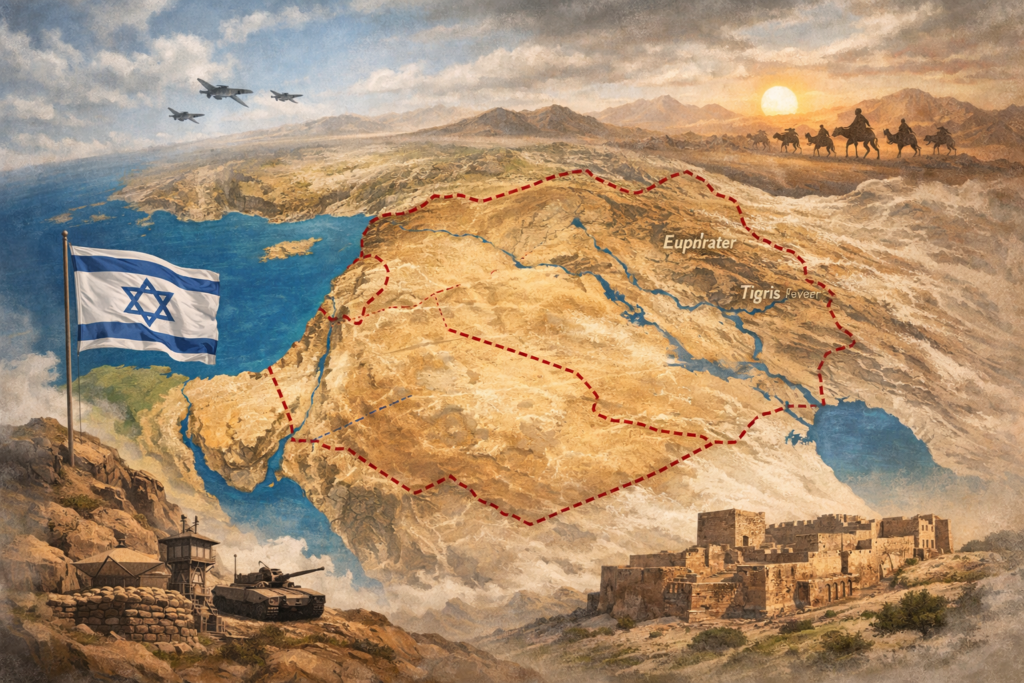
Image Credentials: Image Title: Israel and Lebanon on the Brink: Territorial Ambitions, Hezbollah, and the 2026 Escalation. Source: (sora.openai) Date: April 2026. Attribution: This image was created using AI-generated imagery (sora.openai) and does not depict a real-world scene.
By José Carlos Palma | The Grand Strategy Institute
Here is a deep geopolitical analysis of the concept of “Greater Israel” placed in the wider context of today’s Middle Eastern dynamics, with a focus on the current escalation between Israel and Lebanon as of early April 2026. This article grounds itself in the latest confirmed developments and credible reporting.
The phrase “Greater Israel” has been used in political and academic discourse to refer to various imagined territorial configurations that stretch beyond Israel’s internationally recognized borders. In its most expansive form, it evokes ancient biblical descriptions of land promises, but in current political use, it usually refers either to maximalist territorial visions proposed by ideological fringe groups or to critics’ characterization of certain policy tendencies. The term is not an official state doctrine of the Government of Israel, and views on it within Israeli society range from outright rejection to cautious support for limited security zones beyond the formal border.
In the present conflict dynamics, however, elements of Israeli politics have tied security concerns with territorial control objectives, notably in the context of southern Lebanon and the rise of armed non‑state actors there. Far‑right politicians in Israel have at times called for extending control over border areas, framing such moves as necessary for national security. For example, ministers have publicly argued that the border should be pushed northward to the Litani River, a strategic objective that critics see as an expression of territorially maximalist thinking.
These debates over security spaces and territorial control feed into broader regional tensions, where shifting alliances and proxy conflicts shape how neighboring states react and respond.
Since February 2026, the Middle East has become the theater of intensified conflict, largely defined by the simultaneous confrontation between Israel, the United States, and Iran. Lebanese territory, in particular, has become a focal point because of the involvement of the armed group Hezbollah, an Iran‑backed militia and political actor with substantial military capability inside Lebanon.
Hostilities erupted sharply when Hezbollah launched rockets and drones into northern Israel, widely interpreted as retaliation for prior strikes attributed to Israel against Iranian assets and leaders. These exchanges have escalated into a broader pattern of violence. Since early March, Israeli forces have carried out repeated airstrikes, drone operations, and ground actions across southern Lebanon and around Beirut, targeting Hezbollah infrastructure and positions. These military operations have been coupled with declarations of intent to expand Israeli control into southern Lebanese territory as a form of defensive buffer against future attacks.
The toll on Lebanese civilians and infrastructure has been severe. Reports indicate that since the conflict surge began, more than 1,700 people in Lebanon have been killed and thousands more wounded, with casualties mounting as Israeli strikes have extended beyond frontline villages into urban and densely populated areas of Beirut and its suburbs. At least 1.2 million Lebanese are estimated to have been displaced from their homes, making this one of the fastest‑growing displacement crises in the world.
Lebanese political figures and civil society leaders have condemned the attacks as disproportionate and destructive. Some officials have called for urgent action to dismantle Hezbollah’s military capabilities, while others emphasize the need to protect civilians caught between militant activities and retaliatory strikes.
In early April 2026, a brokered two‑week ceasefire between the United States and Iran was announced to pave the way toward a longer‑term end to hostilities involving multiple fronts. However, Benjamin Netanyahu, Israel’s prime minister, publicly stated that this ceasefire did not apply to the conflict in Lebanon, emphasizing that Israel would continue operations against Hezbollah regardless of the higher‑level truce agreement.
This stance has complicated regional diplomacy. Some mediators argued that the ceasefire should extend to all theaters of conflict, including Lebanon, while Israel maintained that its security considerations and the threat posed by Hezbollah justified ongoing operations.
The international community has reacted unevenly. A coalition of nations at the United Nations condemned violent attacks against peacekeepers in Lebanon, called for accountability for actions that threaten humanitarian personnel, and expressed deep concern over the humanitarian crisis resulting from the conflict.
At the same time, voices such as the United Kingdom’s foreign minister described Israel’s military actions in Lebanon as “deeply damaging,” urging that the ceasefire framework be expanded to prevent greater destabilization.
Hezbollah’s military and political dominance within Lebanon complicates state sovereignty. Lebanese leaders have repeatedly called for the militia’s disarmament, but the group’s entrenched position and regional backing make such efforts contentious both domestically and internationally. The interplay between state authority and non‑state military structures is a core factor in both the outbreak and persistence of the current conflict.
The Israel‑Lebanon dimension of the present crisis is part of a larger geopolitical realignment in the Middle East driven by multi‑layered conflicts involving state and non‑state actors, regional powers, and global strategic interests. In particular:
• The persistence of cross‑border hostilities suggests that temporary ceasefires may not hold absent comprehensive agreements that address underlying security, political, and governance issues.
• Expansion of Israeli military control into Lebanese border areas raises concerns about long‑term occupation dynamics and the potential for entrenched conflict analogous to other protracted border disputes in the region.
• The humanitarian crisis could deepen socio‑economic fractures within Lebanon, forcing shifts in internal politics and demographic patterns that may outlast the immediate conflict.
• External actors, from Iran to Western states, will likely continue to influence outcomes through diplomacy, military assistance, and economic leverage.
In sum, the current situation between Israel and Lebanon reflects a broader fracturing of the regional order where localized conflicts intersect with global strategic rivalries. Without sustained diplomatic efforts that include protections for civilians and mechanisms to rein in non‑state militias, the cycle of escalation may continue, perpetuating instability and human suffering across the region.
The Grand Strategy Institute
Continue Exploring Strategic Analysis
Return to The Grand Strategy Institute for strategic assessments, long-form analysis and research examining geopolitics, military affairs, international security, emerging technologies and the changing international order.
← Back to The Grand Strategy Institute