
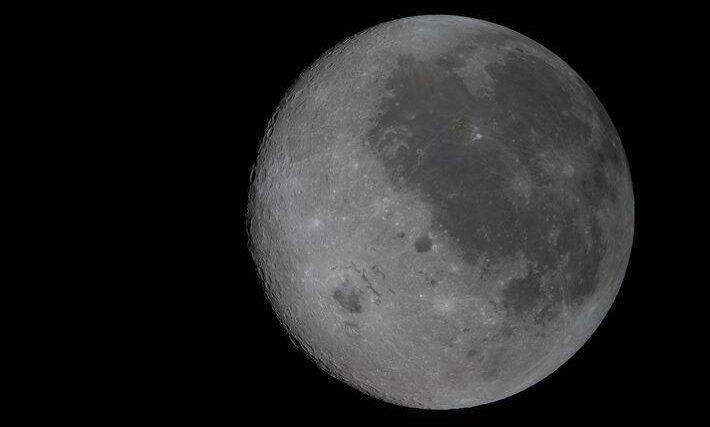
Foto: Nasa
By Open Chronicle Staff with Agencies
CAPE CANAVERAL / LUNAR ORBIT — In a milestone for deep-space exploration, NASA released the first images of the Moon’s far side captured by the Artemis II crew on Monday, April 6, 2026. The historic photos offer a high-resolution look at the “hidden” hemisphere that remains permanently out of view from Earth, marking the first time humans have observed this terrain firsthand since the Apollo era.
The View from Orion
The images were captured as the Orion spacecraft, carrying astronauts Reid Wiseman, Victor Glover, Christina Koch, and Jeremy Hansen, completed a seven-hour flyby of the lunar far side.
-
Topographical Contrast: The photos highlight the stark difference between the two lunar faces. While the near side is defined by smooth, dark “maria” (ancient lava flows), the far side is a rugged, mountainous expanse saturated with impact craters.
-
The “Earthset”: One of the most striking images shows a “crescent Earth” sinking behind the lunar horizon. This “Earthset” was captured just minutes before the crew entered a planned 40-minute communications blackout as they passed directly behind the Moon.
A Rare “Space” Solar Eclipse
In addition to the lunar surface, the crew witnessed a phenomenon impossible to see from Earth: a total solar eclipse from lunar orbit. For nearly 54 minutes, the Moon completely obscured the Sun from Orion’s perspective, allowing the astronauts to capture the solar corona, the Sun’s outer atmosphere, as a glowing halo around the dark lunar disk.
“There’s just so much magic in the terminator,” remarked Pilot Victor Glover, referring to the line dividing day and night on the lunar surface, which he described as creating “islands of light” among the deep valleys.
Record-Breaking Distance
During the flyby, Artemis II set a new record for the farthest distance a crewed spacecraft has traveled from Earth: 252,756 miles (406,771 km). This surpasses the previous record set by the Apollo 13 mission in 1970.
Safe Return and Future Steps
The Orion capsule, named Integrity, successfully returned to Earth on Friday, April 10, 2026, executing a “bull’s-eye” splashdown in the Pacific Ocean off the coast of San Diego.
-
Scientific Value: The thousands of photos and data points collected will be used to map the South Pole-Aitken Basin, a primary target for future lunar habitats.
-
The Path Ahead: The success of this 10-day mission clears the way for Artemis III, which aims to land the first woman and first person of color on the lunar surface as early as 2027.