
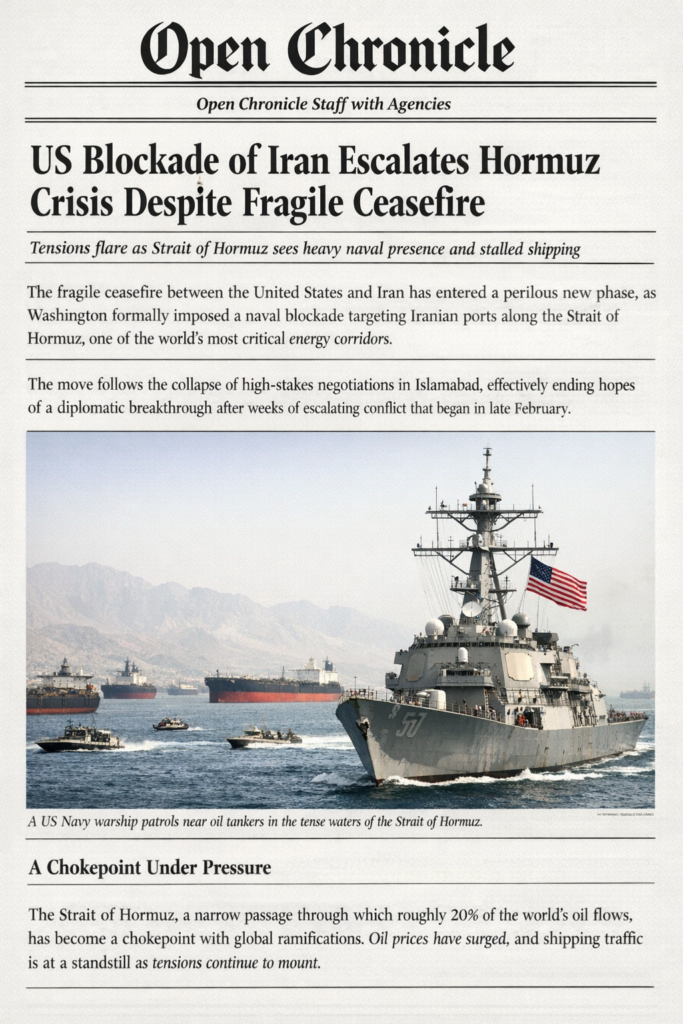
Image Credentials: Image Title: US Blockade of Iran Escalates Hormuz Crisis Despite Fragile Ceasefire Source: (chatgpt.com) Date: April 2026. Attribution: This image was created using AI-generated imagery (chatgpt.com) and does not depict a real-world scene.
By Open Chronicle Staff with Agencies
The fragile ceasefire between the United States and Iran has entered a perilous new phase, as Washington formally imposed a naval blockade targeting Iranian ports along the Strait of Hormuz, one of the world’s most critical energy corridors.
The move follows the collapse of high-stakes negotiations in Islamabad, effectively ending hopes of a diplomatic breakthrough after weeks of escalating conflict that began in late February.
A Chokepoint Under Pressure
The Strait of Hormuz, a narrow passage linking the Persian Gulf to global markets, typically carries roughly one-fifth of the world’s oil supply. Its disruption has immediate global consequences, and markets have already reacted sharply.
Oil prices surged beyond $100 per barrel as shipping traffic slowed to a near standstill, with thousands of vessels and tens of thousands of crew stranded in surrounding waters.
Despite the ceasefire agreement, maritime movement remains severely restricted. Iran continues to exert tight control over transit permissions, allowing only limited passage under strict conditions.
Blockade and Retaliation
US officials describe the blockade as a targeted effort to cut off Iran’s energy exports while preserving navigation for vessels not bound for Iranian ports.
President Donald Trump has warned that any Iranian interference with the blockade would be met with force, stating that hostile vessels could be “eliminated.”
Tehran, for its part, has condemned the move as an act of “piracy” and signaled that retaliation could extend beyond its own waters, potentially threatening ports across the Gulf.
Ceasefire in Name Only
Although a two-week ceasefire was intended to reopen the strait, conditions on the ground suggest otherwise. Analysts report that shipping levels remain far below prewar averages, with major operators unwilling to risk transit amid legal uncertainty and security threats.
Complicating matters further, Iran has accused the United States of violating the truce through continued military operations and indirect regional actions, including ongoing Israeli strikes in Lebanon.
Military Risks Rising
The situation has also drawn US naval forces deeper into the region. Warships have entered the strait for the first time since the conflict began, while mine-clearing operations are underway amid fears of further escalation.
Experts warn that the presence of heavily armed vessels in such confined waters significantly increases the risk of miscalculation, particularly given Iran’s use of fast attack boats, drones, and anti-ship missiles.
Global Fallout
Beyond the immediate military standoff, the economic consequences are mounting. Energy markets remain volatile, and prolonged disruption could deepen inflationary pressures worldwide.
Meanwhile, key US allies have distanced themselves from the blockade, favoring diplomatic solutions and raising concerns about the long-term strategic costs of escalation.
An Uncertain Path Forward
For now, the Strait of Hormuz remains a flashpoint where ceasefire rhetoric collides with operational reality. With shipping stalled, military forces on edge, and diplomacy faltering, the risk of a broader regional confrontation continues to grow.