
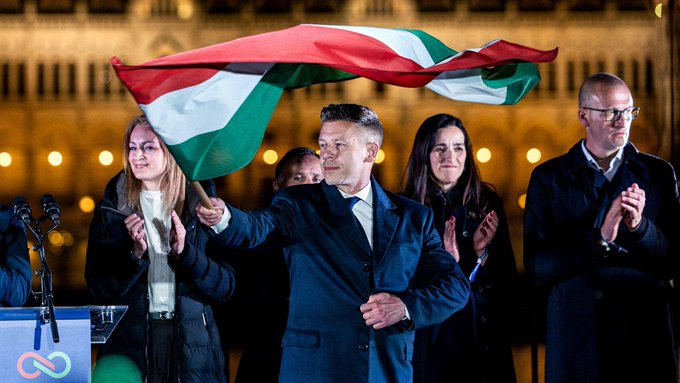
Image: from World News X @ferozwala
Hungary’s political transition is already reshaping its posture within Europe, as incoming Prime Minister Péter Magyar signaled that Budapest will not obstruct the European Union’s €90 billion loan for Ukraine, while making clear that Hungary itself will not participate in the mechanism.
Speaking to foreign media in Budapest, Magyar framed the issue as largely settled, pointing to a prior decision taken at the European Council in December. According to him, Hungary had already opted out under the outgoing government, even as the broader EU moved forward with the financial package.
“I am not sure what exactly we are even talking about,” Magyar said, noting that Hungary, alongside the Czech Republic and Slovakia, is not included in the loan framework and therefore not directly affected by it.
Continuity in Policy, Change in Tone
While distancing his administration from participation in the loan, Magyar emphasized that Hungary would adopt a more predictable and transparent approach in its dealings with European partners. His remarks were widely interpreted as a contrast with the often shifting positions of outgoing Prime Minister Viktor Orbán.
“We will try to be consistent and honest in our communication and will not change our position every six months,” Magyar said, signaling a recalibration rather than a full reversal of Hungary’s stance.
The incoming leader also underscored Hungary’s domestic financial constraints, arguing that the country cannot afford additional borrowing at a time of economic strain. Instead, he placed priority on unlocking suspended EU funds, which Budapest has long argued are owed to it.
EU Looks to Break Deadlock
Magyar’s election victory has raised cautious optimism across European capitals. Officials in Brussels see an opportunity to move forward not only with the Ukraine loan but also with broader policy initiatives that had been slowed by Budapest’s previous resistance.
The German government, in particular, expressed hope that Hungary’s political shift would help accelerate the implementation of the loan package, designed to support Ukraine’s financial stability amid ongoing war-related pressures.
The €90 billion instrument is a cornerstone of the EU’s long-term support strategy for Kyiv, aimed at sustaining government operations, reconstruction efforts, and economic resilience.
Strategic Balancing Act
Despite the more conciliatory tone, Hungary’s position remains carefully calibrated. By choosing not to participate financially while refraining from blocking the initiative, Magyar appears to be seeking a middle ground between domestic constraints and European expectations.
He confirmed that the issue would still be raised in discussions with EU leaders, suggesting that Budapest intends to remain engaged in shaping the broader framework, even from the sidelines.
A Reset in European Relations
Magyar’s rise to power, following his party’s victory in parliamentary elections on 12 April, marks a significant political shift in Hungary. His pledge to restore the country as a “reliable partner” within both the EU and NATO has been closely watched by allies seeking greater cohesion at a time of geopolitical strain.
Whether this recalibration will translate into deeper alignment with European policy remains to be seen. For now, Hungary’s message is one of selective cooperation, supporting collective decisions without fully committing national resources.
As Europe continues to navigate the economic and strategic implications of the war in Ukraine, Budapest’s evolving role may prove pivotal in determining how unified the bloc can remain in the face of ongoing challenges.