
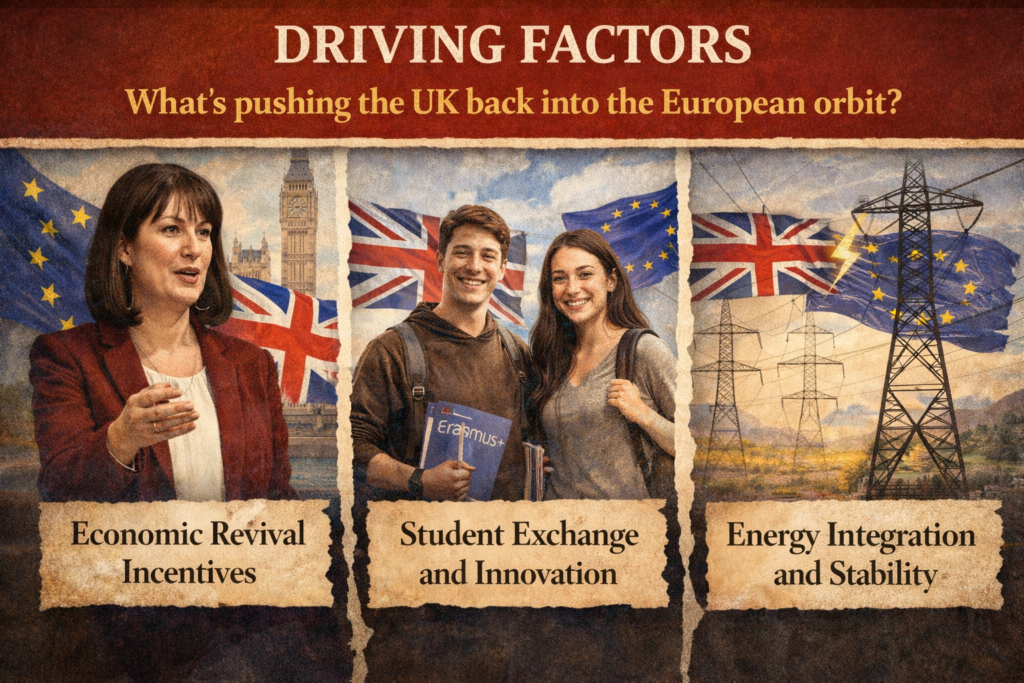
Image Credentials: Image Title: Bridge Building: Three Key Pillars Driving the UK’s Rapid Pivot Toward Europe Source: (chatgpt.com) Date: April 2026. Attribution: This image was created using AI-generated imagery (chatgpt.com) and does not depict a real-world scene.
By Open Chronicle Staff with Agencies
April 13, 2026
BRUSSELS — The European Council has formally signaled a new era of cooperation with London, approving the United Kingdom’s return to the Erasmus+ program and opening high-stakes negotiations for integration into the EU Internal Electricity Market.
The decisions, reached on Monday, mark the most significant “tangible progress” since the first EU-UK Summit last year. They come as Chancellor Rachel Reeves increasingly champions “dynamic alignment” with Brussels, describing the EU as the “biggest prize” for reviving Britain’s stagnant economy.
Here are the three primary drivers currently pushing the UK back into the European orbit:
1. The Return of Erasmus+: A £570m Investment in Youth
After years in the wilderness following the post-Brexit withdrawal, the UK is set to rejoin the Erasmus+ scheme in 2027. The program is far more than just a student exchange; it funds training placements for apprentices, youth workers, and volunteers across the continent.
-
Scale: The government projects that 100,000 UK citizens will benefit annually.
-
Cost: The participation carries a £570 million annual price tag, though London successfully negotiated a 30% discount.
-
Diplomacy: Marilena Raouna, Cyprus’ Deputy Minister for European Affairs, stated that strengthening ties with London is a “key priority” for the current EU presidency, emphasizing the need to reinforce “people-to-people ties.”
2. Energy Security Amid Global Chaos
With the ongoing war in the Middle East and the effective closure of the Strait of Hormuz, energy security has moved to the top of the UK’s national security agenda.
Negotiations have now been greenlit for the UK to join the EU Internal Electricity Market. Currently, post-Brexit friction adds an estimated £370 million a year to energy costs due to differing carbon pricing and trade barriers. Joining the market would allow electricity to flow freely from areas of surplus to areas of high demand, insulating the UK from short-term supply shocks.
However, the European Council was clear: participation requires “dynamic alignment” of UK laws with EU rules to ensure a “level playing field.”
3. The ‘Cohesion’ Price Tag
Perhaps the most controversial pillar of the reset is the EU’s demand for a “fair financial contribution.” Brussels has made energy market access contingent on the UK contributing to the EU Cohesion Policy.
-
The Principle: Wealthier nations contribute funds to develop poorer regions of the bloc to ensure long-term political and economic stability.
-
The Mandate: The Council stated on Monday that the UK’s contribution must “appropriately reflect the relative size of the UK’s economy.”
While this move aligns with Chancellor Reeves’ assertion that the UK “should absolutely align” with Brussels to boost growth, it provides fresh ammunition for critics who argue that “dynamic alignment” is merely a euphemism for becoming a “rule-taker” without a seat at the table.