
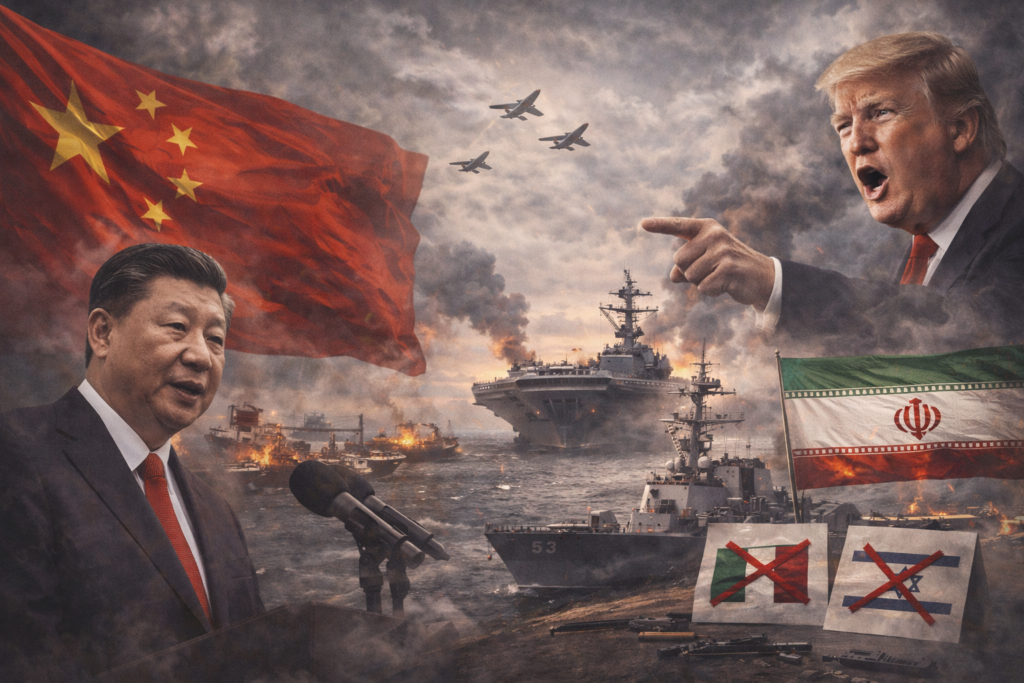
Image Credentials: Image Title: China Condemns U.S. Blockade of Iranian Ports as “Dangerous and Irresponsible” Source: (chatgpt.com) Date: April 2026. Attribution: This image was created using AI-generated imagery (chatgpt.com) and does not depict a real-world scene.
Open Chronicle | With Agencies
Beijing — China has sharply criticized the United States over its naval blockade of Iranian ports, describing the move as “dangerous and irresponsible” and warning it risks escalating tensions across the Middle East.
The remarks come after Donald Trump threatened to target vessels entering or leaving Iranian waters, following the collapse of recent talks between Washington and Tehran. The blockade, which took effect earlier this week, has already begun disrupting maritime traffic in one of the world’s most critical energy corridors.
Beijing Warns of Escalation Risks
China’s Foreign Ministry said the U.S. decision to increase military deployments and impose a targeted blockade could undermine a fragile ceasefire and jeopardize navigation through the Strait of Hormuz.
Officials in Beijing argued that such actions heighten instability at a time when diplomatic efforts are urgently needed. In parallel, Xi Jinping called for respect for sovereignty across the region, signaling China’s intention to position itself as a stabilizing force.
Iran Tightens Control of Strategic Waters
In response to the blockade, Iran has effectively restricted access to the Strait of Hormuz, allowing passage only to vessels from countries it considers friendly, including China. The move has intensified concerns over global oil supply disruptions and maritime security.
The Strait remains a vital artery for international energy flows, and any sustained restrictions are expected to reverberate across global markets.
Diplomatic Maneuvering in Beijing
China is hosting a series of high-level diplomatic meetings this week, bringing together leaders from countries affected by the Middle East crisis. Among them is Pedro Sánchez, who emphasized that China could play an “important role” in promoting peace in the region.
During talks in Beijing, Xi warned against a return to what he described as the “law of the jungle” in international relations, urging greater cooperation and mutual trust among nations.
Other officials, including Sergei Lavrov and Tô Lâm, are also in the Chinese capital for discussions aimed at strengthening coordination on both the conflict and broader geopolitical issues.
Trade Tensions Add to the Crisis
The situation is further complicated by rising trade tensions between Washington and Beijing. Trump has threatened to impose tariffs of up to 50 percent on Chinese goods if Beijing provides military support to Iran, allegations that China has firmly denied.
Chinese officials dismissed the claims as unfounded and warned of “resolute countermeasures” should new tariffs be introduced, raising the prospect of a renewed economic confrontation alongside the geopolitical crisis.
A Fragile Global Balance
The convergence of military escalation, energy disruption, and trade disputes highlights the growing complexity of the الأزمة. Analysts warn that miscalculations could have far-reaching consequences, not only for the Middle East but also for global economic stability.
As tensions mount, China’s positioning as a diplomatic actor underscores shifting dynamics in international relations, where major powers are increasingly competing not only militarily and economically, but also for influence in conflict resolution.