
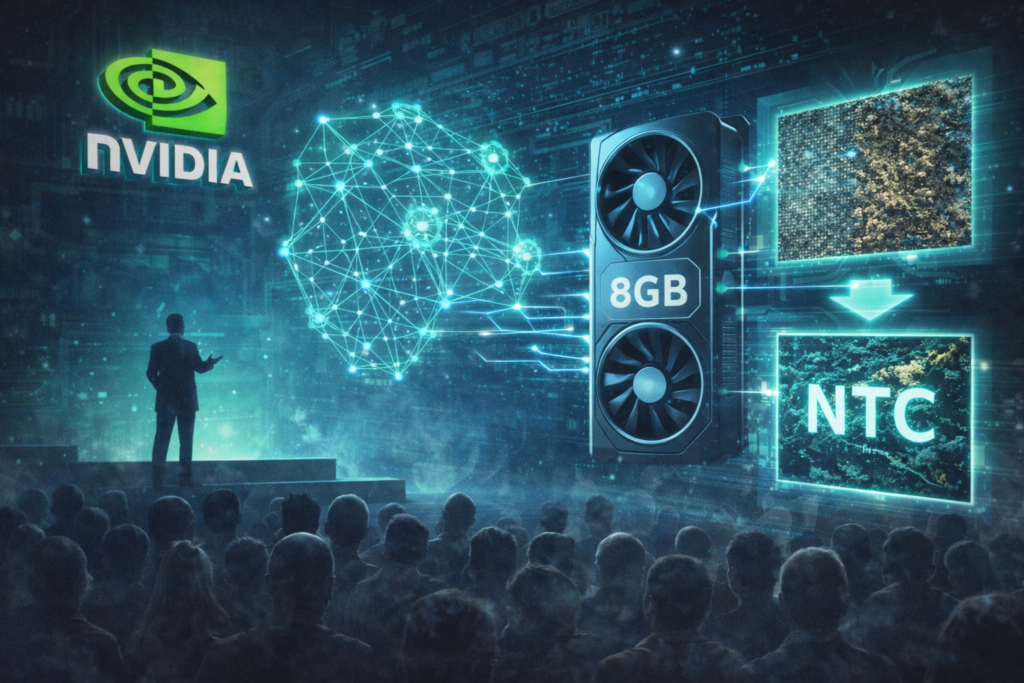
Image Credentials: Image Title: Nvidia Unveils Neural Texture Compression, A Potential Lifeline for 8GB GPUs Source: (chatgpt.com) Date: April 2026. Attribution: This image was created using AI-generated imagery (chatgpt.com) and does not depict a real-world scene.
Open Chronicle | Tech Desk
At its GTC 2026 conference, Nvidia introduced a new technology that could reshape the future of gaming graphics and hardware requirements. Known as Neural Texture Compression, or NTC, the approach leverages artificial intelligence to dramatically reduce how much video memory modern games require, potentially extending the relevance of 8GB GPUs long thought to be nearing obsolescence.
The Core Problem, Textures Dominate VRAM
For decades, textures have been the single largest consumer of GPU memory. Every surface in a modern video game, from character faces to environmental details, relies on high-resolution texture maps that are stored directly in VRAM.
As games have evolved toward 4K and even 8K assets, the size of these textures has surged. Even with established compression techniques like BCn and ASTC, large amounts of precomputed data must still reside in memory. The result is a growing mismatch between game demands and hardware limits, particularly for GPUs equipped with 8GB of VRAM.
Titles such as Hogwarts Legacy and Alan Wake 2 have already exposed these constraints, pushing many systems beyond their memory limits and triggering performance issues.
A Radical Shift, From Storage to Reconstruction
Rather than storing full texture files, NTC introduces a fundamentally different model. It replaces static image data with compact neural representations, essentially small AI models capable of reconstructing textures in real time.
Tensor Cores power this reconstruction process in RTX GPUs, allowing the system to generate high-quality textures dynamically rather than loading them into memory.
Early demonstrations suggest that this method could reduce VRAM usage by up to 80 percent in certain scenarios. That kind of efficiency gain would mark a transformative shift, enabling games to run smoothly on hardware that would otherwise struggle.
Beyond Memory, Smaller Games Too
The implications extend beyond runtime performance. Because neural representations are significantly smaller than traditional texture files, NTC could also reduce game installation sizes, an increasingly pressing issue as modern titles regularly exceed 100GB.
This dual benefit, lower memory usage and smaller storage footprints, represents a rare breakthrough in an industry where both metrics have steadily increased.
Not a Magic Fix for Existing Hardware
Despite the promise, NTC is not a universal solution for older GPUs. The technology operates in multiple modes, with the most effective, known as Inference on Sample, requiring high-end processing capabilities that older cards lack.
GPUs such as the RTX 20 and RTX 30 series may only support less advanced modes like Inference on Load, which improves efficiency during data transfer but does not significantly reduce VRAM usage.
In practical terms, this means that while future GPUs with 8GB or 10GB memory may remain viable, existing hardware will see limited benefits.
Adoption Will Take Time
NVIDIA has already released a beta version of NTC for developers, but widespread adoption will depend on integration into game development pipelines. Developers must train neural models for textures and redesign workflows around this new system, a process that will take time and resources.
As a result, real-world implementation is unlikely before late 2026 or 2027, with new titles being the most likely candidates to fully embrace the technology.
A Strategic Shift for the Industry
NTC also carries strategic implications for GPU design. If successful, it could justify continued production of lower VRAM configurations, even as consumer demand has pushed for higher memory capacities.
At the same time, it signals a broader shift toward AI-driven rendering techniques, where computation increasingly replaces storage as the defining factor in performance.
The Beginning of an AI-Driven Graphics Era
Neural Texture Compression represents more than just another optimization. It reflects a deeper transformation in how digital graphics are created and delivered.
If widely adopted, it could redefine expectations around hardware requirements, game sizes, and visual fidelity, marking a turning point where artificial intelligence becomes central not only to gameplay, but to the very fabric of virtual worlds.