
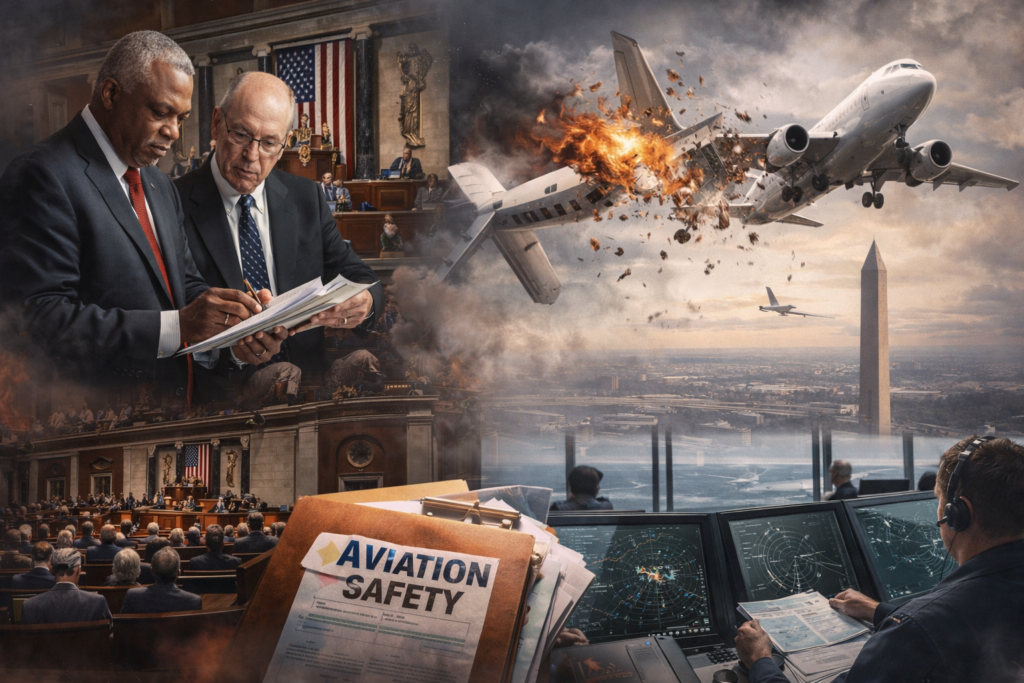
Image Credentials: Image Title: U.S. House Moves to Advance Aviation Safety Bill After Deadly Midair Crash Source: (chatgpt.com) Date: April 2026. Attribution: This image was created using AI-generated imagery (chatgpt.com) and does not depict a real-world scene.
Open Chronicle | With Agencies
Washington — Lawmakers in the United States House of Representatives are pushing forward new aviation safety legislation following a deadly midair collision near Washington, D.C., an incident that has reignited concerns over air traffic control systems and flight safety standards across the United States.
The proposed bill, which is expected to come to a vote in the House, seeks to strengthen oversight, modernize aging infrastructure, and improve coordination between aviation authorities in the wake of the crash that claimed multiple lives.
A Tragedy That Prompted Urgency
The midair collision, which occurred in congested airspace near the U.S. capital, has drawn intense scrutiny from regulators and lawmakers alike. Early investigations pointed to possible communication breakdowns and systemic gaps in air traffic management, prompting calls for immediate reform.
Officials have stressed that while aviation remains one of the safest modes of transportation, the incident exposed vulnerabilities that must be addressed to prevent future tragedies.
Legislative Push for Reform
The bill under consideration includes measures aimed at enhancing the capabilities of the Federal Aviation Administration, including increased funding for advanced radar systems, improved pilot communication protocols, and expanded training for air traffic controllers.
Lawmakers from both parties have signaled support for the legislation, framing it as a necessary step to restore public confidence and ensure that safety standards keep pace with rising air traffic volumes.
Provisions also focus on accelerating the deployment of next-generation technologies designed to improve aircraft tracking and reduce the risk of midair collisions, particularly in high-density corridors.
Industry and Expert Reactions
Aviation experts have welcomed the initiative, noting that the U.S. airspace system, while robust, faces growing pressure from increased commercial flights, private aviation, and emerging technologies such as drones.
Industry stakeholders have emphasized the importance of sustained investment and coordination between federal agencies, airlines, and technology providers to implement meaningful improvements.
Broader Implications for Air Safety
The legislative effort reflects a broader recognition that aviation safety requires constant adaptation. As air travel demand continues to grow, so too does the complexity of managing increasingly crowded skies.
The outcome of the House vote is expected to shape the direction of U.S. aviation policy in the coming years, potentially setting new benchmarks for safety and operational resilience.
Looking Ahead
If passed, the bill will move to the Senate for consideration, where further debate is expected. In the meantime, investigators continue to examine the circumstances surrounding the crash, with findings likely to inform future regulatory actions.
For families affected by the tragedy, the legislative push represents a step toward accountability and prevention, as the nation grapples with the consequences of a rare but devastating aviation accident.