
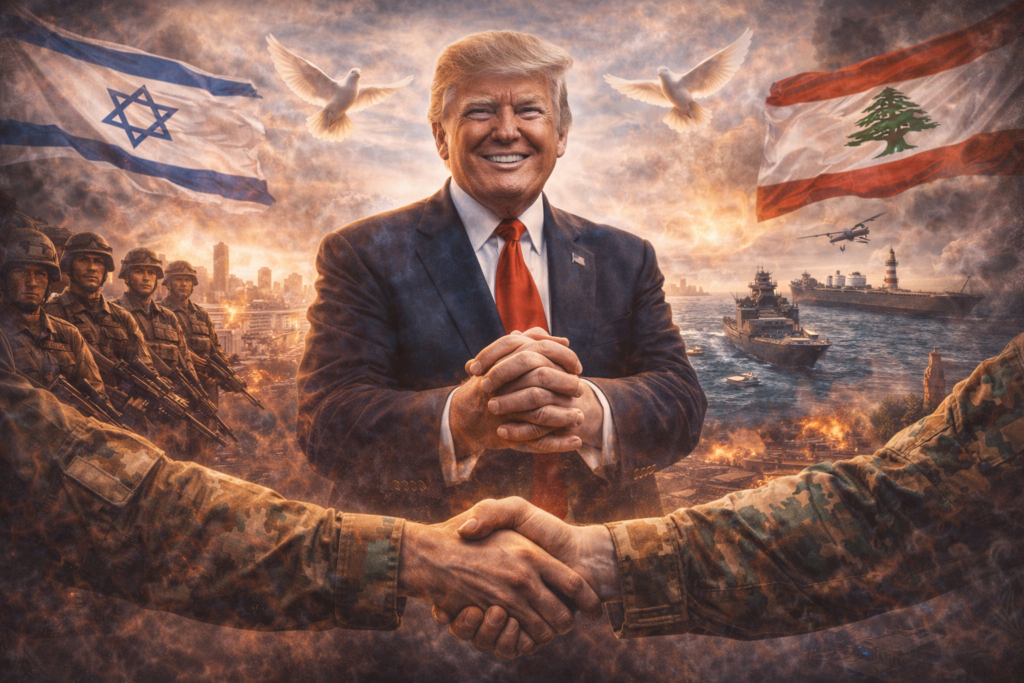
Image Credentials: Image Title: Donald Trump Announces Israel–Lebanon Ceasefire as Hormuz Crisis Keeps Pressure on Iran War Source: (chatgpt.com) Date: April 2026. Attribution: This image was created using AI-generated imagery (chatgpt.com) and does not depict a real-world scene.
Open Chronicle | With Agencies
Washington / Middle East — Donald Trump has announced that Israel and Lebanon have agreed to a 10-day ceasefire, offering a potential opening for de-escalation in a widening regional conflict, even as tensions surrounding Iran and the Strait of Hormuz continue to strain global stability.
The ceasefire, set to begin at 5 p.m. Eastern Time, follows direct conversations between Trump, Israeli Prime Minister Benjamin Netanyahu, and Lebanese President Joseph Aoun.
A Fragile Pause in a Broader Conflict
Trump described the agreement as a step toward achieving lasting peace between the two countries, which have been drawn into escalating violence linked to Israel’s military campaign against Hezbollah, an Iran-backed force operating in Lebanon.
The fighting has intensified in recent weeks, with Israeli operations causing significant casualties and displacement. Lebanese authorities report that more than one million people have been forced from their homes, while thousands have been killed during the campaign.
Despite the ceasefire announcement, questions remain about its durability, particularly given the broader regional dynamics tied to the Iran war.
U.S. Push for Diplomacy
Trump said he has directed Vice President JD Vance and Secretary of State Marco Rubio to work alongside military leadership to support negotiations and help translate the temporary ceasefire into a lasting settlement.
He also indicated that both Netanyahu and Aoun could be invited to the White House for further talks, signaling an effort to expand diplomatic engagement beyond the immediate ceasefire window.
Parallel efforts are underway through regional intermediaries. Pakistani officials are reportedly engaging with Tehran and other actors in an attempt to facilitate a new round of U.S.–Iran negotiations in the coming days.
Strait of Hormuz Remains a Critical Pressure Point
While the ceasefire may ease tensions in Lebanon, the broader conflict remains defined by the crisis in the Strait of Hormuz.
The vital shipping route remains effectively closed to most commercial traffic due to Iranian threats and the ongoing U.S. naval blockade of Iranian ports. The resulting tanker gridlock has driven up global oil and gas prices, intensifying economic pressure on all parties involved.
The closure of the strait, through which a significant portion of global energy supplies flows, has become one of the central leverage points in the conflict.
China Calls for Stability and Reopening
China has emphasized the urgency of restoring normal navigation through the Strait of Hormuz, reflecting its heavy reliance on energy imports from the region.
In a call with Iran’s foreign minister, Chinese Foreign Minister Wang Yi urged restraint and stressed that freedom of navigation is a priority for the international community.
At the same time, Beijing reiterated its position that Iran’s sovereignty must be respected, highlighting the delicate balance between economic interests and geopolitical alignment.
Economic Stakes and Global Impact
The prolonged disruption in the Strait of Hormuz continues to ripple through global markets. Rising energy prices are affecting production costs and economic forecasts worldwide, particularly for major importers such as China.
Although China has significant reserves and diversified energy sources, officials have warned that the conflict has created a “complex and volatile” environment that could impact global growth.
A Narrow Window for De-Escalation
The 10-day ceasefire between Israel and Lebanon offers a limited but significant opportunity to reduce immediate violence. However, the broader conflict involving Iran, maritime security, and global energy flows remains unresolved.
Whether this pause can be leveraged into a more comprehensive diplomatic breakthrough will depend on parallel negotiations and the willingness of all parties to move beyond military confrontation.
For now, the Middle East stands at a crossroads, with fragile diplomacy and strategic pressure unfolding simultaneously across multiple fronts.