
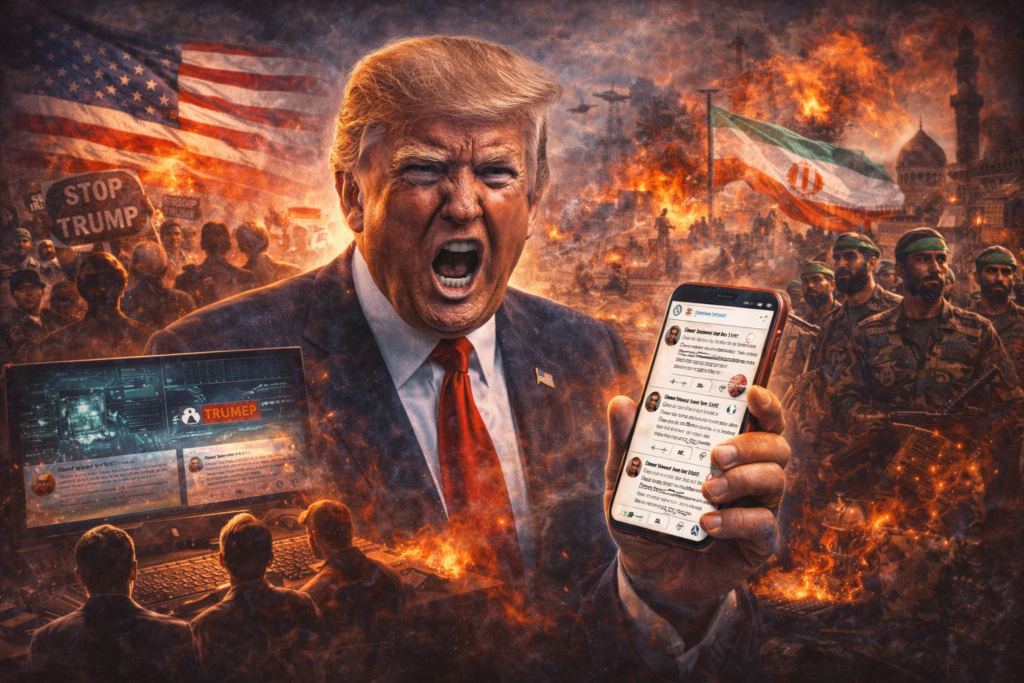
Image Credentials: Image Title: Concerns Mount Over Donald Trump’s Rhetoric Amid Iran War Escalation Source: (chatgpt.com) Date: April 2026. Attribution: This image was created using AI-generated imagery (chatgpt.com) and does not depict a real-world scene.
Washington — A series of increasingly aggressive and controversial public statements by Donald Trump has intensified debate in the United States over presidential conduct, leadership under pressure, and the broader implications for national and global stability.
The remarks, made largely through social media posts, have drawn criticism from political opponents, mental health professionals, and foreign policy analysts, particularly as they coincide with the ongoing war involving Iran.
Escalating Rhetoric Raises Alarm
In recent days, Trump has issued a series of highly charged messages directed at Iran, including explicit threats and inflammatory language. One post warning of catastrophic consequences for the country reignited concerns about the tone and substance of presidential communication during a time of conflict.
Critics argue that such rhetoric risks escalating tensions further, particularly in a volatile geopolitical environment where miscalculation could have far-reaching consequences.
Political Fallout and Constitutional Debate
The statements have prompted renewed calls from some lawmakers to consider invoking the Twenty-fifth Amendment to the United States Constitution, a mechanism that allows for the removal of a president deemed unfit to serve.
Figures including Jamie Raskin and Jasmine Crockett have publicly questioned Trump’s fitness for office, citing what they describe as troubling patterns in his recent behavior.
However, such measures remain politically and procedurally complex, requiring broad consensus within the executive branch.
Expert Analysis, Behavior Under Scrutiny
Mental health professionals and analysts have weighed in cautiously, emphasizing that public figures cannot be formally diagnosed without direct evaluation. Nonetheless, some experts suggest that the tone and content of the statements may reflect heightened stress, frustration, or strategic communication choices.
Dr. Geoff Grammer, a psychiatrist and former military officer, described the possibility that the rhetoric reflects a shift toward more unfiltered expression, potentially shaped by the pressures of leadership and surrounding influences.
Other specialists, including trauma therapist Shari Botwin, pointed to patterns of heightened emotional intensity and the use of provocative language as potential indicators of stress responses or attempts to project control.
Strategic Signaling or Escalation Risk?
Some foreign policy experts argue that Trump’s rhetoric could be interpreted as a negotiating tactic, sometimes referred to as the “madman theory”, where unpredictability is used to pressure adversaries.
However, others warn that such an approach carries significant risks, particularly in a conflict involving multiple global actors and sensitive military dynamics.
Paul Fritch noted that the language may also reflect frustration, as diplomatic pathways to de-escalation have narrowed.
Diplomatic Constraints and Military Pressure
Analysts point out that recent reductions in diplomatic capacity and the breakdown of negotiation channels have left fewer tools available for conflict resolution. This has increased reliance on military pressure and public messaging, both of which can amplify tensions.
The ongoing crisis has also highlighted the challenges of managing complex international conflicts without a robust diplomatic infrastructure.
White House Response
The White House has dismissed criticism, defending the president’s leadership and contrasting it with previous administrations. Officials argue that Trump’s approach reflects strength and decisiveness in the face of global threats.
A Moment of Heightened Uncertainty
As the conflict with Iran continues, the intersection of political rhetoric, military strategy, and global diplomacy remains highly sensitive.
Whether Trump’s statements represent a calculated strategy or a departure from conventional norms, their impact is already being felt across political, diplomatic, and public spheres.
For the United States and its allies, the stakes extend beyond domestic debate, shaping perceptions of leadership and influencing the trajectory of one of the most volatile crises in recent years.