
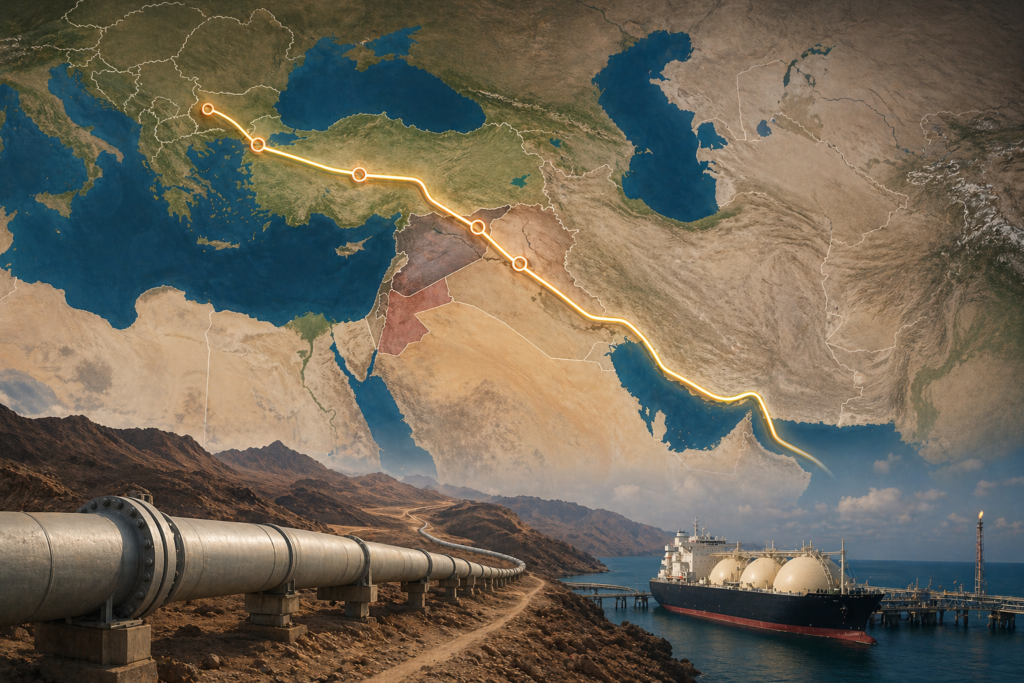
Image Credentials: Image Title: Qatar–Türkiye–Europe pipeline resurfaces as costly alternative to Strait of Hormuz route Source: (chatgpt.com) Date: April 2026. Attribution: This image was created using AI-generated imagery (chatgpt.com) and does not depict a real-world scene.
Open Chronicle | Energy & Geopolitics
A long-discussed plan to transport natural gas from Qatar to Europe via Türkiye is attracting attention as tensions in the Middle East continue to disrupt traditional energy routes. However, analysts warn that, while strategically appealing, it could prove prohibitively expensive and fraught with geopolitical risks.
The proposed Qatar–Türkiye–Europe gas pipeline, first introduced in 2000, would carry gas across Saudi Arabia, Jordan, Syria, and Türkiye before reaching European markets. The initiative was shelved in 2009, but shifting regional dynamics, particularly in Syria, have revived interest in the project as Europe looks to diversify supply routes.
Strategic appeal amid Hormuz uncertainty
The renewed focus on alternative energy corridors comes as instability surrounding the Strait of Hormuz continues to threaten global energy flows. The narrow waterway remains one of the world’s most critical transit points, with a significant portion of exports passing through it.
Europe currently relies on multiple sources for its gas needs, including Russia and shipments from Hormuz. According to estimates, around 40 million cubic meters of gas per day reach Europe through Hormuz-linked routes, while Russian supplies remain substantially higher.
The proposed pipeline could potentially deliver up to 100 million cubic meters daily, offering a land-based alternative less vulnerable to maritime disruption.
High costs and economic concerns
Despite its potential capacity, the financial implications of the pipeline remain a major obstacle. Experts suggest that gas transported on the new route could cost significantly more than existing supplies.
European countries currently pay roughly $5 per cubic meter for Russian gas, while gas shipped from Hormuz costs about $8. In contrast, projections indicate that gas delivered through the Qatar–Türkiye–Europe pipeline could exceed $12 per cubic meter, raising concerns about competitiveness and affordability.
In addition to higher energy prices, the construction costs are expected to surpass $20 billion, reflecting the scale and complexity of the approximately 4,000-kilometer.
Geopolitical risks remain significant
Beyond economic challenges, the pipeline would traverse several regions marked by political instability and ongoing conflict, particularly, which remains a critical chokepoint, where unresolved tensions could jeopardize both construction and long-term security.
These risks have led many analysts to question whether the project can realistically move forward without substantial political stabilization across the route.
Diplomatic engagement underway
Amid renewed discussions, Türkiye’s Energy Minister Alparslan Bayraktar is expected to visit Qatar in the coming days to explore the feasibility of the project and assess potential cooperation.
While the pipeline represents an ambitious attempt to reshape regional energy dynamics, its future will depend on whether economic and geopolitical hurdles can be overcome.
For now, it remains a concept caught between strategic necessity and practical uncertainty.