
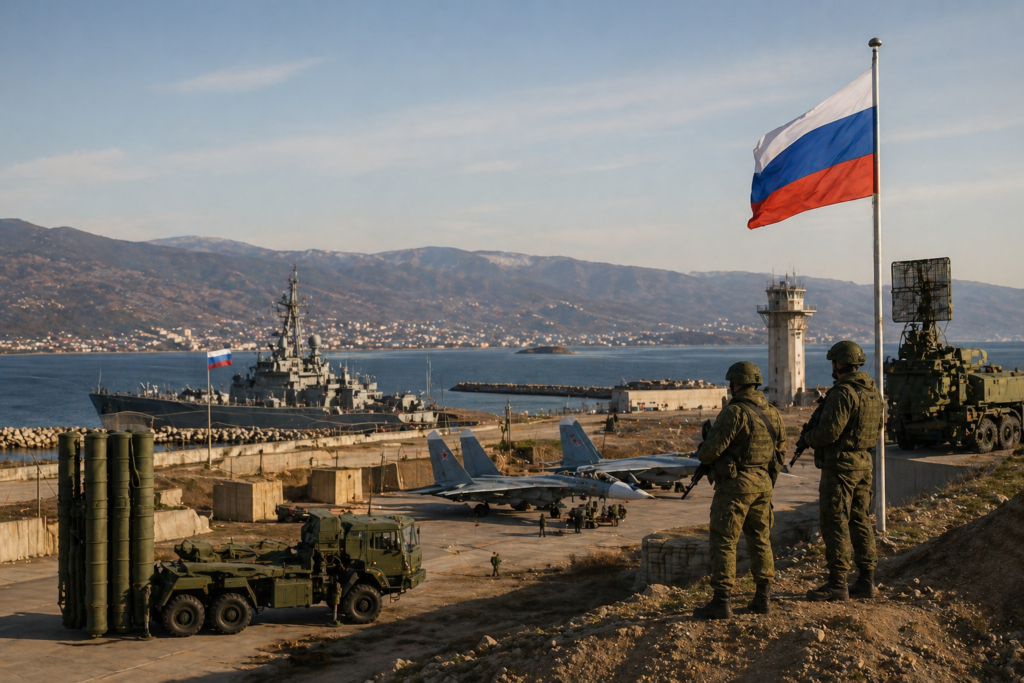
Image Credentials: Image Title: After US withdrawal from Syria, focus shifts to the future of Russian military bases Source: (chatgpt.com) Date: April 2026. Attribution: This image was created using AI-generated imagery (chatgpt.com) by Open Chronicle and does not depict a real-world scene.
Open Chronicle | Middle East Security
The withdrawal of U.S. forces from Syria is reshaping the strategic landscape of a conflict that has endured for more than a decade, raising pressing questions about the long-term future of foreign military presence in the country, particularly that of Russia.
Washington’s exit marks the end of a mission that began in 2014, when the United States entered Syria to combat ISIS through airstrikes and limited ground support in partnership with local forces such as the Syrian Democratic Forces. While the campaign succeeded in dismantling the group’s territorial control, ISIS remains active through scattered insurgent cells.
Analysts view the U.S. withdrawal as part of a broader recalibration of American foreign policy under Donald Trump, prioritizing reduced military commitments abroad in favor of less direct and more flexible forms of engagement.
This shift has intensified scrutiny over the broader model of foreign military bases in Syria, especially as the country navigates a new phase following major political changes in 2024.
Attention is now turning to Russia, which remains the most significant external military actor in Syria. Moscow intervened in 2015 at the request of the government led by Bashar al-Assad, playing a decisive role in shifting the balance of power through air campaigns and strategic support.
Unlike the U.S., Russia’s presence has been anchored in a network of key military installations, particularly along the Syrian coast. The Khmeimim Air Base has served as the hub of Russian air operations, while the Tartus naval base provides Moscow with its only permanent naval foothold in the Mediterranean.
In recent months, however, signs have emerged that Russia is adjusting its posture. Rather than maintaining a widespread inland presence, Moscow appears to be consolidating its forces around these strategic coastal assets.
Experts suggest this reflects a pragmatic recalibration. By reducing deployments in less critical areas such as Aleppo and Deir ez-Zor, Russia can lower operational costs while preserving its core strategic interests, particularly access to the Mediterranean and regional influence.
“The coastal bases will remain a red line because they are Moscow’s gateway,” said analyst Muhammad Hamza, pointing to a shift toward a more concentrated and sustainable military footprint.
This repositioning comes at a time when Russia faces mounting pressures elsewhere, notably the ongoing war in Ukraine, which continues to stretch its military and economic resources.
At the same time, the internal dynamics within Syria are evolving. The question of foreign military presence has become increasingly sensitive, tied closely to issues of sovereignty and post-war reconstruction. Syrian officials are expected to approach the matter cautiously, potentially using the future of foreign bases as leverage in negotiations for economic or political support.
Legal experts note that existing agreements governing Russia’s presence are not fixed and could be renegotiated depending on political developments. This opens the door to multiple scenarios, ranging from partial reductions to a complete withdrawal over time.
Regionally, other actors, including Turkey, are closely monitoring the situation, given the direct security implications. Meanwhile, Western governments continue to assess how best to counterbalance Russian influence in the Middle East.
Ultimately, the U.S. departure does not necessarily signal a broader exodus of foreign forces from Syria. Instead, it highlights a transition toward more flexible, cost-conscious military strategies. For Russia, the likely path forward appears to be a leaner presence focused on strategic strongholds rather than expansive deployments.
As Syria enters a new phase, the future of foreign military bases will remain a key factor shaping both its internal stability and its role in the wider regional balance.
The Grand Strategy Institute
Continue Exploring Strategic Analysis
Return to The Grand Strategy Institute for strategic assessments, long-form analysis and research examining geopolitics, military affairs, international security, emerging technologies and the changing international order.
← Back to The Grand Strategy Institute