
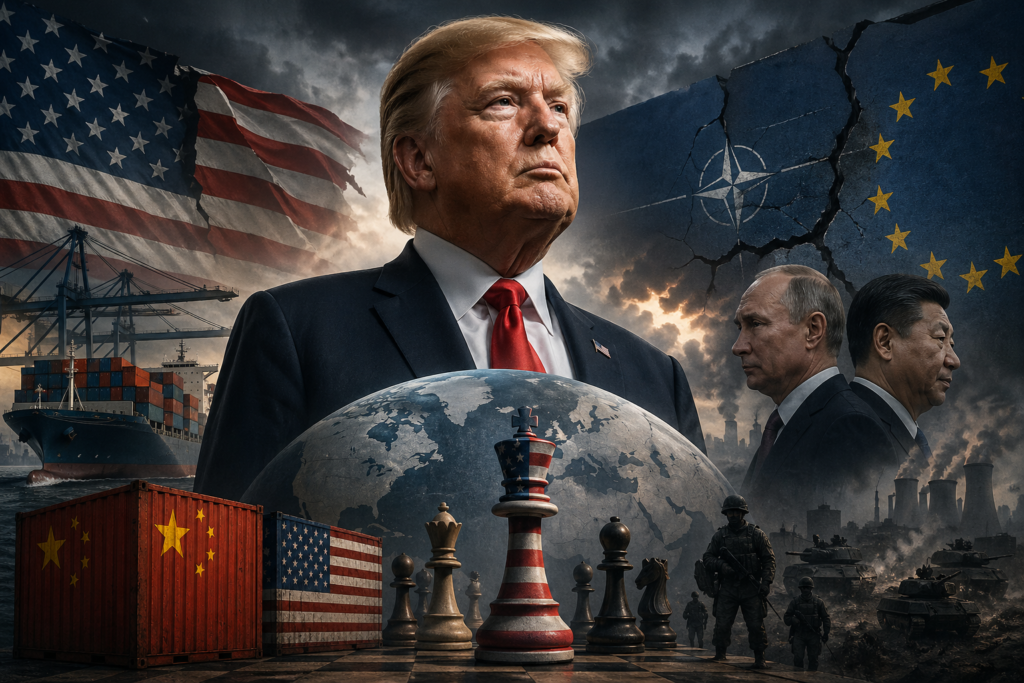
Image Credentials: Image Title: Trump’s Worldview Isn’t an Aberration. It’s a System Source: (chatgpt.com) Date: April 2026. Attribution: This image was created using AI-generated imagery (chatgpt.com) by Open Chronicle and does not depict a real-world scene.
By design, not impulse, Donald Trump’s approach to economics and global power is reshaping how America sees the world, and how the world responds in return.
By Elliot Hayes | The Grand Strategy Institute
For years, critics of Donald Trump have framed his foreign policy as chaotic, impulsive, and even incoherent. That reading misses the deeper structure.
Trump does have a worldview. It is simply not one built on the postwar assumptions that governed U.S. strategy for decades.
Instead, it rests on three interlocking ideas: that global economics is a rigged competition, that alliances are liabilities unless constantly renegotiated, and that power is best exercised through leverage, not leadership.
This is not a break from ideology. It is an alternative one.
Trump’s economic instincts are rooted in a blunt premise: countries don’t trade, they compete. And in that competition, he believes the United States has been losing.
That belief drove his confrontation with China, transforming what had been a managed rivalry into open economic conflict. Tariffs were not a side tactic; they were the strategy. Hundreds of billions of dollars in goods were targeted, not just to punish Beijing, but to force structural change.
He pulled the United States out of the Trans-Pacific Partnership on his first week in office, rejecting a deal designed to bind Asian economies closer to Washington and limit China’s influence. His reasoning was consistent: Multilateral trade frameworks dilute American control.
Even the renegotiation of the North American Free Trade Agreement into the United States-Mexico-Canada Agreement followed the same logic. The goal was not integration; it was correction, forcing supply chains back toward U.S. territory.
Economists argued over the results. Politically, the message landed: America would no longer accept the terms of globalization as given.
Nowhere is Trump’s worldview more disruptive than in his treatment of alliances.
For decades, Washington treated partnerships like the North Atlantic Treaty Organization as force multipliers, tools that extended U.S. power and stabilized key regions.
Trump saw something else. A cost center.
He repeatedly pressed NATO members to increase defense spending, publicly questioning whether the United States should defend countries that “don’t pay their bills.” Behind closed doors, he went further, reportedly floating withdrawal from the alliance entirely.
This was not rhetorical excess. It reflected a core belief that security guarantees should be conditional, not automatic.
That shift alone, even without formal withdrawal, injected uncertainty into the alliance’s foundation.
Trump’s skepticism extended across the Atlantic. The European Union, long seen in Washington as a partner in liberal order-building, became, in his framing, an economic rival.
He supported Brexit. He criticized EU trade practices. He framed European integration not as a stabilizing force, but as a structure designed, in part, to constrain American advantage.
That view marked a quiet but significant break from decades of U.S. policy, which had encouraged European unity as a pillar of global stability.
Trump’s rejection of multilateralism was not selective; it was systemic.
He withdrew from the Paris Agreement, arguing it imposed unfair burdens on American industry. He crippled the dispute system of the World Trade Organization, accusing it of enabling economic abuses.
Each move followed the same logic: if a global institution limits U.S. flexibility, it is a bad deal.
The cumulative effect was profound. The United States shifted from system manager to system skeptic.
Trump’s worldview also reshaped how Washington related to other major powers.
His hardline stance on China coexisted with an unusually conciliatory tone toward Vladimir Putin. While sanctions on Russia remained in place, Trump’s rhetoric often emphasized respect over rivalry.
This duality puzzled traditional strategists. But within Trump’s framework, it fits. Personal relationships matter. Power respects power. Ideology matters less than perceived strength.
In the short term, Trump’s approach delivered visible shifts.
Trade partners recalibrated. NATO allies increased defense spending. China entered negotiations under pressure.
But the longer-term picture is more complicated.
Alliances, once seen as fixed assets, became conditional. U.S. reliability, a cornerstone of its global influence, came into question. The country gained leverage, but risked losing trust.
That trade-off may define the legacy of Trump’s doctrine.
The broader impact extends far beyond Washington.
If the United States treats global politics as transactional, others will follow. Institutions weaken. Regional powers assert themselves. Cooperation becomes episodic rather than structural.
The result is not necessarily chaos. It is something more subtle, and potentially more dangerous: a world where stability depends less on shared rules and more on shifting bargains.
Trump didn’t just disrupt the system. He offered an alternative to it.
A world of sovereign deals instead of shared frameworks. Of leverage instead of leadership. Of competition as the default setting of international life.
The question now is not whether that vision exists. It does.
The question is whether the United States, and the world it shaped, can function under its terms.
The Grand Strategy Institute
Continue Exploring Strategic Analysis
Return to The Grand Strategy Institute for strategic assessments, long-form analysis and research examining geopolitics, military affairs, international security, emerging technologies and the changing international order.
← Back to The Grand Strategy Institute