
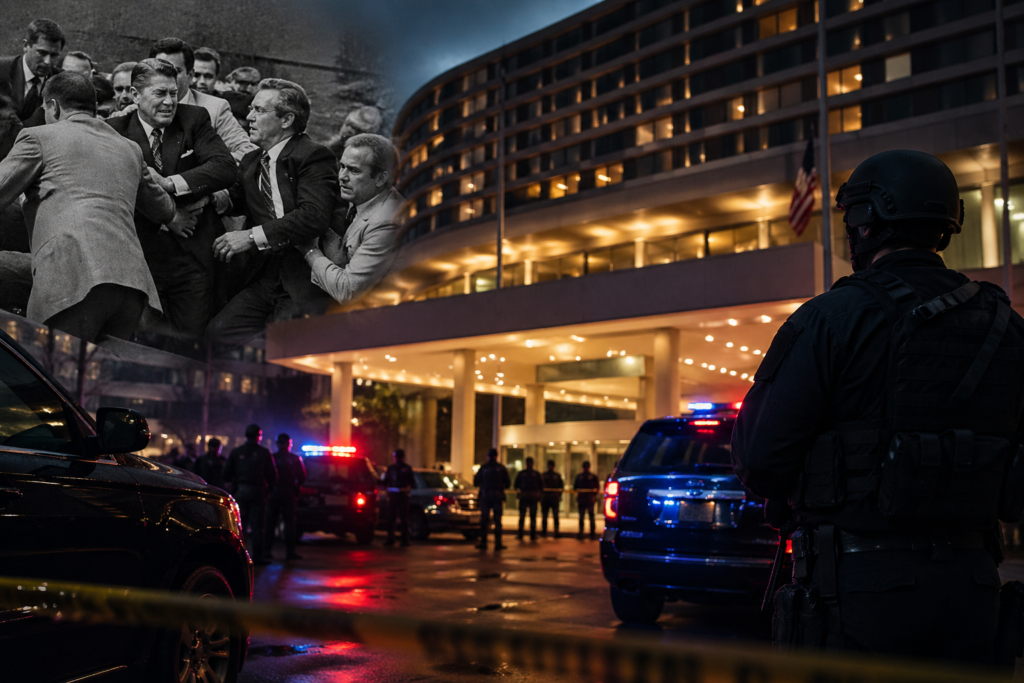
Image Credentials: Image Title: Gunfire at Washington Hilton Rekindles Echoes of Reagan-Era Assassination Attempt Source: (chatgpt.com) Date: April 2026. Attribution: This image was created using AI-generated imagery (chatgpt.com) by Open Chronicle and does not depict a real-world scene.
By Open Chronicle
A shooting incident at the Washington Hilton Hotel during the White House Correspondents’ Dinner has revived a powerful historical parallel in American political memory, drawing comparisons to the 1981 assassination attempt against former U.S. President Ronald Reagan.
On Saturday evening, the hotel, long associated with major political gatherings in the U.S. capital, once again became the focal point of national attention after gunfire erupted during the annual event attended by President Donald Trump and senior government officials. The incident triggered an immediate security response, with Secret Service agents swiftly evacuating the president, the first lady, and other high-ranking figures from the premises.
Tonight’s White House Correspondents Dinner shooting occurred at the Washington Hilton, site of the March 1981 assassination attempt on President Ronald Reagan by John Hinckley Jr. pic.twitter.com/8Ip2HE1gD6
— Dovi Safier (@safier) April 26, 2026
Authorities later confirmed that a suspect, reportedly armed with multiple weapons, attempted to breach a security checkpoint inside the hotel. Law enforcement intervened before the situation could escalate further. One officer was injured during the confrontation and taken to the hospital, though officials indicated the injuries were not life-threatening. The suspect was apprehended and transported for medical evaluation, with investigations ongoing into his motives.
The choice of location has added a layer of significance to the event. The Washington Hilton is etched into U.S. history as the site of the March 30, 1981, assassination attempt on President Reagan. As Reagan exited the hotel after delivering a speech, he was shot by John Hinckley Jr., an attack that left the president seriously wounded and sent shockwaves across the nation. Reagan’s survival and recovery later became emblematic of resilience in American political life.
More than four decades later, the recurrence of gunfire linked to a sitting Republican president at the same venue has prompted reflection among political observers and the public alike. While there is no indication of a direct connection between the two incidents beyond geography and coincidence, the symbolic resonance is unmistakable.
Security at the White House Correspondents’ Dinner is typically among the most stringent for any civilian event in Washington, given the concentration of political leadership, journalists, and public figures. The fact that an armed individual was able to approach a checkpoint has raised questions about evolving threat environments and the challenges faced by protective services in an era of increasingly unpredictable lone-actor violence.
Officials have emphasized that, based on current evidence, the suspect appears to have acted alone. No broader conspiracy or network has been identified. Nonetheless, the breach attempt underscores the persistent risks associated with high-visibility political events, even those held in controlled and heavily guarded settings.
The White House Correspondents’ Dinner, traditionally a blend of political satire and media engagement, has now been overshadowed by security concerns. The event has been postponed, with organizers indicating it will be rescheduled at a later date.
Beyond the immediate investigation, the incident has reignited debate over security preparedness, political symbolism, and the enduring vulnerability of public institutions. The Washington Hilton, already a site of historic violence, now carries an added chapter, one that once again connects it to the fragile intersection of politics and security in the United States.