
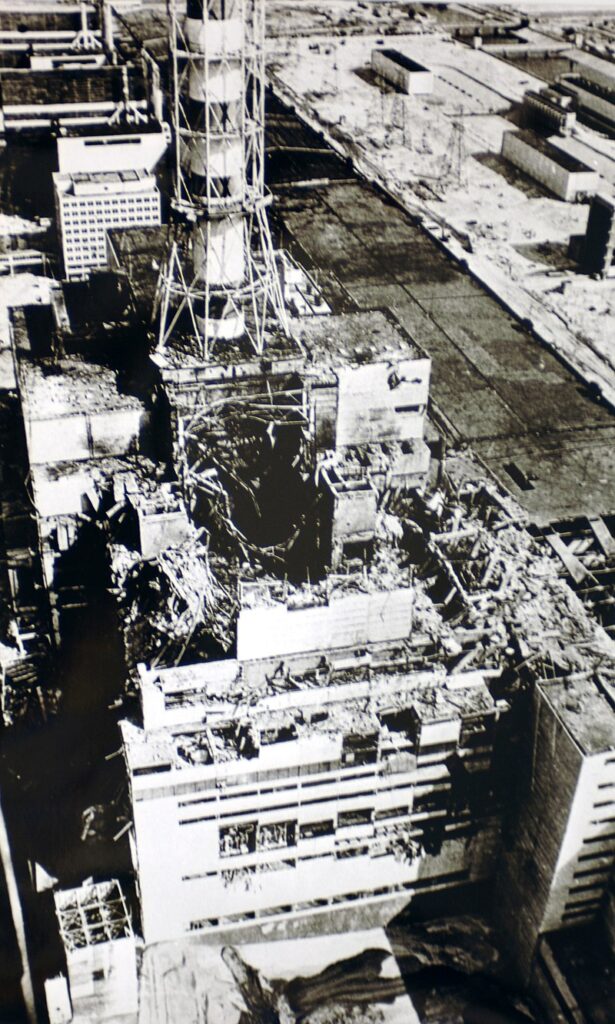
Image: from Today In Socialism X @2dayinsocialism
By Open Chronicle with Agencies
Nearly forty years after the Chernobyl disaster, the legacy of the world’s worst civilian nuclear accident continues to shape global debates, now intensified by the realities of modern conflict.
On April 26, 1986, a catastrophic explosion at Reactor No. 4 of the Soviet-era plant in northern Ukraine released vast amounts of radioactive material into the atmosphere. The disaster, triggered by a failed safety test and compounded by design flaws and human error, forced a global reckoning on nuclear safety standards. According to the International Atomic Energy Agency, it remains a defining moment in the history of nuclear energy.
Forty years to the day since the world's worst civilian nuclear disaster, Chernobyl is once again a site of crisis. In the early hours of April 26, 1986, operators conducting a low-power safety test on Reactor 4 lost control of the flawed RBMK-1000 design, triggering two… pic.twitter.com/kTpiwjNKmO
— Geo Political Guy (@GeoPoliticalGuy) April 26, 2026
Radiation spread across much of Europe, with detection as far away as Sweden, exposing the scale of the catastrophe. The heaviest contamination fell on Ukraine, Belarus, and parts of Russia. In the immediate aftermath, hundreds of thousands of workers, including engineers, soldiers, and emergency responders, were mobilized in an unprecedented containment effort.
The long-term human cost remains a subject of debate. United Nations–linked estimates suggest around 4,000 deaths among the most exposed populations, while other studies argue the toll could be significantly higher, reflecting ongoing scientific uncertainty about the effects of radiation exposure.
The region surrounding the plant, known as the exclusion zone, remains largely uninhabitable. The nearby city of Pripyat, once home to thousands, stands abandoned as a stark reminder of the disaster. Yet, in the absence of human activity, wildlife has flourished. Species such as the Przewalski’s horse have been reintroduced, and ecosystems have evolved in unexpected ways.
In recent years, however, Chernobyl has re-entered global focus not just as a historical site, but as a contemporary security concern. During the early stages of the war in Ukraine in 2022, Russian forces seized control of the facility, raising alarm among international observers. Experts warned that military activity in the area could disturb radioactive soil, particularly in the highly contaminated Red Forest, or damage critical monitoring systems.
Concerns deepened following reports of damage to the New Safe Confinement structure, the massive steel shield built to contain the destroyed reactor. A drone-related incident in 2025 further highlighted the vulnerability of nuclear infrastructure in conflict zones.
Speaking during anniversary commemorations in Kyiv, Rafael Grossi stressed the urgency of maintaining and repairing protective systems, warning that delays could pose serious risks.
Chernobyl’s lessons now extend far beyond Ukraine. As geopolitical tensions rise and conflicts increasingly intersect with strategic infrastructure, the risks associated with nuclear facilities are once again under scrutiny. The disaster demonstrated that safety depends not only on engineering and technology, but also on political stability, transparency, and international cooperation.
Today, Chernobyl stands as both a symbol of past failure and a warning for the future. In an era where war can reach even the most sensitive sites, the question is no longer just how to build safer reactors, but how to protect them in an increasingly unstable world.