
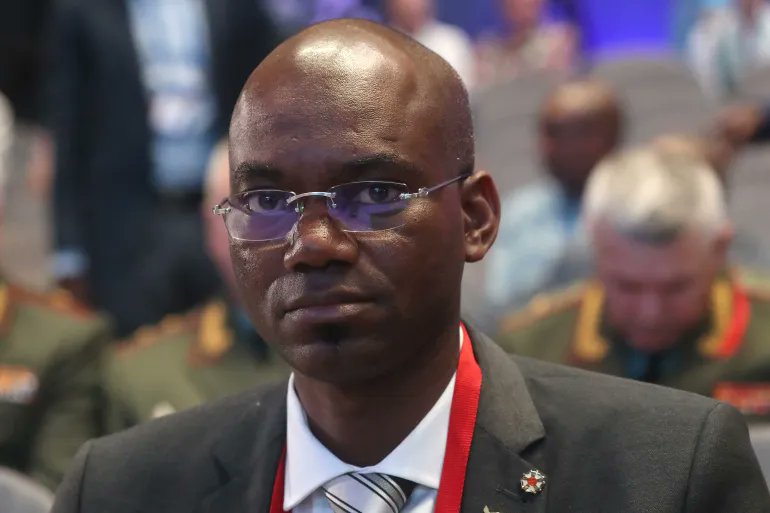
Image: from Rifnote ng X @rifnoteng
By Open Chronicle with Agencies
Mali has been shaken by a surge of coordinated attacks that culminated in the death of Defence Minister Sadio Camara, highlighting the deepening security crisis facing the country.
Camara was killed in what authorities described as a suicide truck bombing targeting his residence in Kati, a key military town near the capital Bamako. According to a government statement delivered by spokesman Issa Ousmane Coulibaly, the attack involved a vehicle packed with explosives driven directly into the minister’s compound.
Despite reportedly engaging the attackers and neutralising some of them, Camara sustained critical injuries and later died in hospital. The blast caused extensive destruction, collapsing his residence and damaging a nearby mosque, where several worshippers were also killed. Reports indicate that members of Camara’s family were among the dead.
The assassination forms part of what analysts describe as one of the most significant waves of violence in Mali in recent years. Fighting was reported across multiple regions, including Kati, Gao, Kidal, Mopti, and Sévaré, suggesting a highly coordinated offensive by both jihadist groups and separatist forces.
Militants linked to Jama’at Nusrat al-Islam wal-Muslimin are believed to have carried out simultaneous attacks nationwide, while the Azawad Liberation Front focused its operations in the north, where it seeks to establish an independent state.
The scale of the violence prompted urgent security measures. Mali’s military government, led by Assimi Goïta, has increased patrols, reinforced checkpoints, and imposed curfews in affected areas, including Bamako.
In the northern city of Kidal, clashes between separatist forces and government troops intensified. The Azawad Liberation Front claimed it had reached an agreement with Russian mercenaries, often referred to as the Africa Corps, to facilitate their withdrawal from the area after days of fighting. The group later declared that Kidal was under its control, though these claims have not been independently verified by Malian authorities.
The involvement of foreign fighters reflects the evolving dynamics of Mali’s conflict. Following the withdrawal of French forces and United Nations peacekeepers, the Malian government turned to Russian mercenaries to bolster its campaign against insurgent groups. However, despite these efforts, large parts of the country remain beyond state control.
Security experts warn that the latest attacks signal a dangerous escalation. Ulf Laessing of the Konrad Adenauer Foundation described the violence as possibly the largest coordinated jihadist assault Mali has experienced in years.
International reactions have been swift. António Guterres condemned the attacks and expressed solidarity with the Malian people, while regional bloc ECOWAS and the African Union also voiced concern over the deteriorating situation.
Mali has faced persistent instability for more than a decade, driven by a complex mix of jihadist insurgency, ethnic separatism, and political upheaval. The current military leadership, which came to power in a 2020 coup, had pledged to restore order, but the resurgence of large-scale violence underscores the ongoing challenges.
As the country mourns the loss of a senior military figure, the broader question remains unresolved: whether Mali’s current strategy can contain a conflict that continues to expand in both scale and intensity.