
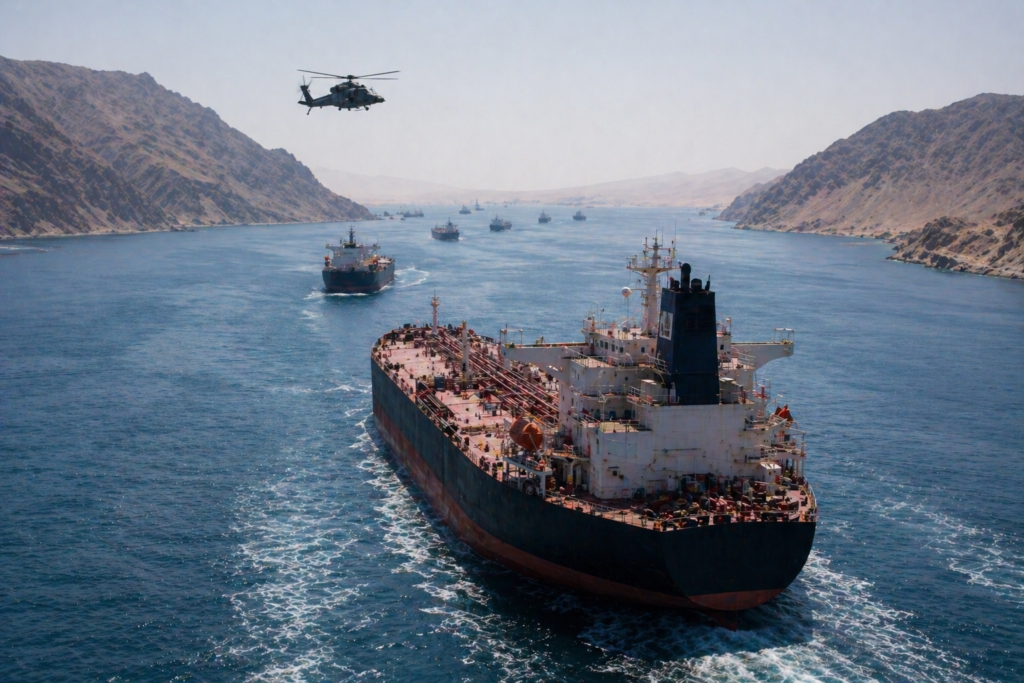
Image Credentials: Image Title: IMO Calls for De-escalation Before Evacuation Corridor in Strait of Hormuz Source: (chatgpt.com) Date: April 2026. Attribution: This image was created using AI-generated imagery (chatgpt.com) by Open Chronicle and does not depict a real-world scene.
By Open Chronicle with Agencies
The International Maritime Organization has warned that no evacuation corridor can be established in the Strait of Hormuz without a sustained de-escalation of hostilities and guarantees that key shipping routes are free of mines.
Speaking in London during a session of the Marine Environment Protection Committee, Secretary-General Arsenio Dominguez stressed that safety conditions must be met before any operation can begin. He said it would be impossible to implement evacuation plans while the situation remains unstable and potentially hazardous for vessels.
According to the agency, around 20,000 crew members aboard approximately 1,600 ships are currently stranded in the Persian Gulf and the Strait of Hormuz. Since the start of the conflict involving Iran, at least 29 attacks on vessels have been recorded, highlighting the risks faced by maritime traffic in one of the world’s most critical shipping corridors.
Dominguez emphasized that a prolonged reduction in hostilities is essential, along with international cooperation to ensure navigation channels are cleared and secure. Without these conditions, he warned, any attempt to organize safe passage would be unfeasible.
The IMO also firmly rejected the idea of allowing transit through the strait in exchange for fees or tolls, an approach reportedly advocated by Tehran. Dominguez reiterated that freedom of navigation is a fundamental principle of international law and cannot be subject to negotiation or financial conditions.
Citing conventions such as SOLAS, the International Convention for the Safety of Life at Sea, he underlined that no country has the legal authority to obstruct or control passage through an international strait. The only viable solution, he said, is a return to normal maritime operations without restrictions or additional charges.
The Secretary-General confirmed that the organization remains in contact with all countries in the region, including Iran, in an effort to promote dialogue and reinforce adherence to international maritime law.
As the conflict continues to disrupt global energy flows and trade routes, the situation in the Strait of Hormuz remains a focal point of concern for the international community, with safety, legality, and stability all hanging in the balance.