
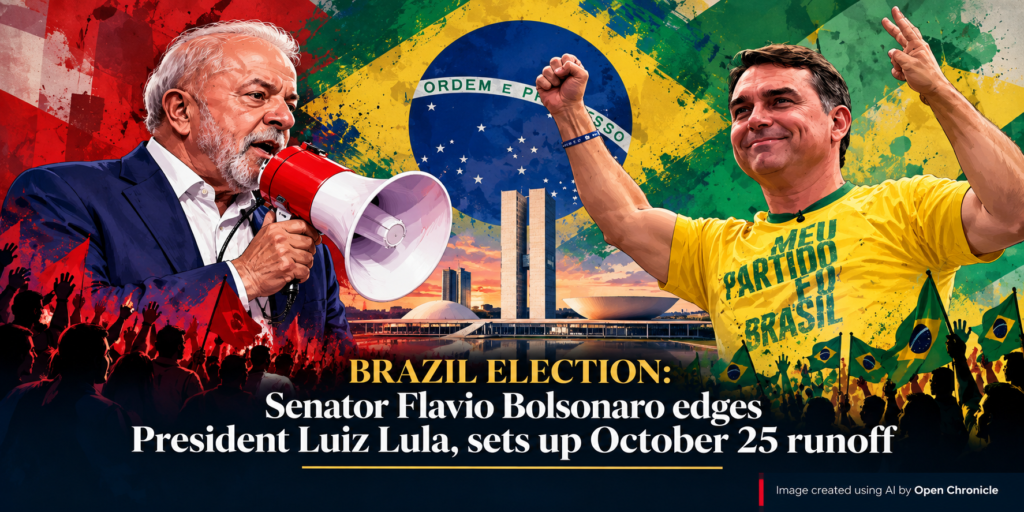
Senator Flávio Bolsonaro finished narrowly ahead of President Luiz Inácio Lula da Silva in Brazil’s first round presidential vote, setting up an October 25 runoff after a campaign dominated by the cost of living, corruption, public security and concerns about the country’s economic outlook.
By Open Chronicle with agencies
Brazil’s presidential election is heading to a second round after Senator Flávio Bolsonaro narrowly outpolled President Luiz Inácio Lula da Silva in a first round result that exceeded expectations for the right wing challenger.
With nearly all votes counted, Bolsonaro received about 47 percent of the vote, compared with 45 percent for Lula. Neither candidate secured the majority required to win outright, sending the contest to a decisive runoff on October 25.
The result was stronger than expected for Bolsonaro. Private surveys before the election had generally suggested that Lula would finish the first round about three percentage points ahead.
Instead, the senator enters the final stage of the campaign with a narrow advantage and fresh momentum.
Bolsonaro Celebrates Stronger Than Expected Result
“Brazil wants change and I am very happy with the results,” Bolsonaro told reporters in Brasília after nearly all ballots had been counted.
He portrayed the result as evidence of growing public opposition to Lula’s Workers’ Party and said it could mark the beginning of the end of the party’s political era.
Bolsonaro is the son of former President Jair Bolsonaro, who is serving a 27 year prison sentence for plotting a coup following his defeat in the 2022 presidential election.
Flávio Bolsonaro’s performance places him within reach of the presidency and confirms that the political movement associated with his father remains a major force in Brazilian politics.
Lula Promises a New Campaign
Lula acknowledged that the result had fallen short of his expectations.
Speaking to supporters at a hotel in São Paulo, the president said he had believed he could secure victory in the first round.
“Starting tomorrow, we begin a new campaign,” Lula said.
He promised to use the runoff campaign to emphasize his government’s record and convince voters to give him another term.
The president now faces the challenge of expanding his coalition while responding to voter dissatisfaction over living costs, household debt, crime and the country’s broader economic performance.
A Campaign Dominated by Everyday Concerns
The election has centered heavily on issues affecting Brazilians in their daily lives.
The cost of living, corruption and insecurity emerged as major concerns during the campaign, while Brazil’s fiscal position and slowing economic growth added another layer to the contest.
Despite falling unemployment and inequality, Lula has struggled to persuade some voters who continue to face high prices, substantial household debt and concerns about crime and gang activity.
Bolsonaro sought to capitalize on those frustrations.
As the race tightened, Lula moved to ban online gambling, expanded welfare measures and proposed additional debt relief for Brazilian families.
Yet detailed policy debate remained limited, with both leading candidates staying away from the major television debates.
A Significant Protest Vote
Bolsonaro’s first round performance appears to have benefited from voters who initially supported other candidates but ultimately decided that defeating Lula was their priority.
Before voting on Sunday, Bolsonaro said he was counting on a protest vote from people who might otherwise have supported another candidate but opposed the incumbent.
That dynamic was reflected in accounts from voters.
Some Brazilians who had considered supporting other candidates ultimately moved towards Bolsonaro as the election approached.
Political analyst Rafael Favetti suggested that this could also create a challenge for Bolsonaro in the second round because some of the additional support he might otherwise have gained during the runoff may already have shifted towards him in the first round.
“The protest vote foreshadows what is to come in the runoff,” Favetti said.
Polls Underestimated Bolsonaro
The result also raises questions about pre election polling.
“The pollsters missed badly,” said Robert Muggah, cofounder of the Igarapé Institute.
He suggested that surveys showing a close second round contest could again underestimate Bolsonaro’s support.
The unexpected first round result will increase scrutiny of polling as Brazil moves towards the October 25 vote.
Both campaigns now have to determine where additional votes can be found among supporters of eliminated candidates and those who did not participate in the first round.
Economy Looms Over the Runoff
Brazil’s economic outlook is likely to remain one of the defining issues of the second round.
Public debt has risen above 82 percent of gross domestic product, contributing to concerns about government finances and the spending decisions facing the country’s next administration.
The government has also reduced its economic growth forecasts to 2.0 percent for this year and 2.3 percent for next year.
Bolsonaro has positioned himself as a more business friendly alternative, and expectations surrounding his candidacy have already influenced sentiment towards Brazilian financial markets.
Lula, meanwhile, will seek to emphasize falling unemployment and inequality while defending the social policies of his administration.
The central question will be whether those achievements can outweigh voter concerns about prices, debt, economic growth and security.
Banco Master Scandal Hangs Over Political Establishment
Corruption allegations also overshadowed the campaign.
The collapse of Banco Master became a major political controversy after Daniel Vorcaro, who ran the bank, was arrested earlier this year and accused of involvement in a multibillion dollar fraud scheme.
Vorcaro denies the allegations.
A federal police investigation has examined his relationships with figures across Brazil’s political establishment.
Flávio Bolsonaro is being investigated for suspected money laundering that police have linked to the case. He denies wrongdoing.
The investigation remains unresolved as the senator enters the second round.
Trump Relationship Draws Attention
Brazil’s election has also attracted attention because of Bolsonaro’s relationship with US President Donald Trump.
The Brazilian contest follows a series of electoral victories for right wing political forces across Latin America, some of them ideologically aligned with Trump.
Trump has not formally endorsed either Brazilian presidential candidate.
However, he has hosted Flávio Bolsonaro at the White House and publicly praised him.
Lula’s allies have expressed concerns about possible foreign interference and have suggested that the Trump administration could challenge the legitimacy of the result if Lula wins.
Those concerns intensified following an aborted attempt to send US officials to Brazil ahead of the election.
No evidence presented in the supplied information establishes that Washington intends to reject the eventual result.
Brazil Prepares for October 25 Showdown
The first round has transformed what had been expected to be a Lula led contest into an exceptionally close race.
Bolsonaro enters the runoff with 47 percent of the first round vote and the psychological advantage of having exceeded expectations.
Lula remains close behind at 45 percent and will now attempt to rebuild momentum by presenting the second round as a new campaign.
Both candidates must also compete for voters who supported eliminated candidates in the first round.
For Brazil, the next three weeks will decide not only who occupies the presidency, but which political direction the country chooses at a moment of economic pressure, public concern over security and continuing polarization.
On October 25, Brazilian voters will make that choice.