
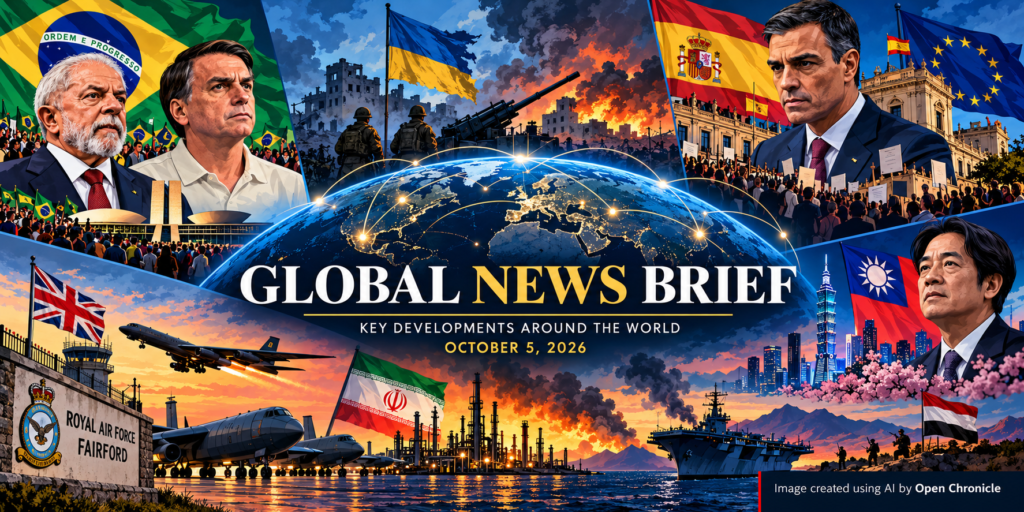
Brazil heads for a presidential runoff between Luiz Inácio Lula da Silva and Flávio Bolsonaro, Spain moves towards an early election, Russia continues its campaign against Ukraine, tensions surrounding Iran and Yemen remain high, and new security disputes stretch from Taiwan to the Caribbean.
By Open Chronicle with agencies
The international news cycle on October 5 is being shaped by elections, wars, security crises and shifting diplomatic relationships across several regions.
Brazil’s presidential election will proceed to a second round after neither leading candidate secured a majority, while Spain is heading towards a snap election following mounting political pressure over the housing crisis. In Europe, the war in Ukraine remains central, with Russian attacks continuing and Germany announcing further military support for Kyiv.
Across the Middle East, Iran has warned that American bases and warships could become targets if the United States launches a ground invasion, while Yemen’s internationally recognized government has begun a major operation against the Houthis.
Europe
Spain Heads Towards a Snap Election
Spanish Prime Minister Pedro Sánchez has called an early election following mounting political pressure and the defeat of housing measures in parliament.
Reports indicate that the election is expected on November 29.
The decision follows widespread protests over Spain’s housing crisis, which has become an increasingly significant political challenge for the government. The election now opens another period of uncertainty in one of the European Union’s largest member states.
Russia Continues Strikes Against Ukraine
Russian military operations against Ukraine remain intense.
A Russian drone strike hit an Indian owned pharmaceutical warehouse in Sumy, killing an employee, according to reports.
Ukraine also believes Russia has shared jet and drone technology with North Korea, President Volodymyr Zelenskyy said.
German Chancellor Friedrich Merz has reinforced Berlin’s support for Ukraine during his visit to Kyiv, with reports indicating that Germany is providing additional military assistance.
Zelenskyy has also said that the United States wants three way talks by the end of October, adding another diplomatic dimension to efforts surrounding the conflict.
Latvia Maintains Its Pro Ukraine Direction
Latvia’s election has produced a result expected to preserve the country’s support for Ukraine.
The United List emerged as a significant force in the new parliament, while the election itself took place under the continuing shadow of Russia’s war against Ukraine and broader concerns about security on NATO’s eastern flank.
Bosnia Votes Amid Persistent Political Divisions
Bosnia and Herzegovina’s elections have again exposed the country’s deep political and ethnic divisions.
The campaign highlighted competition between political forces aligned with the pro Russian camp of Milorad Dodik and those supporting Ukraine and closer Western integration.
The result will have implications for Bosnia’s internal political balance as well as its relationship with the European Union.
US Bombers Leave RAF Fairford
The United States has removed its deployed bombers from RAF Fairford in Britain following a security scare surrounding the base.
The Pentagon confirmed that US bombers had been withdrawn, while reports connected the decision to an investigation into a suspected terrorist plot.
Fairford has played an important role in supporting American long range bomber operations during the Iran conflict, giving the withdrawal significance beyond Britain itself.
France Faces Continuing Student Unrest
Large scale student protests are continuing in France, with reports indicating that more than 5,000 people have been arrested as demonstrations escalate.
The unrest follows days of disruption affecting schools and confrontations between demonstrators and police.
Catalonia Faces Severe Flooding
Heavy rainfall has caused flooding across Catalonia, submerging streets and roads.
The extreme weather adds to a series of recent destructive rainfall events affecting southern Europe, including several days of intense rainfall on the Greek island of Crete.
Middle East
Iran Warns Against a US Ground Invasion
Iran has warned that American military bases and warships would become targets if Washington launches a ground invasion.
Tehran says it is reviewing the latest American response while maintaining readiness for different military scenarios.
Iranian officials have simultaneously maintained that there is no military solution to the wider Middle East conflict, leaving diplomacy and military deterrence operating alongside one another.
Iran’s Oil Minister Resigns
Iran’s oil minister has resigned, with the president appointing a replacement.
The change comes at a particularly sensitive moment for Tehran because the war has placed enormous attention on Iranian energy production and the movement of oil through the Strait of Hormuz.
Oil traffic through Hormuz has begun recovering, but concerns remain about tanker attacks and the wider stability of energy supplies.
Saudi Aramco has meanwhile cut its crude prices for Asian customers to their lowest level in six years as oil flows recover.
Yemen Launches Major Offensive Against Houthis
Yemen’s government has launched a major military operation against Houthi forces as competition for control of strategically important territory intensifies.
The operation comes as the Houthis tighten their position around the Bab el Mandeb area, one of the world’s most important maritime passages.
Yemeni military authorities have claimed extensive operations and heavy Houthi losses, while the Saudi led coalition has pledged continued support for the Yemeni government.
Gaza Humanitarian Pressures Continue
Humanitarian conditions in Gaza remain severe.
Reports say Israeli restrictions could mean that sufficient winter shelter materials take more than seven months to enter the territory.
The United Nations estimates that Gaza now contains approximately 61 million tonnes of rubble and that clearing it could take as long as a decade.
Four Palestinians were also reported killed and 19 wounded by Israeli fire in Gaza.
Israel and Syria Tensions Persist
Israeli military activity in southern Syria continues to generate tensions.
Syria has condemned Israel’s “Sufa 53” project in the Golan buffer zone, while Israeli forces reportedly destroyed an abandoned building during a military operation in southwestern Syria.
The Israeli military also said it killed a man it described as an assailant in southern Syria.
Asia Pacific
FBI Arrests Woman Accused of Spying on Taiwan President’s Family
American authorities have arrested a woman accused of acting on behalf of China and conducting surveillance connected with the family of Taiwan President Lai Ching te.
Reports say the investigation concerns alleged surveillance of the Taiwanese president’s son in the United States.
The case comes amid persistent tensions involving Beijing, Washington and Taipei and places intelligence activity alongside the military and diplomatic competition surrounding Taiwan.
The allegations remain subject to the legal process.
Japan Seeks Stable Relations With China
Japan’s prime minister has described China as an important neighbour and pledged to pursue stable relations despite continuing economic and security tensions.
The position illustrates Tokyo’s difficult strategic balance as it strengthens security relationships with the United States and other partners while maintaining extensive economic ties with China.
Okinawa Case Fuels Anger Over US Military Presence
Japan has urged American forces to enforce discipline following the arrest of a US Marine in connection with an alleged murder and robbery in Okinawa.
The case has triggered protests and renewed scrutiny of the American military presence on the island.
Japan Pushes for Greater Space Autonomy
Japan is also looking towards greater strategic independence in space.
The country’s space leadership is emphasizing autonomy as international competition accelerates, reflecting the growing connection between civilian space programs, advanced technology and national security.
South Korea Orders Investigation Into Data Leaks
South Korea’s president has ordered an investigation into data leaks affecting the country’s financial industry.
The move comes as governments across Asia confront the security implications of increasingly digitized financial systems and large scale collections of personal data.
Pacific Leaders Gather Ahead of COP31
Pacific leaders are gathering in Fiji ahead of COP31 in Türkiye, with oceans, climate policy and the blue economy among the major issues under discussion.
Climate change remains an existential concern for many Pacific island states, giving the region an influential voice in international climate negotiations despite its relatively small population.
The Americas
Brazil Heads to Lula Bolsonaro Runoff
Brazil’s presidential election is heading to a second round after neither of the leading candidates secured a majority.
Senator Flávio Bolsonaro finished ahead of President Luiz Inácio Lula da Silva in the first round, according to reports, setting up a runoff scheduled for October 25.
The contest will extend one of the most closely watched political battles in Latin America and leave both campaigns with several weeks to mobilize voters ahead of the decisive ballot.
US Launches New AI Initiative
President Donald Trump has announced a new federal initiative focused on artificial intelligence.
Jay Clayton has been selected to lead what the administration calls the “Super Intelligence Force”, an effort intended to examine AI risks and opportunities while preserving American technological leadership.
The initiative comes as artificial intelligence becomes increasingly connected with national security, economic competition and the strategic rivalry between the United States and China.
US Military Conducts Another Caribbean Strike
The US military says four people were killed in a strike against a suspected drug trafficking vessel in the Caribbean.
The operation forms part of Washington’s expanding military campaign against vessels it associates with narcotics trafficking.
The campaign has now become a significant new dimension of American security policy in the Caribbean.
Six Presumed Dead After Medical Aircraft Crash
The search for six people aboard a medical transport aircraft that disappeared while travelling from Bermuda towards Boston has ended.
The US Coast Guard suspended its search after debris from the aircraft was located, with all six people aboard presumed dead according to reports.
Africa
Ethiopian Government Forces Retake Tigray Capital
Ethiopian government forces have reportedly regained control of the Tigray regional capital, marking a major setback for Tigrayan forces.
The development represents a potentially significant shift in the renewed confrontation in northern Ethiopia.
Regional diplomacy is unfolding simultaneously, with neighbouring governments increasingly focused on the wider implications for the Horn of Africa.
Egypt and Sudan Reject Unilateral Measures Over Water
A four way summit has rejected unilateral measures considered harmful to the water rights of Egypt and Sudan.
The dispute forms part of the wider geopolitical struggle surrounding the Nile and relations between Egypt, Sudan and Ethiopia.
The African Union has separately denied blaming Egypt for the Ethiopian crisis after Cairo objected to earlier statements.
Aid Convoy Hit in Sudan
A strike on World Food Programme aid trucks in Sudan reportedly killed one person.
The incident comes as Sudan’s conflict continues to expose humanitarian workers and civilians to severe risks and complicate efforts to deliver assistance.
The Global Picture
October 5 opens with elections and political instability competing with war and security crises for international attention.
Brazil is moving towards a decisive presidential runoff. Spain is preparing for a snap election. Bosnia and Latvia are navigating political contests heavily influenced by Europe’s security environment.
At the same time, the Russia Ukraine war continues to shape European defense and diplomacy, while the confrontation involving Iran is affecting military deployments, oil markets and security calculations across the Middle East.
The growing Yemen conflict adds another layer of instability around the Red Sea and Bab el Mandeb, while tensions involving Taiwan, China, Japan and the United States demonstrate that strategic competition in the Asia Pacific remains equally consequential.
Across these regions, several themes increasingly overlap: military power, elections, intelligence operations, energy security, technology, climate pressures and control of strategic trade routes.
The result is a global news environment in which developments thousands of kilometres apart are increasingly connected by the same questions of security, economic resilience and geopolitical competition.