
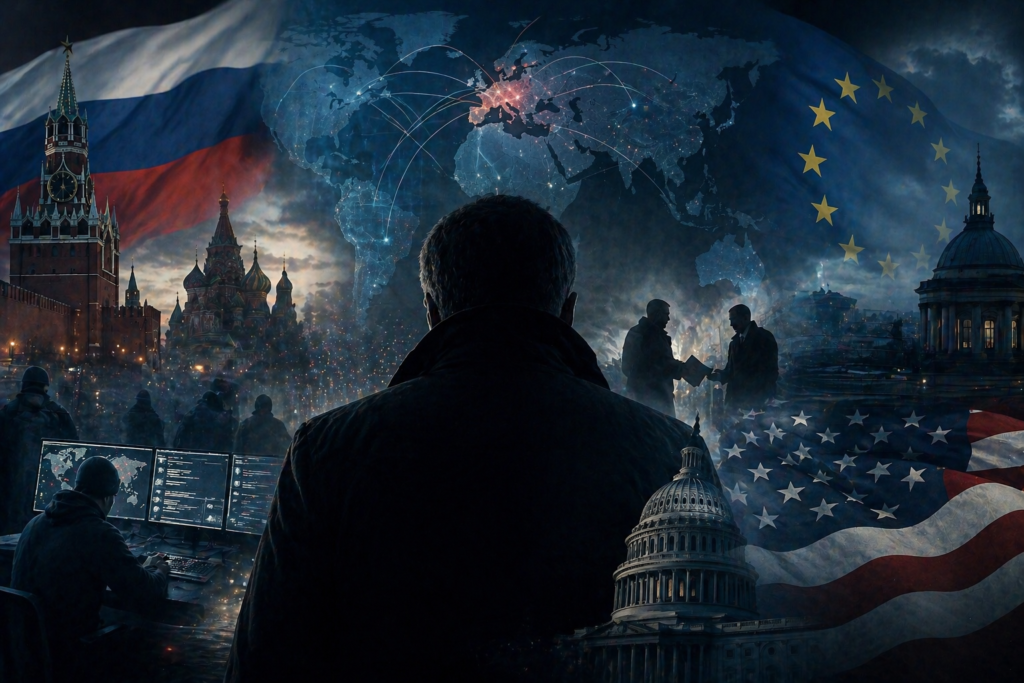
Image Credentials: Image Title: A New Era of Espionage; the Invisible War Reshaping Global Security Source: (chatgpt.com) Date: April 2026. Attribution: This image was created using AI-generated imagery (chatgpt.com) by Open Chronicle and does not depict a real-world scene.
Opinion
By José Carlos Palma *
The war in Ukraine is not confined to trenches, drones, or devastated cities. There is another battlefield, far less visible but equally decisive, stretching across European capitals, digital networks, and strategic institutions. It is an unprecedented surge in intelligence activity, driven by a conflict that has fundamentally reshaped how power is projected and contested.
In recent years, Russia has been repeatedly linked to espionage, sabotage, and influence operations across Europe. The arrest of a suspected spy in Berlin, accused of passing information about military aid to Ukraine, is only one example among many. These incidents are not isolated. They form part of a broader, consistent pattern that points to a deliberate strategy of intelligence gathering and destabilization.
Since 2022, European authorities have uncovered networks involving both trained operatives and loosely connected individuals recruited for specific tasks. These so-called “disposable agents” are often used for surveillance, data collection, and in some cases, planning acts of sabotage targeting critical infrastructure or NATO-linked assets.
Yet the most transformative dimension of this new phase lies in the digital domain. The use of artificial intelligence, as revealed in operations linked to Rybar, marks a significant evolution. Automated systems are now capable of generating large volumes of multilingual content, amplifying narratives, shaping public opinion, and testing reactions in real time. This is propaganda on an industrial scale, with global reach and minimal cost.
This trend extends beyond Europe. In the United States, officials have repeatedly warned of foreign interference in electoral processes. From the digital campaigns attributed to Russia in 2016 to more recent allegations involving Iran-linked hackers targeting political campaigns, the pattern is clear: elections have become a primary target. The objective is not only to influence outcomes, but to erode trust in democratic institutions themselves.
The Western response has been uneven. On one hand, there has been a strengthening of cybersecurity capabilities, closer coordination between intelligence agencies, and increased vigilance. On the other hand, structural vulnerabilities remain, particularly in regulating digital platforms and adapting to rapidly evolving threats. The hybrid nature of these operations, blending traditional espionage with disinformation and psychological tactics, makes them especially difficult to counter.
It is important to recognize that this escalation did not emerge overnight. The war in Ukraine has acted as a catalyst, accelerating dynamics that were already in motion. What has changed is the scale and sophistication. Espionage is no longer just about gathering information. It is now an active instrument of influence and disruption.
We are, in effect, witnessing the emergence of a new kind of cold war, one that is digital, diffuse, and constant. Europe, due to its geographic proximity and political involvement, has become a central arena in this invisible confrontation.
Ignoring this reality would be a strategic mistake. History shows that conflicts are not won solely on the battlefield, but also through the ability to understand and anticipate an adversary’s actions. Today, that capability depends on mastering intelligence in all its forms.
The question is no longer whether this invisible war will continue, but whether democratic societies are prepared to confront it.
The Grand Strategy Institute
Continue Exploring Strategic Analysis
Return to The Grand Strategy Institute for strategic assessments, long-form analysis and research examining geopolitics, military affairs, international security, emerging technologies and the changing international order.
← Back to The Grand Strategy Institute