
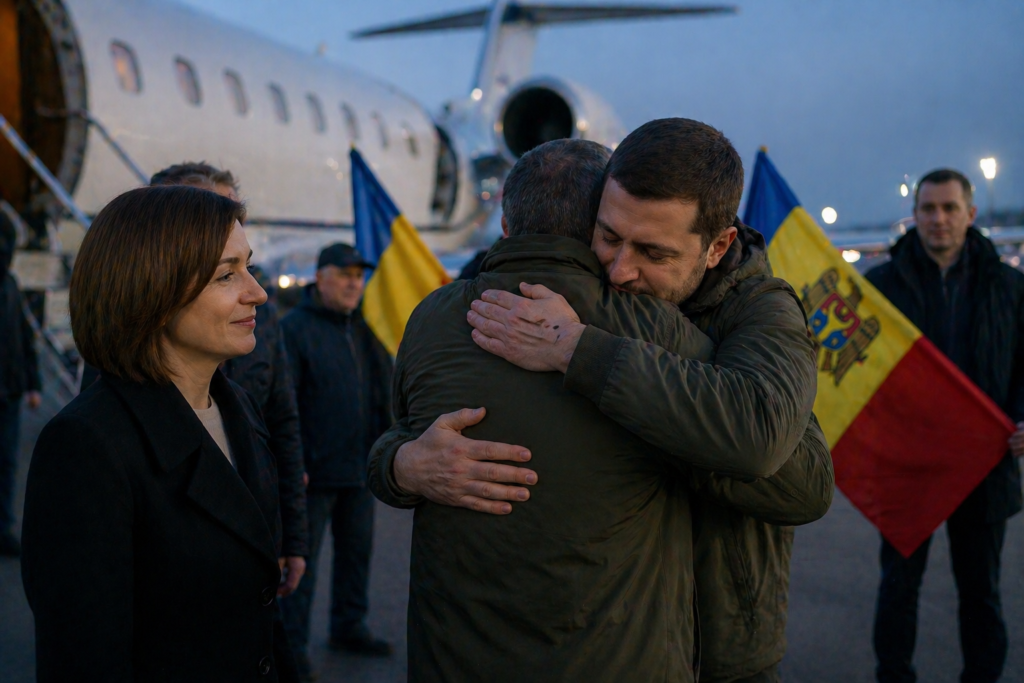
Image Credentials: Image Title: Moldova Conducts Spy Exchange with Russia, Secures Release of Intelligence Officers Source: (chatgpt.com) Date: April 2026. Attribution: This image was created using AI-generated imagery (chatgpt.com) by Open Chronicle and does not depict a real-world scene.
By Open Chronicle with Agencies
Maia Sandu announced a complex prisoner exchange involving Moldova and Russia, resulting in the release of two Moldovan intelligence officers in return for several detainees, including a convicted spy.
At the center of the exchange was Alexandru Bălan, a former deputy director of Moldova’s Intelligence and Security Service who had been convicted of treason. Bălan was accused of passing sensitive state information to Belarusian and Russian intelligence services and had been extradited from Romania shortly before the deal.
A Carefully Coordinated Operation
According to Sandu, the exchange was the result of months of discreet negotiations led by Moldova’s intelligence services. Many operational details were kept confidential to avoid jeopardizing the process.
The agreement included the release of two Moldovan intelligence officers detained in Russia. In return, Moldova handed over Bălan and another individual, identified as Russian national Popova Nina, who was accused of acting against Moldovan state interests.
Bălan was pardoned by presidential decree to facilitate his transfer as part of the exchange.
International Mediation and Support
Sandu expressed gratitude to Donald Trump and his administration for their role in mediating the agreement. She also acknowledged the contributions of Poland and Romania, emphasizing the importance of coordinated diplomatic efforts.
The US Embassy in Bucharest welcomed the outcome, noting that the broader operation also secured the release of three Polish citizens detained in Belarus.
Officials described the exchange as a significant example of international cooperation, involving multiple countries working together to resolve sensitive security and humanitarian issues.
Broader Implications
The case highlights ongoing intelligence tensions in Eastern Europe, particularly involving Russia and neighboring states. It also underscores the strategic importance of partnerships among Western and regional allies in addressing such challenges.
While the release of the detained individuals marks a diplomatic success, it also reflects the complex and often opaque nature of intelligence operations and negotiations in the region.
For Moldova, the return of its officers represents both a humanitarian achievement and a reaffirmation of its security priorities amid a shifting geopolitical landscape.