
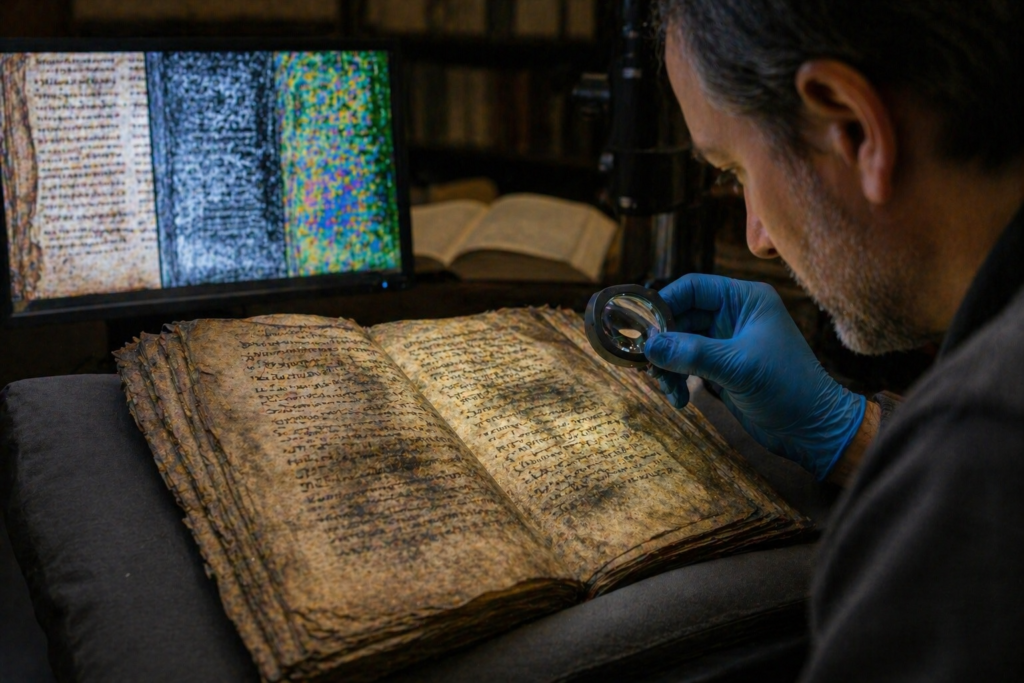
Image Credentials: Image Title: Lost Biblical Manuscript Recovered Through Advanced Imaging Techniques Source: (chatgpt.com) Date: April 2026. Attribution: This image was created using AI-generated imagery (chatgpt.com) by Open Chronicle and does not depict a real-world scene.
By Open Chronicle with Agencies
A long-lost section of an early biblical manuscript has been brought back to light, offering new insight into the development of Christian scripture. Scholars have successfully reconstructed dozens of pages from what is known as Codex H, a sixth-century text that had been partially erased and reused during the Middle Ages.
A Manuscript Hidden in Plain Sight
The story of Codex H begins in Mount Athos, home to the historic Monastery of Megisti Lavra. Founded in 963 by Athanasius the Athonite, the monastery became a major center for preserving religious texts.
In 1218, a monk named Markarios repurposed fragments of the manuscript, using them to reinforce the binding of another book. At the time, the original document, which contained the Epistles of Paul, was likely considered too damaged or outdated to preserve intact.
Over time, its pages were scattered across Europe, eventually appearing in collections in cities such as Paris, Turin, Kyiv, Moscow, and St. Petersburg.
Rediscovery Across Centuries
The manuscript began to resurface centuries later when Bernard de Montfaucon identified fragments embedded in book bindings at the Abbey of Saint-Germain-des-Prés in Paris.
Now, a research team led by Garrick Allen has taken the recovery further, reconstructing 42 pages of the original text. Working alongside the Early Manuscripts Electronic Library, the team used multispectral imaging to reveal writing that had been obscured for centuries.
Technology Reveals the Invisible
The breakthrough came from the ability to detect “offset” traces left by ink transfers. Over time, corrosive ink from later writing had left faint mirrored impressions of the original text on adjacent pages.
While invisible to the naked eye, these traces became legible through advanced imaging techniques, allowing researchers to reconstruct previously lost passages.
The recovered text includes some of the earliest known chapter lists for the Epistles, along with annotations and corrections made by sixth-century scribes.
A Window Into Scriptural Evolution
The findings highlight not only the content of the manuscript but also the complex history of how biblical texts were transmitted, altered, and preserved over time.
Scholars emphasize that the New Testament was not a static work but evolved through centuries of copying, editing, and translation. Manuscripts like Codex H provide valuable evidence of these processes, offering insight into both religious and cultural contexts.
Radiocarbon analysis has confirmed the manuscript’s origins in the sixth century, reinforcing its importance as one of the earliest witnesses to the New Testament tradition.
A Landmark Discovery
For researchers, the recovery of Codex H represents a major step forward in understanding early Christian texts.
Garrick Allen described the discovery as “monumental,” noting that uncovering even small fragments would have been significant. The reconstruction of dozens of pages, he said, opens new avenues for studying the history and transmission of scripture.
As technology continues to advance, similar techniques may reveal further hidden texts, reshaping our understanding of the past and the documents that have shaped religious thought for centuries.