
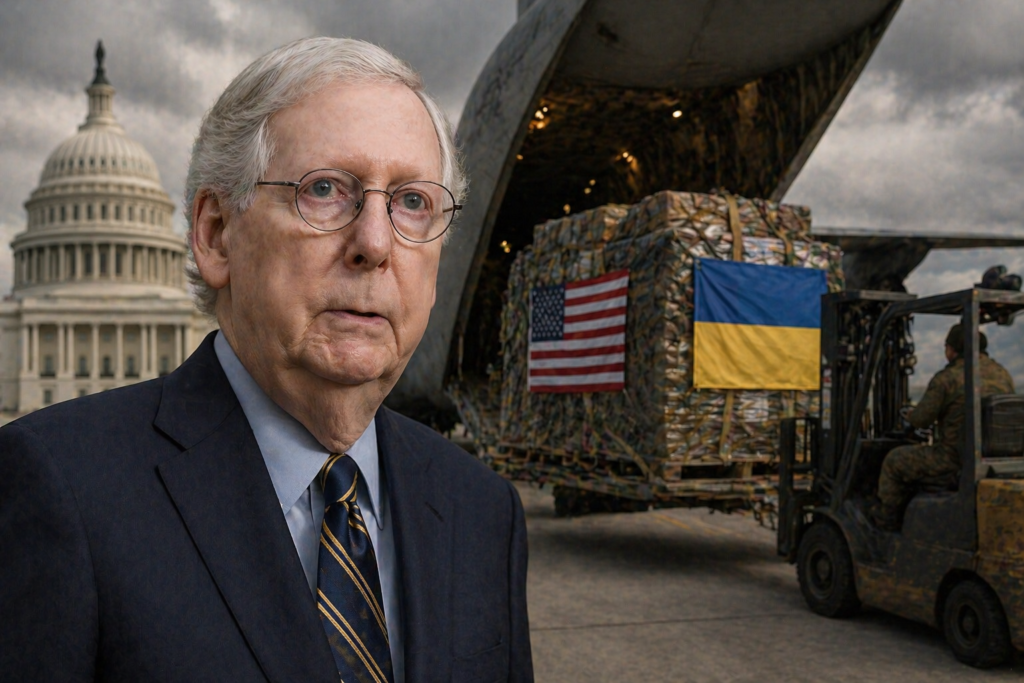
Image Credentials: Image Title: McConnell Criticizes Pentagon Over Delays in Ukraine Military Aid Source: (chatgpt.com) Date: April 2026. Attribution: This image was created using AI-generated imagery (chatgpt.com) by Open Chronicle and does not depict a real-world scene.
By Open Chronicle with Agencies
Mitch McConnell has sharply criticized the Pentagon over delays in delivering military assistance to Ukraine, warning that hundreds of millions of dollars approved by Congress remain unused despite broad bipartisan support.
In an opinion piece published in The Washington Post, McConnell argued that the U.S. Department of Defense has failed to act on funding already allocated under the Ukraine Security Assistance Initiative. The program includes $400 million in aid for fiscal year 2026, with an additional $400 million planned for 2027.
According to the senator, the funds are effectively “collecting dust” while lawmakers struggle to obtain clear explanations from defense officials. He accused the Pentagon of failing to communicate with Congress, particularly pointing to the policy office led by Elbridge Colby.
McConnell said Senate appropriators have been “stonewalled” in their attempts to understand why the assistance has not been delivered, adding that members of armed services committees have also expressed growing frustration with the lack of transparency.
The criticism comes at a time when continued U.S. support for Ukraine remains a central issue in Washington. McConnell rejected claims that public opinion has shifted against aiding Kyiv, insisting that Americans still largely support efforts to counter Russian aggression.
Framing the matter as a strategic priority, he described military assistance to Ukraine as an investment in U.S. national security rather than an act of charity. He argued that helping Ukraine defend itself strengthens broader stability and deters adversaries.
The funding in question was included in the approximately $900 billion National Defense Authorization Act for fiscal year 2026, which received strong backing in Congress.
The Pentagon has not publicly detailed the reasons behind the delay, leaving open questions about implementation timelines and policy direction. As the debate continues, the issue underscores tensions between lawmakers and defense officials over the pace and execution of U.S. foreign military commitments.