
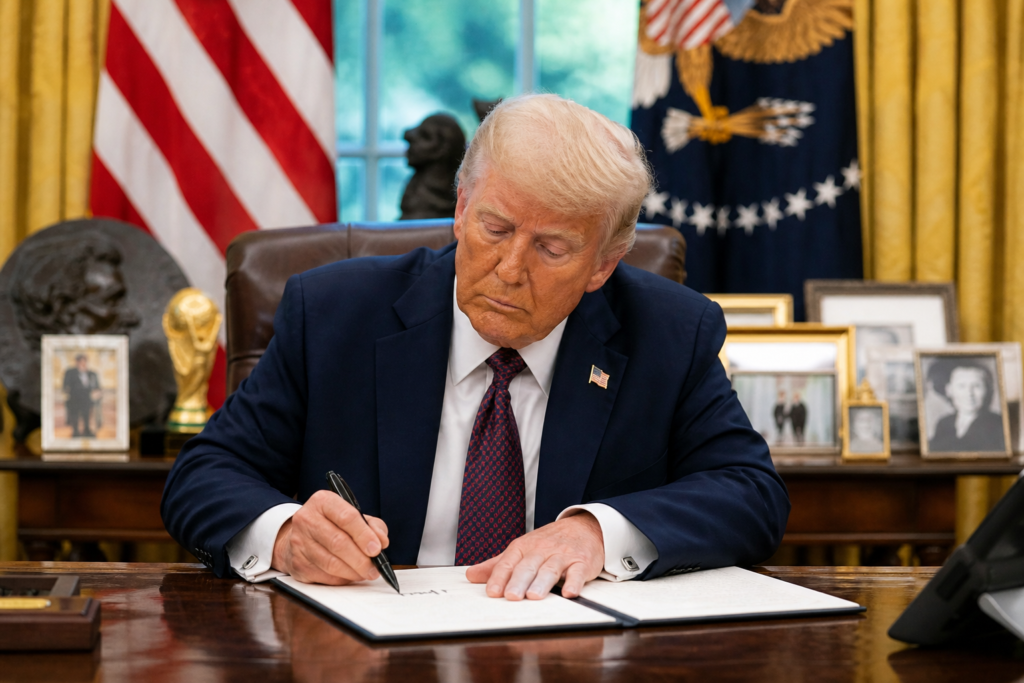
Image Credentials: Image Title: Trump Signs Order to Expand Access to Retirement Savings Plans in the US Source: (chatgpt.com) Date: May 2026. Attribution: This image was created using AI-generated imagery (chatgpt.com) by Open Chronicle and does not depict a real-world scene.
By Open Chronicle with Agencies
U.S. President Donald Trump has signed an executive order aimed at broadening access to retirement savings options, introducing a new federal initiative designed to help millions of Americans better prepare for the future.
The order directs the creation of a government-run website, expected to be launched as TrumpIRA.gov, which will allow users to compare private retirement savings plans. The initiative is intended to make it easier for individuals, particularly those without employer-sponsored plans, to find suitable options tailored to their needs.
The move comes ahead of the implementation of the “Saver’s Match,” a federal program introduced under legislation passed during the administration of Joe Biden. Set to take effect in January, the program will provide matching contributions of up to $1,000 annually for low-income workers earning under $35,000.
Trump said the new platform could be transformative for millions of Americans currently excluded from traditional retirement systems. Officials estimate that around 50 million workers in the United States lack access to employer-sponsored retirement plans.
“For millions of Americans who lack employer-sponsored plans, this will be really revolutionary,” Trump said during the signing ceremony at the White House.
The initiative will be overseen by the U.S. Treasury Department, which has been tasked with developing and managing the comparison platform. The goal is to increase participation in retirement savings programs by simplifying access and improving transparency across available options.
The executive order reflects a broader effort to address gaps in the U.S. retirement system, where participation often depends on employer-based offerings. By combining a federal matching incentive with easier access to private plans, policymakers aim to encourage long-term financial security, particularly among lower-income households.
As the January rollout approaches, the success of the initiative will likely depend on how effectively it reaches underserved workers and whether it can significantly boost participation in retirement savings nationwide.