
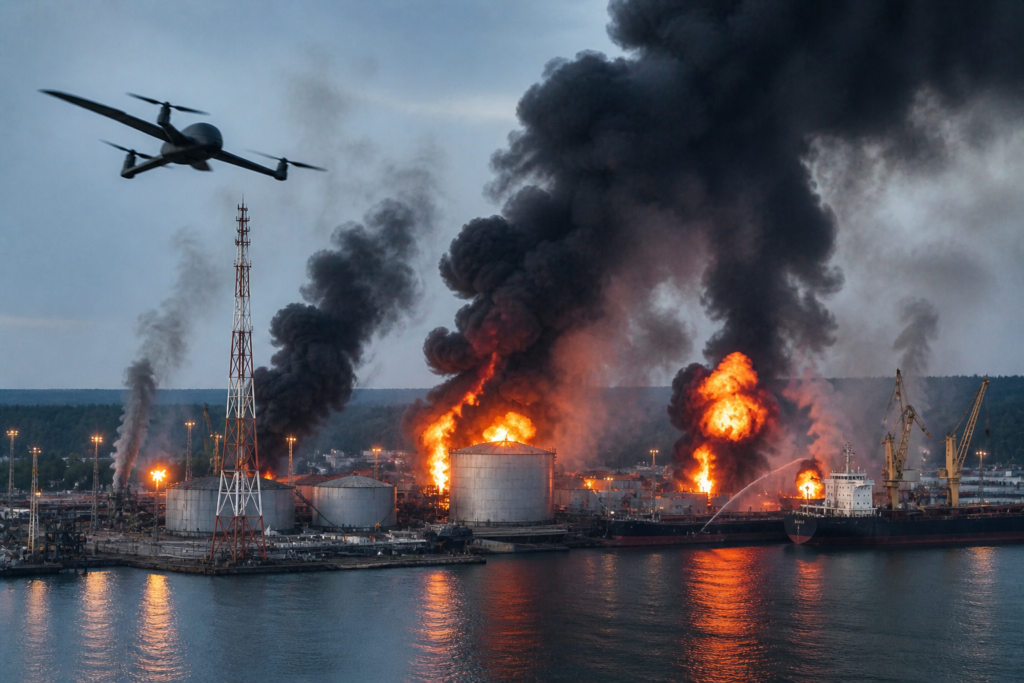
Image Credentials: Image Title: Ukrainian Drones Strike Russian Baltic Port of Primorsk Source: (chatgpt.com) Date: May 2026. Attribution: This image was created using AI-generated imagery (chatgpt.com) by Open Chronicle and does not depict a real-world scene.
By Open Chronicle with Agencies
Ukrainian drones targeted the Russian Baltic Sea port of Primorsk, marking a significant extension of Kyiv’s long-range strike capabilities and highlighting the evolving dynamics of the conflict.
According to reports cited by France 24, the attack focused on infrastructure linked to Russia’s energy exports. Primorsk serves as a key terminal for oil shipments, making it a strategically important site for Moscow’s economy and logistics.
Russian authorities confirmed that drones had been intercepted in the region, while acknowledging damage in the vicinity of the port. Emergency services were deployed, and operations were reportedly disrupted, although officials did not provide full details on the extent of the impact.
🇺🇦 AFU launched a massive drone attack on the Primorsk sea trade port in the Leningrad region.
🔥 The strikes caused a fire at the strategic facility and damaged Russian military equipment and port infrastructure.
Read more 👀 https://t.co/JHdoB5Qn5q
— The Ukrainian Review (@UkrReview) May 3, 2026
The strike reflects Ukraine’s increasing reliance on drone warfare to reach targets far beyond the front lines. By focusing on critical infrastructure, Kyiv aims to weaken Russia’s economic capacity and complicate its ability to sustain military operations.
Military analysts note that attacks on ports like Primorsk carry both symbolic and practical implications. Beyond immediate damage, they signal Ukraine’s ability to project power deep into Russian territory, including areas previously considered relatively secure.
For Russia, the incident underscores growing vulnerabilities in its defensive perimeter, particularly in regions tied to global trade and energy supply chains. The Baltic Sea corridor plays a crucial role in exporting Russian oil, making any disruption potentially significant for international markets.
The development comes amid continued escalation in the use of unmanned systems by both sides, with drones increasingly shaping the battlefield. From surveillance to precision strikes, these technologies are redefining how the war is fought.
As the conflict continues, such operations are likely to intensify, raising concerns about further disruptions to critical infrastructure and the broader implications for regional security.