
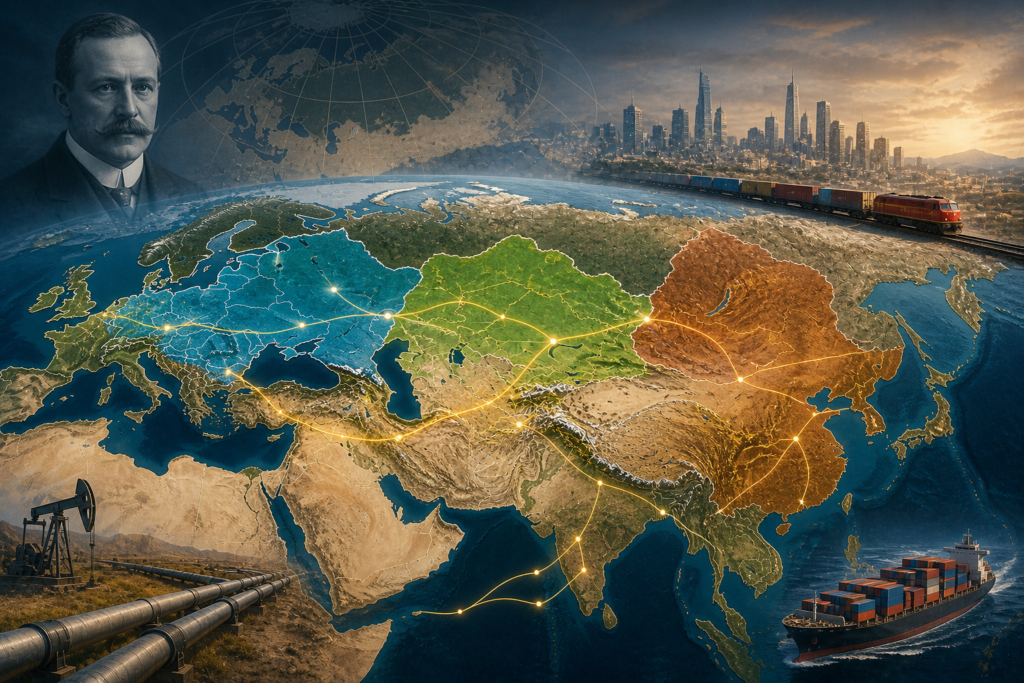
Image Credentials: Image Title: Heartland Theory and the New Geopolitics of Central Eurasia Source: (chatgpt.com) Date: May 2026. Attribution: This image was created using AI-generated imagery (chatgpt.com) by Open Chronicle and does not depict a real-world scene.
By José Carlos Palma *
The Heartland Theory, first developed by British geographer Halford Mackinder in the early 20th century, continues to influence how analysts understand the geopolitical structure of Eurasia. More than a century later, the theory has gained renewed relevance as Central Eurasia once again becomes a key arena of strategic competition.
Mackinder argued that the central landmass of Eurasia, which he called the Heartland, held exceptional geopolitical importance. In his view, whoever controlled this vast inland space would possess the potential to dominate the wider “World Island,” meaning Europe, Asia, and Africa, and ultimately shape global power.
His famous formula placed Eastern Europe at the center of this logic: control over Eastern Europe opened the way to the Heartland, and control over the Heartland opened the way to Eurasian dominance. Later revisions of his theory expanded the Heartland to include the Black Sea and Baltic regions, linking Eastern Europe more closely with Central Asia and the Caucasus.
The theory was later challenged by Nicholas Spykman, who argued that the decisive zone was not the inland Heartland but the coastal Rimland, stretching along Eurasia’s maritime edges. For Spykman, control of the Rimland was the key to shaping Eurasian and global power.
Today, both approaches remain useful, but neither fully explains the present structure of Central Eurasia. Modern geopolitics is no longer defined only by military conquest or imperial control. Economic corridors, energy routes, transport networks, regional integration, and political sovereignty now play a central role.
The historical evolution of the Heartland shows repeated cycles of expansion and fragmentation. The region was shaped by the Hun Empire, Turkic and Khazar khanates, the Arab Caliphate, the Seljuk and Mongol empires, Timur’s realm, the Ottoman and Safavid empires, and later the Russian and Soviet empires.
The Soviet Union represented the most complete modern expression of the Heartland, combining Central Asia, the Caucasus, and Eastern Europe into a single geopolitical structure. Its collapse in the early 1990s reshaped the map, leaving behind newly independent states and reducing Russia’s role to that of a northern Eurasian power rather than the sole organizer of the wider region.
In the 21st century, Central Eurasia can be understood as a broader geopolitical space made up of three interconnected segments: Central Europe, the Central Caucasus, and Central Asia. These territories form the core land bridge between Western Europe and East Asia, and between Russia and South Asia.
This structure gives Central Eurasia a crucial function. It enables land-based connectivity across the continent, linking trade, energy, security, and political systems along both west-to-east and north-to-south routes.
Unlike earlier imperial models, the modern Heartland cannot be organized through domination by one power or one ideology. Its long-term stability depends on cooperation, self-organization, economic compatibility, and mutual benefit among independent states.
The rise of globalization has also changed the meaning of regional power. No state in Central Eurasia can develop in isolation. Transport corridors, energy pipelines, digital infrastructure, and security partnerships now bind the region into wider global systems.
This makes Central Eurasia not only a historical concept, but a present-day strategic reality. Its importance lies less in conquest and more in connectivity. The region’s future will depend on whether its states can build stable institutions, deepen cooperation, and avoid becoming battlegrounds for outside powers.
Mackinder’s Heartland may no longer command the world in the old imperial sense, but Central Eurasia remains one of the most important spaces in global politics. Its geography still matters, but its future will be shaped by integration, resilience, and the ability of its states to manage their own place between Europe, Russia, China, the Middle East, and South Asia.
The Grand Strategy Institute
Continue Exploring Strategic Analysis
Return to The Grand Strategy Institute for strategic assessments, long-form analysis and research examining geopolitics, military affairs, international security, emerging technologies and the changing international order.
← Back to The Grand Strategy Institute