
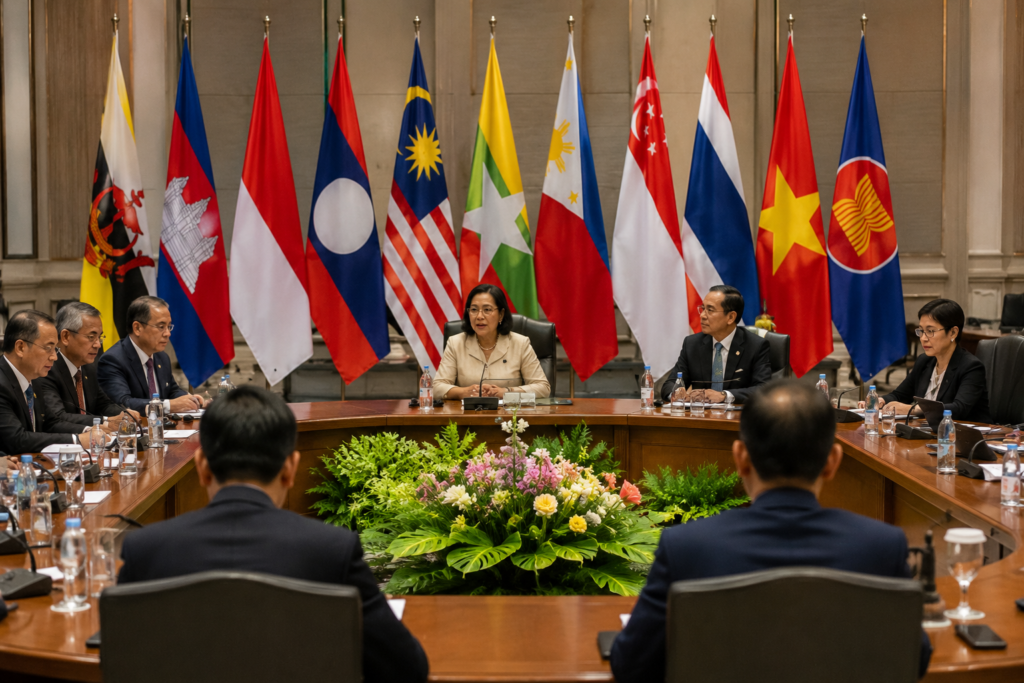
Image Credits: Image Title: ASEAN Foreign Ministers Meet in Philippines Ahead of Regional Summit. Source: (chatgpt.com) Date: May 2026. Attribution: This image was created using AI-generated imagery (chatgpt.com) by Open Chronicle and does not depict a real-world scene.
By Open Chronicle with agencies
Foreign ministers from the Association of Southeast Asian Nations gathered in the Philippines on Thursday ahead of the bloc’s main summit meeting, with discussions focused on regional energy security and the growing impact of tensions in the Middle East.
The ministerial meeting was chaired by Philippine Foreign Affairs Secretary Maria Theresa Lazaro, as Manila currently holds the rotating chairmanship of the Association of Southeast Asian Nations.
According to an official statement, ministers discussed several issues considered strategically important for the region, including the evolving global energy crisis and the implications of the ongoing confrontation involving Iran and the United States.
Regional governments are increasingly concerned about the economic consequences of instability in the Middle East, particularly disruptions affecting global oil shipments and maritime trade routes. Rising fuel costs and supply uncertainty have placed additional pressure on Southeast Asian economies already navigating slower global growth and inflationary challenges.
Diplomats attending the meeting also reviewed contingency measures related to the safety of ASEAN nationals living and working in the Middle East. Several member states have citizens employed across the Gulf region, making the security situation a growing concern for regional leaders.
The summit, scheduled for Friday, is expected to focus on strengthening regional economic resilience and coordinating a collective response to ongoing energy disruptions. Officials are also expected to discuss broader geopolitical tensions and their impact on trade, investment, and maritime security across the Indo-Pacific.
ASEAN member states have increasingly sought to maintain neutrality amid intensifying global rivalries, while continuing to emphasize dialogue, regional stability, and economic cooperation.
The bloc, which includes 10 Southeast Asian nations, remains one of the world’s most strategically important economic regions, with major shipping routes and supply chains running through its waters.