
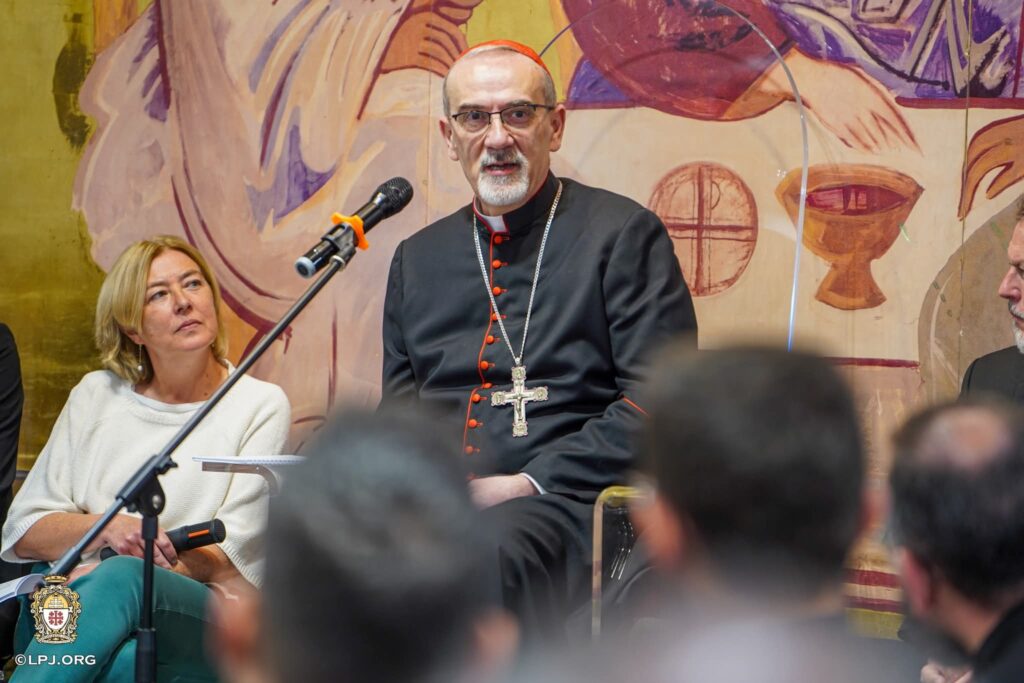
Image: From Latin Patriarchate of Jerusalem X @LPJerusalem
By Open Chronicle with agencies
The Latin Patriarch of Jerusalem, Pierbattista Pizzaballa, has warned that extremism is increasingly taking root within parts of Israeli society amid the ongoing war in Gaza, describing what he called a growing “culture of contempt” directed toward Arabs and non-Jews.
In an interview with the Italian newspaper Corriere della Sera, the cardinal said the atmosphere created after the Oct. 7, 2023, attacks and the subsequent military campaign in the Gaza Strip has intensified extremist rhetoric and deepened divisions within society.
“Unfortunately, extremism is gaining traction in this context,” Pizzaballa said. “We are seeing its consequences in certain sectors of Israeli civil society.”
He stressed that such attitudes do not represent the majority of Israelis, but warned that hostility toward Arabs and other non-Jewish communities is becoming increasingly visible.
‘A Diseased Germ Within Society’
Pizzaballa described the trend as deeply concerning and said media narratives have contributed to amplifying intolerance and polarization.
“The culture of contempt for everything that is not theirs, not only for everything Arab but for everything that is not Jewish, is unfortunately growing,” he stated.
Calling the phenomenon “a diseased germ within a society,” the cardinal warned that it must be confronted before it becomes even more dangerous.
His comments come at a time of continuing violence across the region, with the war in Gaza fueling broader political, religious, and humanitarian tensions throughout the Middle East.
Criticism of Political and Military Approaches
The patriarch also criticized what he described as a wider failure of political leadership and dialogue across the region.
“The gravity of the situation in the Middle East must be addressed within the framework of international legality and without adding more victims,” he said.
Pizzaballa argued that war has increasingly become a substitute for diplomacy and negotiations.
He referred to war as a “new idolatry,” warning that many people now believe dialogue has lost its value after the events of Oct. 7 and the months of violence that followed.
“It seems dialogue counts for nothing, and that those with money and power can do whatever they want,” he said.
Doubts Over Two-State Solution
Asked whether he still believed in the possibility of a two-state solution between Israel and the Palestinians, Pizzaballa offered a cautious and complex response.
“Yes and no,” he said, acknowledging that the current territorial and political realities make such a solution increasingly difficult to achieve.
He pointed specifically to the lack of territorial continuity for a future Palestinian state as one of the main obstacles.
Despite those concerns, he insisted Palestinians cannot be denied the right to dignity, identity, and hope for a future state.
“You cannot tell Palestinians they have no right to a future in their own home,” he said.
Religion Should Not Justify Violence
The cardinal also strongly condemned the use of religion as a justification for violence and extremism.
“You cannot use the name of God to justify violence,” he said, describing such actions as “the gravest sin one can commit.”
He warned against allowing extremist voices to monopolize religious narratives and called for renewed efforts toward coexistence, dialogue, and respect between communities.
Pizzaballa’s remarks reflect growing international concern over the social and political impact of the Gaza war, which has intensified tensions not only across the Middle East but also within societies directly affected by the conflict.