
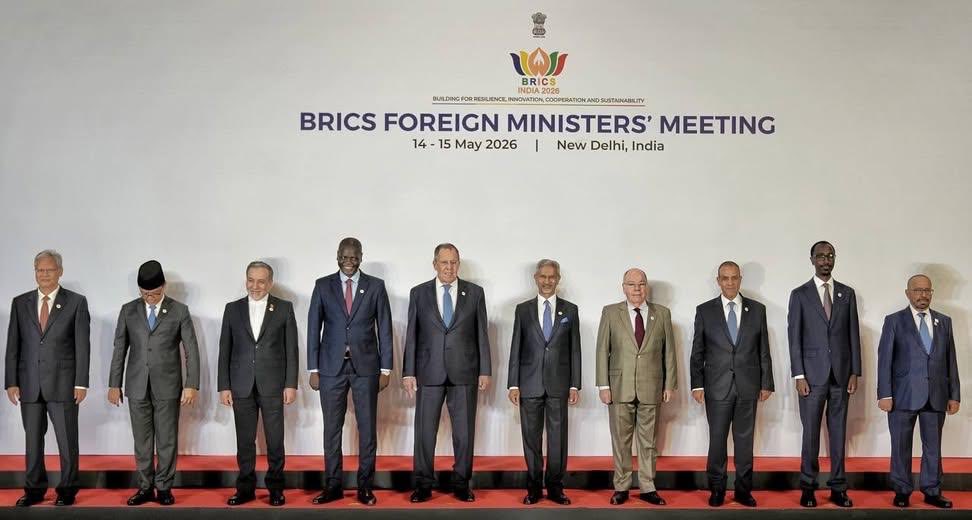
Image: from S.L. Kanthan X @Kanthan2030
By Open Chronicle with agencies
The expanding BRICS alliance gathered in India on Thursday under the shadow of rising tensions linked to the Iran war, disruptions in global oil supplies, and growing divisions inside the bloc itself.
Foreign ministers meeting in New Delhi focused heavily on energy security, maritime trade routes, and the impact of instability surrounding the Strait of Hormuz, one of the world’s most critical energy corridors.
Indian Foreign Minister Subrahmanyam Jaishankar opened the summit by calling for “safe, unimpeded maritime flows” through international waters.
“We meet at a time of considerable flux in international relations,” Jaishankar said. He added that developing nations increasingly expect BRICS to play a “constructive and stabilizing role” in global affairs.
🌍🛢️ #BRICS summit begins in #NewDelhi: #Iran #war, #oil shock and #dollar dominance loom over meet 🇮🇳📊 https://t.co/IVNOMEx8GT pic.twitter.com/KAnE9Dgmwm
— Economic Times (@EconomicTimes) May 14, 2026
Iran and UAE Face Diplomatic Friction
The summit brought Iran and the United Arab Emirates face-to-face amid lingering tensions from the recent conflict involving the United States, Israel, and Iran.
Analysts say the divisions inside BRICS may make it difficult for member states to agree even on the language used to describe the war and the broader Middle East crisis.
Iranian Foreign Minister Abbas Araghchi urged fellow BRICS members to unequivocally condemn American and Israeli military strikes against Iran.
However, observers expect resistance from several member states, particularly the UAE and Saudi Arabia, both of which maintain strategic ties with Washington.
Netanyahu Visit Claims Add to Tensions
Diplomatic tensions intensified further following claims by Israeli officials that Prime Minister Benjamin Netanyahu secretly visited the UAE during the conflict to strengthen bilateral relations.
According to Israeli statements, Netanyahu allegedly met UAE President Mohammed bin Zayed Al Nahyan during the war.
The UAE swiftly denied the claims, insisting that relations with Israel are “public” and not conducted through “non-transparent or unofficial arrangements.”
Araghchi later issued a strongly worded social media statement without directly naming the UAE.
“Enmity with the Great People of Iran is a foolish gamble,” he wrote, warning that those “colluding with Israel” would eventually be “held to account.”
Energy Security Dominates Agenda
The war and continuing instability around the Strait of Hormuz have heavily disrupted global oil and gas supplies, placing energy security at the center of the BRICS discussions.
India, which holds the BRICS chairmanship for 2026, is facing increasing economic pressure linked to rising energy costs and shrinking foreign currency reserves.
Indian Prime Minister Narendra Modi has urged citizens to reduce fuel consumption and avoid purchasing gold in an effort to ease pressure on the country’s economy.
Officials said discussions in New Delhi are expected to focus on oil flows through the Gulf, energy market stability, and expanding trade in local currencies rather than relying on the US dollar.
Expanding Bloc Faces Internal Divisions
Originally formed by Brazil, Russia, India, China, and South Africa, BRICS has expanded significantly in recent years.
The bloc now also includes Egypt, Ethiopia, Iran, the UAE, and Indonesia, reflecting efforts by emerging economies to build alternatives to Western-led institutions.
However, the rapid expansion has also introduced new geopolitical rivalries and conflicting strategic priorities.
While some BRICS members support closer alignment against Western sanctions and military influence, others maintain strong partnerships with the United States and European powers.
Maritime Stability Seen as Critical
The continuing instability around the Strait of Hormuz remains a major concern for BRICS economies heavily dependent on imported energy.
Nearly a fifth of global oil shipments pass through the narrow waterway, making any disruption a serious threat to international markets.
Observers say the New Delhi summit highlights how the Iran conflict is reshaping global diplomacy and exposing divisions even among countries seeking to challenge Western dominance in international affairs.