
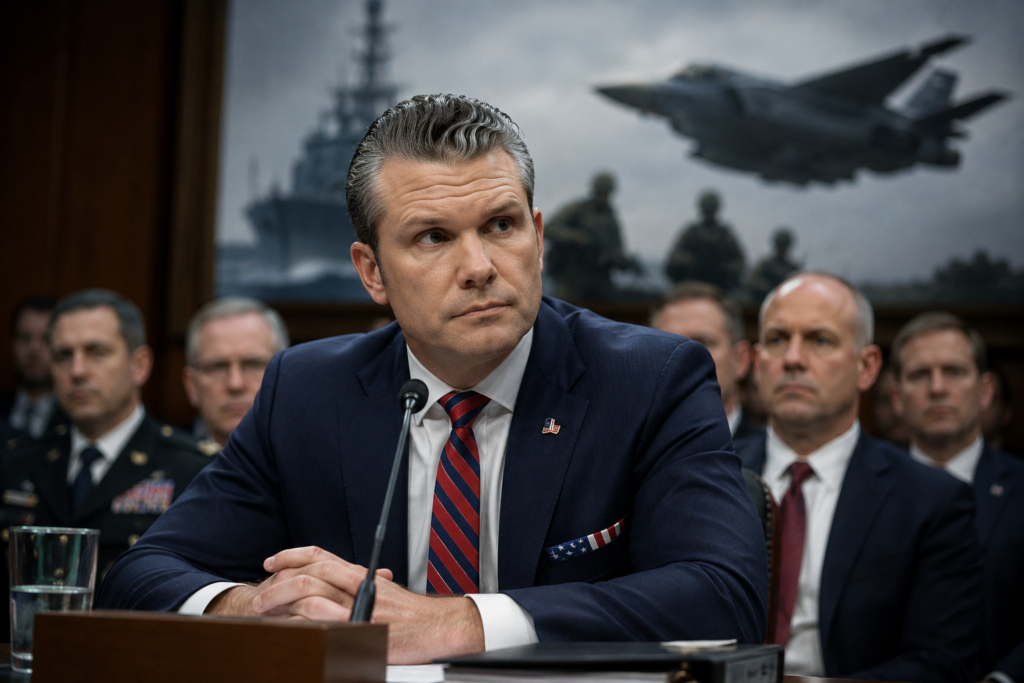
Image Credits: Image Title: Pentagon Faces Scrutiny Over Proposed $1.5 Trillion Military Budget. Source: (chatgpt.com) Date: May 2026. Attribution: This image was created using AI-generated imagery (chatgpt.com) by Open Chronicle and does not depict a real-world scene.
By Open Chronicle with agencies
US Defense Secretary Pete Hegseth is facing growing criticism after failing to provide detailed explanations for the Trump administration’s proposed $1.5 trillion military budget, a figure that would mark the largest defense spending package in American history when adjusted for inflation.
During congressional appropriations hearings this week, lawmakers from both parties questioned Pentagon officials over what many described as a lack of strategic clarity behind the unprecedented funding request. Critics argued that the administration relied heavily on broad rhetoric about “lethality,” industrial expansion, and national security without outlining concrete objectives or identifying specific emerging threats that would justify such a dramatic increase in military spending.
Senator Mark Kelly, a former Navy fighter pilot, openly challenged the Pentagon’s justification for the proposal during a Senate hearing. Kelly argued that military budgeting should be tied to clearly identified security challenges and measurable defense capabilities rather than vague statements about maintaining superiority.
According to the proposal, billions of dollars would be allocated toward unspecified “critical capabilities” for military operations, while another major portion would finance a sovereign artificial intelligence infrastructure initiative aimed at supporting strategic investments in private industry. However, Pentagon officials offered limited details about which companies or programs would benefit from the funding.
The proposed budget exceeds military spending levels seen during World War II and the Cold War when adjusted for inflation. Analysts note that it would represent a roughly 45 percent increase over current spending levels, intensifying concerns about federal deficits and long-term fiscal sustainability.
The debate comes as the United States remains engaged in military operations linked to the conflict involving Iran. Notably, the proposed $1.5 trillion budget reportedly does not include additional supplemental funding that may be requested for ongoing operations in the Middle East, potentially pushing total defense spending even higher.
Some lawmakers also expressed concern over the administration’s plan to divide the funding into two separate legislative processes. While approximately $1.15 trillion would move through the standard congressional appropriations system, another $350 billion would reportedly be handled through budget reconciliation, allowing approval with a simple Senate majority and potentially reducing congressional oversight.
Independent Senator Angus King criticized the structure of the proposal, warning that it risked creating what he described as a “slush fund” with limited transparency.
A major portion of the requested funding would go toward development of the so-called “Golden Dome” missile defense initiative, a large-scale missile shield intended to protect the United States from advanced threats. The Pentagon is seeking an initial $17 billion for the project, although estimates from the Congressional Budget Office suggest total costs could eventually exceed $1 trillion.
Defense analysts remain skeptical about both the feasibility and effectiveness of such a system, particularly against modern hypersonic and nuclear-capable weapons. Critics argue the proposal reflects broader problems within Pentagon spending practices, where enormous sums are directed toward ambitious defense programs with uncertain outcomes.
The controversy also highlights ongoing concerns about financial accountability within the Department of Defense. The Pentagon has never successfully completed a full audit, despite repeated efforts over the past several years to improve transparency and oversight.
Supporters of the proposal argue that the United States must maintain overwhelming military superiority amid growing competition with powers such as China and Russia. However, critics point out that President Donald Trump recently described Chinese President Xi Jinping as a “friend” during meetings in Beijing, raising questions about the administration’s broader strategic messaging.
Policy experts from several research institutes argue that military spending should be based on clearly defined security threats rather than the size of the US economy or generalized geopolitical competition.
The budget debate is expected to intensify in the coming weeks as Congress begins negotiations over fiscal year 2027 spending priorities.