
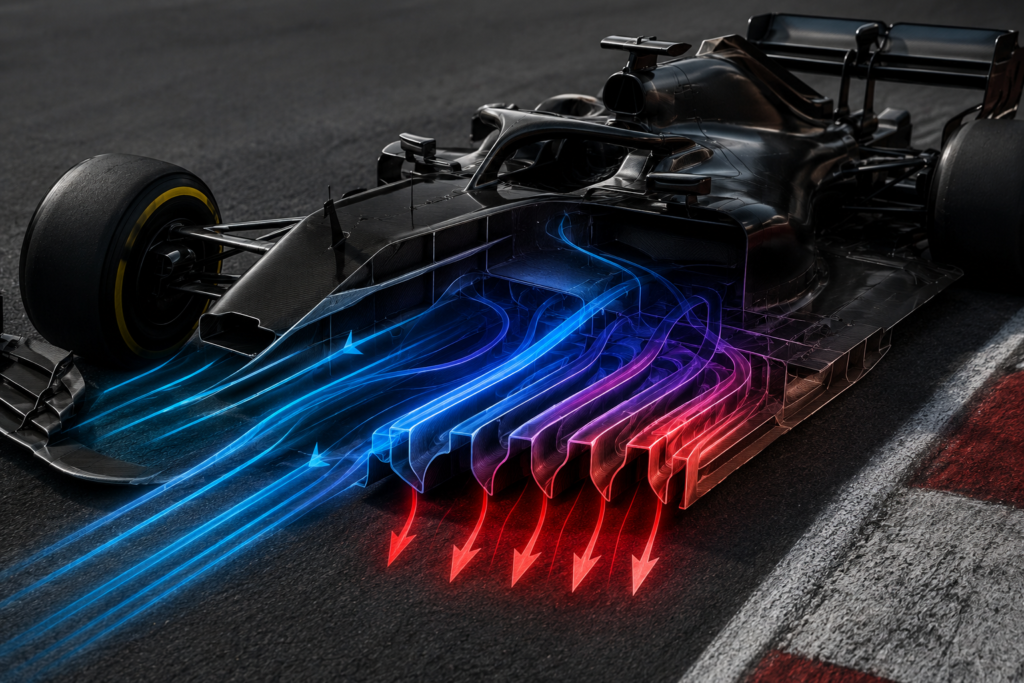
Image Credentials: Image Title: Ground Effect Explained: The Secret Behind Formula 1’s Incredible Speed. Source: (chatgpt.com) Date: May 2026. Attribution: This image was created using AI-generated imagery (chatgpt.com) by Open Chronicle and does not depict a real-world scene.
By Open Chronicle
Modern Formula 1 cars are among the fastest machines ever created, capable of cornering at speeds that seem to defy physics. While massive rear wings and aggressive aerodynamics play an important role, the true secret behind today’s extraordinary grip lies somewhere less visible.
Underneath the car.
This is the world of ground effect, one of the most powerful and sophisticated aerodynamic concepts in motorsport history. It is the technology that allows Formula 1 cars to generate enormous levels of downforce while remaining remarkably efficient at high speed.
And when it works perfectly, it makes an F1 car feel almost glued to the asphalt.
The Physics Behind Ground Effect
At its core, ground effect is based on controlling airflow beneath the car.
Modern Formula 1 cars use specially designed underfloors shaped like Venturi tunnels. These tunnels narrow and expand strategically to manipulate air pressure and velocity beneath the chassis.
The principle comes directly from the Venturi effect, a concept in fluid dynamics stating that when air passes through a narrow space, its speed increases while its pressure decreases.
In Formula 1, engineers exploit this phenomenon to create low-pressure zones under the car. The pressure difference between the underside of the car and the air above it effectively sucks the vehicle toward the track surface, generating immense downforce without relying entirely on large aerodynamic wings.
The faster the airflow moves beneath the floor, the stronger the effect becomes.
This invisible aerodynamic suction is what allows modern F1 cars to attack corners at astonishing speeds.
Why Ground Effect Is So Powerful
Traditional aerodynamic wings generate downforce by disrupting airflow, but they also create drag. More grip often means more aerodynamic resistance and lower straight-line speed.
Ground effect changes that balance.
Because much of the downforce comes from the floor rather than exposed wings, Formula 1 teams can achieve enormous grip levels with greater aerodynamic efficiency. This allows cars to corner aggressively while still maintaining extremely high speeds on straights.
In simple terms, ground effect creates more performance for less aerodynamic penalty.
That efficiency is one of the main reasons Formula 1 fully embraced the concept once again under the sport’s current technical regulations introduced in 2022.
Modern F1 cars may look visually dramatic from above, but much of their true aerodynamic sophistication exists underneath the chassis where fans rarely see it.
The Critical Importance of Ride Height
Ground effect, however, is incredibly sensitive.
The distance between the car floor and the track surface, known as ride height, becomes one of the most critical variables in the entire setup of a Formula 1 car.
If the car sits too high, airflow loses efficiency, and downforce drops dramatically. If it runs too low, airflow beneath the floor can suddenly stall, causing a dangerous and immediate loss of grip.
Teams constantly search for the perfect balance between maximum aerodynamic suction and mechanical stability.
This challenge became especially visible with the return of ground effect regulations in recent seasons, particularly through the phenomenon known as porpoising.
Porpoising and Aerodynamic Instability
Porpoising occurs when the airflow beneath the car repeatedly stalls and reattaches at high speed.
As the car gets pulled closer to the track by increasing downforce, the airflow underneath can suddenly collapse. The car then rises again before the airflow re-stabilizes, creating a violent bouncing motion along straights.
The effect can become severe enough to impact driver visibility, comfort, and even safety.
Teams spent much of the early ground effect era trying to control these oscillations through suspension adjustments, floor redesigns, and aerodynamic refinements.
The issue highlighted just how extreme and delicate modern Formula 1 aerodynamics have become.
At the highest level of motorsport, even a few millimeters of ride height can completely transform a car’s behavior.
Following Another Car
Ground effect also plays a major role in improving racing itself.
Previous generations of Formula 1 cars relied heavily on complex upper body aerodynamics and turbulent airflow producing wings. This created “dirty air” behind cars, making it extremely difficult for drivers to follow closely through corners.
By shifting a greater proportion of downforce generation underneath the car, Formula 1 aimed to reduce aerodynamic turbulence and improve wheel to wheel racing.
The goal was simple.
Allow drivers to follow each other more closely without losing massive amounts of grip.
While challenges remain, the modern ground effect era has generally improved overtaking opportunities and racing intensity compared to previous aerodynamic generations.
Why Formula 1 Returned to Ground Effect
Ground effect is not new to Formula 1.
The concept first transformed the sport in the late 1970s and early 1980s when teams like Lotus pioneered underfloor aerodynamics capable of generating extraordinary levels of downforce. Those early cars became so fast and physically demanding that the technology was eventually restricted for safety reasons.
Decades later, Formula 1 has brought ground effect back using far more advanced computational tools, materials, and safety standards.
Today’s cars combine the lessons of the past with modern aerodynamic understanding, creating machines that are faster, more efficient and more stable than ever before.
Yet the philosophy remains fundamentally the same.
Harness airflow beneath the car to unlock levels of grip that once seemed impossible.
The Invisible Force Defining Modern Formula 1
To casual fans, Formula 1 performance may appear to come primarily from engines or visible wings.
But the reality is far more complex.
The true performance of a modern F1 car is often hidden underneath the chassis, inside carefully sculpted tunnels where engineers manipulate pressure, airflow and physics itself to create astonishing cornering ability.
Ground effect is not simply an aerodynamic trick.
It is the foundation of modern Formula 1 speed.
And it remains one of the clearest examples of how engineering innovation continues pushing the limits of what race cars can achieve.